

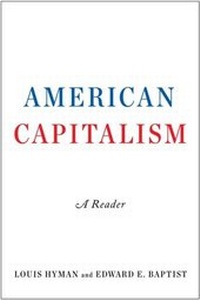
American Capitalism
A Reader
1st Edition
Published on 2. September 2014
224 pages
978-1-4767-8431-1 (ISBN)
Description

From Cornell University Professors Louis Hyman and Edward E. Baptist, a collection of the most relevant readings on the history of capitalism in America, created to accompany their EdX course American Capitalism: A Reader.
To understand the past and especially our own times, arguably no story is as essential to get right as the history of capitalism. Nearly all of our theories about promoting progress come from how we interpret the economic changes of the last 500 years. This past decade's crises continue to remind us just how much capitalism changes, even as basic features like wage labor, financial markets, private property, and entrepreneurs endure. While capitalism has a global history, the United States plays a special role in that story.
American Capitalism: A Reader will help you to understand how the United States became the world's leading economic power, while revealing essential lessons about what has been and what will be possible in capitalism's ongoing revolution. Combining a wealth of essential readings, introductions by Professors Baptist and Hyman, and questions to help guide readers through the materials and broader subject, this course reader will prepare students to think critically about the history of capitalism in America.
To understand the past and especially our own times, arguably no story is as essential to get right as the history of capitalism. Nearly all of our theories about promoting progress come from how we interpret the economic changes of the last 500 years. This past decade's crises continue to remind us just how much capitalism changes, even as basic features like wage labor, financial markets, private property, and entrepreneurs endure. While capitalism has a global history, the United States plays a special role in that story.
American Capitalism: A Reader will help you to understand how the United States became the world's leading economic power, while revealing essential lessons about what has been and what will be possible in capitalism's ongoing revolution. Combining a wealth of essential readings, introductions by Professors Baptist and Hyman, and questions to help guide readers through the materials and broader subject, this course reader will prepare students to think critically about the history of capitalism in America.
More details
Persons
Louis Hyman and Edward E. Baptist
Content
- Intro
- Acknowledgments
- Foreword by Edward E. Baptist
- Why Study the History of Capitalism? by Louis Hyman
- Part I: Capitalism Comes to America
- Module 1: Economies Before Capitalism
- The Wealth of Nations (1776): Adam Smith
- The Communist Manifesto (1848): Karl Marx and Friedrich Engels
- A Farewell to Alms: A Brief Economic History of the World (2007): Gregory Clark
- Module 2: Mercantile World
- The First Charter of Virginia (1606): King James I
- The Mayflower Compact, 1620: Agreement Between the Settlers at New Plymouth (1620)
- Second Treatise of Civil Government (1690): John Locke
- Module 3: Plantations
- Virginia Slavery Laws (1630-1670): William Waller Hening
- Sweetness and Power: The Place of Sugar in Modern History (1985): Sidney Mintz
- Module 4: The Tea Party
- The Autobiography of Benjamin Franklin (1791): Benjamin Franklin
- Module 5: The Capitalist Constitution
- Federalist Paper No. 10 (1787): James Madison
- Federalist Paper No. 51 (1787): James Madison
- Sections from the Constitution of the United States
- First Report on the Public Credit (1790): Alexander Hamilton
- Report on a National Bank (1790): Alexander Hamilton
- Report on Manufactures (1791): Alexander Hamilton
- Part II: Making Capitalism American
- Module 6: The Haitian Revolution and the War of 1812
- Letters from the South: Paper Money (1835): James Kirke Paulding
- The Memoirs of Vincent Nolte (1854): Vincent Nolte
- Module 7: Slavery and Industrial Demand
- In Defense of the American System (1832): Henry Clay
- Slavery in the United States (1837): Charles Ball
- The Great Divergence: China, Europe, and the Making of the World Economy (2000): Kenneth Pomeranz
- Module 8: The Birth of the American Factory
- Chants Democratic: New York City and the Rise of the American Working Class (1984): Sean Wilentz
- The Lynn Shoemakers Strike (1860): The New York Times
- Module 9: American Finance
- Veto Message Regarding the Bank of the United States (1832): Andrew Jackson
- Toxic Debt, Liar Loans, and Securitized Human Beings (2011): Edward E. Baptist
- Module 10: Cash Consumption
- The Murder of Helen Jewett (1830)
- Module 11: American Capitalisms and Regional Development
- The Financial Power of Slavery (1840): Joshua Leavitt
- Address before the Wisconsin State Agricultural Society (1859): Abraham Lincoln
- Nature's Metropolis: Chicago and the Great West (1991): William Cronon
- The Monied Metropolis: New York City and the Consolidation of the American Bourgeoisie, 1850-1896 (2001): Sven Beckert
- Part III: Making Corporate Capitalism
- Module 12: Second Industrial Revolution
- Railroaded: The Transcontinentals and the Making of Modern America (2011): Richard White
- Module 13: Legitimating Capitalism
- How the Other Half Lives (1890): Jacob Riis
- The Omaha Platform (1892)
- The Populist Vision (2007): Charles Postel
- The Gospel of Wealth (1901): Andrew Carnegie
- Twenty Years at Hull-House: With Autobiographical Notes (1910): Jane Addams
- Module 14: Jim Crow Capitalism
- The Souls of Black Folk (1903): W. E. B. Dubois
- Selection of Jim Crow Laws (1880s-1960s)
- The Socialist Party and the Working Class (1904): Eugene V. Debs
- Preamble to the IWW Constitution (1905): Industrial Workers of the World
- Syndicalism (1913): William Z. Foster
- IWW Songs To Fan the Flames of Discontent (1917): Joe Hill
- Module 15: Fordism
- Principles of Scientific Management (1913): Frederick Taylor
- "Labor" and "Capital" Are False Terms (1922): Henry Ford
- The Great A&P and the Struggle for Small Business in America (2011): Marc Levinson
- Module 16: New Deal Capitalism
- Second Fireside Chat (1933): Franklin Delano Roosevelt
- The Many and the Few: A Chronicle of the Dynamic Auto Workers (1985): Henry Kraus
- Module 17: Capitalism At War
- Radio Address of the President Announcing Unlimited National Emergency (1941): Franklin Delano Roosevelt
- Executive Order to Desegregate Wartime Production (1941): Franklin Delano Roosevelt
- Part IV: Making American Capitalism Global
- Module 18: American Superpower
- Speech at Harvard University on the European Aid Program (1947): George Marshall
- The Stages of Economic Growth (1959): Walt Whitman Rostow
- Module 19: Postwar Capitalism
- Budgetism: Opiate of the Middle Class (1956): William H. Whyte
- Rethinking the Postwar Corporation: Management, Monopolies, and Markets (2012): Louis Hyman
- Module 20: American Hubris
- IBM Annual Report (1967): IBM
- Module 21: Cheaper
- A One-Sided Class War: Rethinking Doug Fraser's 1978 Resignation from the Labor-Management Group (2003): Jefferson Cowie
- Labor and Monopoly Capital: The Degradation of Work in the Twentieth Century (1974): Harry Braverman
- Module 22: Instability
- Where Managers Will Go (1992): John Huey
- Not Just a Mortgage Crisis: How Finance Maimed Society (2010): Gerald F. Davis
- Bibliography
- Permissions
- Copyright
