

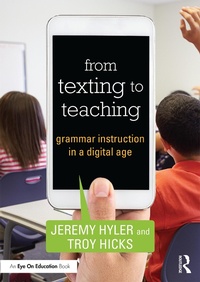
From Texting to Teaching
Grammar Instruction in a Digital Age
Published on 8. May 2017
152 pages
978-1-317-36329-3 (ISBN)
Description

Don't blame technology for poor student grammar; instead, use technology intentionally to reach students and actually improve their writing! In this practical book, bestselling authors Jeremy Hyler and Troy Hicks reveal how digital tools and social media - a natural part of students' lives - can make grammar instruction more authentic, relevant, and effective in today's world.
Topics Covered:
Teaching students to code switch and differentiate between formal and informal sentence styles
Using flipped lessons to teach the parts of speech and help students build their own grammar guides
Enlivening vocabulary instruction with student-produced video
Helping students master capitalization and punctuation in different digital contexts
Each chapter contains examples, screenshots, and instructions to help you implement the ideas. With the strategies in this book, you can empower students to become better writers with the tools they already love and use daily. Additional resources and links are available on the book's companion wiki site: textingtoteaching.wikispaces.com
Topics Covered:
Teaching students to code switch and differentiate between formal and informal sentence styles
Using flipped lessons to teach the parts of speech and help students build their own grammar guides
Enlivening vocabulary instruction with student-produced video
Helping students master capitalization and punctuation in different digital contexts
Each chapter contains examples, screenshots, and instructions to help you implement the ideas. With the strategies in this book, you can empower students to become better writers with the tools they already love and use daily. Additional resources and links are available on the book's companion wiki site: textingtoteaching.wikispaces.com
Reviews / Votes
"From Texting to Teaching presents a new approach to teaching grammar. The use of social media among students is not going away. Acknowledging the importance of digital grammar to our students is a unique and necessary concept. I really like how the examples in this book are so relatable for kids, and how they actually helped kids see the difference between the two types of grammar and when each should be used. The templates provided are really good, and I like the way the authors provide step-by-step instructions. I recommend this book for middle school English departments."--David Ellena, Principal, Tomahawk Creek Middle School, Midlothian, VA
"There are teachers who would like to be energized when it comes to grammar instruction. I am definitely not a grammarian, but that doesn't mean I can't do better to help my students in this area of writing. This book will help. And students will really enjoy practicing these strategies because the blend with technology increases the interest. The writers are respectful of children and students and what their reality is today."
--Dana Dusbiber, English Teacher, Rosa Parks K-8 School, Sacramento, CA
More details
Language
English
Place of publication
London
United Kingdom
Publishing group
Taylor & Francis Ltd
Target group
Professional and scholarly
Illustrations
13 s/w Tabellen, 5 s/w Photographien bzw. Rasterbilder, 18 s/w Zeichnungen, 23 s/w Abbildungen
13 Tables, black and white; 18 Line drawings, black and white; 5 Halftones, black and white; 23 Illustrations, black and white
File size
1,70 MB
ISBN-13
978-1-317-36329-3 (9781317363293)
Copyright in bibliographic data and cover images is held by Nielsen Book Services Limited or by the publishers or by their respective licensors: all rights reserved.
Schweitzer Classification
Other editions
Additional editions

Book
05/2017
1st Edition
Routledge
€133.69
Shipment within 10-20 days
Book
05/2017
1st Edition
Routledge
€41.40
Shipment within 10-20 days
Persons
Jeremy Hyler is a middle school English teacher and a teacher consultant for the Chippewa River Writing Project, a satellite site of the National Writing Project. He is co-author with Troy Hicks on Create, Compose, Connect: Reading, Writing, and Learning with Digital Tools (Routledge, 2014).
Troy Hicks is a Professor of English and education at Central Michigan University, and Director of the Chippewa River Writing Project. He has authored or co-authored nine books, and over 30 journal articles and book chapters for teachers and other educators.
Troy Hicks is a Professor of English and education at Central Michigan University, and Director of the Chippewa River Writing Project. He has authored or co-authored nine books, and over 30 journal articles and book chapters for teachers and other educators.
Content
Notes on the Book
Dedication
Acknowledgements
Meet the Authors
Foreword by Liz Kolb
Chapter 1 - What's the Matter with the Teaching of Grammar?
The Great Grammar Debate, Part 1: 1890s to 1990s
The Great Grammar Debate, Part 2: 100 Years and Counting
The Great Grammar Debate, Part 3: Here Comes the Common Core
Rethinking Grammar Instruction in a Single Year: A Guide to the Rest of the Book
Chapter 2: An Approach to Teaching Grammar with Digital Tools
What the Research Says: The (Non) Effects of Text Speak
Redefining Grammar Instruction in a Digital Age
Triple E Framework: Engage, Enhance, Extend
Tools of the Trade: Technologies for Digital Grammar Instruction
Beginner: Getting Started with Screen Capture, Screencasting, and Annotation
Intermediate: Sharing Media and Assessing Students' Understanding
Expert: Producing and Publishing More Enriched Media
And...We're Off... Ready, Tech, Go!
Chapter 3: Learning the Parts of Speech with Flipped Lessons
What is Flipping the Classroom, Exactly?
Critiques of the Flipped Model
Digital Tools for Flipping Grammar
Building a Flipped Video Lesson
Working Through the Video: Steps for Student
Using Flipped Videos from Other Sources
Breaking it Down: Pronouns of the Personal Type
Before the Flipped Lesson
During the Flipped Lesson
After the Flipped Lesson
Building a Personal Grammar Guide
Adverbs and Adjectives
Final Thoughts and What's Next
Chapter 4: Learning Sentence Style with Formal and Informal Writing
Code Switching
Compound, Complex, and Complete: Making Sentences Matter
Sentence Combining with Lino
I Tawt I Taw a Tweet Sentence
Sentence Hacking
Putting Lexile Leveling to Use for Writers
What's Next
Chapter 5: Enlivening Vocabulary
The Struggle is Real
Building Vocabulary with Quizlet
Building "Study Sets" in Quizlet
Building Toward Assessment with Quizlet
Extensions for Quizlet
Breathing Life into Vocabulary with Video
The Vocabulary Video Assignment
Extensions and Adaptations
Student Vocabulary Growth Over Time
Final Thoughts
Chapter 6 - Mastering Mechanics: Capitalization and Punctuation
Capitalization
The Dreaded Pronoun: "i"
Capitalization Extensions
The Paradox of Punctuation
Taking Time to Pause with a Comma
Is it a Period? Is it a Comma? No, it's a Semicolon!
Extensions and Adaptations
Final Thoughts
Chapter 7 - Assessing Grammar in a Digital Age
From Texting to Teaching: Four Tips
Dealing with Assessments
Summative Assessment through Portfolios
Student Reflections
Students Raise Their Voices: Asking For and Implementing Their Feedback
Afterword: Navigating Your Own Grammatical Journey
References
Dedication
Acknowledgements
Meet the Authors
Foreword by Liz Kolb
Chapter 1 - What's the Matter with the Teaching of Grammar?
The Great Grammar Debate, Part 1: 1890s to 1990s
The Great Grammar Debate, Part 2: 100 Years and Counting
The Great Grammar Debate, Part 3: Here Comes the Common Core
Rethinking Grammar Instruction in a Single Year: A Guide to the Rest of the Book
Chapter 2: An Approach to Teaching Grammar with Digital Tools
What the Research Says: The (Non) Effects of Text Speak
Redefining Grammar Instruction in a Digital Age
Triple E Framework: Engage, Enhance, Extend
Tools of the Trade: Technologies for Digital Grammar Instruction
Beginner: Getting Started with Screen Capture, Screencasting, and Annotation
Intermediate: Sharing Media and Assessing Students' Understanding
Expert: Producing and Publishing More Enriched Media
And...We're Off... Ready, Tech, Go!
Chapter 3: Learning the Parts of Speech with Flipped Lessons
What is Flipping the Classroom, Exactly?
Critiques of the Flipped Model
Digital Tools for Flipping Grammar
Building a Flipped Video Lesson
Working Through the Video: Steps for Student
Using Flipped Videos from Other Sources
Breaking it Down: Pronouns of the Personal Type
Before the Flipped Lesson
During the Flipped Lesson
After the Flipped Lesson
Building a Personal Grammar Guide
Adverbs and Adjectives
Final Thoughts and What's Next
Chapter 4: Learning Sentence Style with Formal and Informal Writing
Code Switching
Compound, Complex, and Complete: Making Sentences Matter
Sentence Combining with Lino
I Tawt I Taw a Tweet Sentence
Sentence Hacking
Putting Lexile Leveling to Use for Writers
What's Next
Chapter 5: Enlivening Vocabulary
The Struggle is Real
Building Vocabulary with Quizlet
Building "Study Sets" in Quizlet
Building Toward Assessment with Quizlet
Extensions for Quizlet
Breathing Life into Vocabulary with Video
The Vocabulary Video Assignment
Extensions and Adaptations
Student Vocabulary Growth Over Time
Final Thoughts
Chapter 6 - Mastering Mechanics: Capitalization and Punctuation
Capitalization
The Dreaded Pronoun: "i"
Capitalization Extensions
The Paradox of Punctuation
Taking Time to Pause with a Comma
Is it a Period? Is it a Comma? No, it's a Semicolon!
Extensions and Adaptations
Final Thoughts
Chapter 7 - Assessing Grammar in a Digital Age
From Texting to Teaching: Four Tips
Dealing with Assessments
Summative Assessment through Portfolios
Student Reflections
Students Raise Their Voices: Asking For and Implementing Their Feedback
Afterword: Navigating Your Own Grammatical Journey
References
