

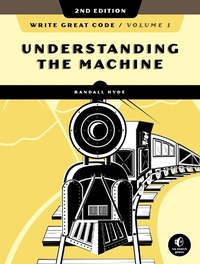
Write Great Code, Volume 1, 2nd Edition
Understanding the Machine
Published on 4. August 2020
472 pages
978-1-7185-0037-2 (ISBN)
Description

Understanding the Machine, the first volume in the landmark Write Great Code series by Randall Hyde, explains the underlying mechanics of how a computer works.
This, the first volume in Randall Hyde's Write Great Code series, dives into machine organization without the extra overhead of learning assembly language programming. Written for high-level language programmers, Understanding the Machine fills in the low-level details of machine organization that are often left out of computer science and engineering courses.
Learn:
• How the machine represents numbers, strings, and high-level data structures, so you'll know the inherent cost of using them.
• How to organize your data, so the machine can access it efficiently.
• How the CPU operates, so you can write code that works the way the machine does.
• How I/O devices operate, so you can maximize your application's performance when accessing those devices.
• How to best use the memory hierarchy to produce the fastest possible programs.
Great code is efficient code. But before you can write truly efficient code, you must understand how computer systems execute programs and how abstractions in programming languages map to the machine's low-level hardware. After all, compilers don't write the best machine code; programmers do. This book gives you the foundation upon which all great software is built.
NEW IN THIS EDITION, COVERAGE OF:
• Programming languages like Swift and Java
• Code generation on modern 64-bit CPUs
• ARM processors on mobile phones and tablets
• Newer peripheral devices
• Larger memory systems and large-scale SSDs
This, the first volume in Randall Hyde's Write Great Code series, dives into machine organization without the extra overhead of learning assembly language programming. Written for high-level language programmers, Understanding the Machine fills in the low-level details of machine organization that are often left out of computer science and engineering courses.
Learn:
• How the machine represents numbers, strings, and high-level data structures, so you'll know the inherent cost of using them.
• How to organize your data, so the machine can access it efficiently.
• How the CPU operates, so you can write code that works the way the machine does.
• How I/O devices operate, so you can maximize your application's performance when accessing those devices.
• How to best use the memory hierarchy to produce the fastest possible programs.
Great code is efficient code. But before you can write truly efficient code, you must understand how computer systems execute programs and how abstractions in programming languages map to the machine's low-level hardware. After all, compilers don't write the best machine code; programmers do. This book gives you the foundation upon which all great software is built.
NEW IN THIS EDITION, COVERAGE OF:
• Programming languages like Swift and Java
• Code generation on modern 64-bit CPUs
• ARM processors on mobile phones and tablets
• Newer peripheral devices
• Larger memory systems and large-scale SSDs
More details
Other editions
Additional editions
Book
07/2020
2nd Edition
No Starch Press
€47.00
Available immediately
Person
Randall Hyde is the author of The Art of Assembly Language, one of the most highly recommended resources on assembly, and the three volume Write Great Code series (all No Starch Press). He is also the co-author of The Waite Group's MASM 6.0 Bible. He has written for Dr. Dobb's Journal, Byte, as well as professional journals.
Content
Chapter 1: What You Need to Know to Write Great Code
Chapter 2: Numeric Representation
Chapter 3: Binary Arithmetic and Bit Operations
Chapter 4: Floating-Point Representation
Chapter 5: Character Representation
Chapter 6: Memory Organization and Access
Chapter 7: Composite Data Types and Memory Objects
Chapter 8: Boolean Logic and Digital Design
Chapter 9: CPU Architecture
Chapter 10: Instruction Set Architecture
Chapter 11: Memory Architecture and Organization
Chapter 12: Input and Output
Chapter 13: Computer Peripheral Buses
Chapter 14: Mass Storage Devices and Filesystems
Chapter 15: Miscellaneous Input and Output Devices
Afterword: Thinking Low-Level, Writing High-Level
Appendix A: ASCII Character Set
Glossary
Chapter 2: Numeric Representation
Chapter 3: Binary Arithmetic and Bit Operations
Chapter 4: Floating-Point Representation
Chapter 5: Character Representation
Chapter 6: Memory Organization and Access
Chapter 7: Composite Data Types and Memory Objects
Chapter 8: Boolean Logic and Digital Design
Chapter 9: CPU Architecture
Chapter 10: Instruction Set Architecture
Chapter 11: Memory Architecture and Organization
Chapter 12: Input and Output
Chapter 13: Computer Peripheral Buses
Chapter 14: Mass Storage Devices and Filesystems
Chapter 15: Miscellaneous Input and Output Devices
Afterword: Thinking Low-Level, Writing High-Level
Appendix A: ASCII Character Set
Glossary
