

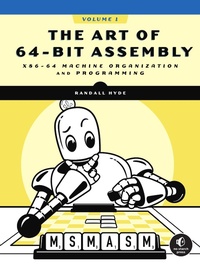
The Art of 64-Bit Assembly, Volume 1
x86-64 Machine Organization and Programming
Published on 16. November 2021
1032 pages
978-1-7185-0109-6 (ISBN)
Description

A new assembly language programming book from a well-loved master. Art of 64-bit Assembly Language capitalizes on the long-lived success of Hyde's seminal The Art of Assembly Language.
Randall Hyde's The Art of Assembly Language has been the go-to book for learning assembly language for decades. Hyde's latest work, Art of 64-bit Assembly Language is the 64-bit version of this popular text. This book guides you through the maze of assembly language programming by showing how to write assembly code that mimics operations in High-Level Languages. This leverages your HLL knowledge to rapidly understand x86-64 assembly language.
This new work uses the Microsoft Macro Assembler (MASM), the most popular x86-64 assembler today. Hyde covers the standard integer set, as well as the x87 FPU, SIMD parallel instructions, SIMD scalar instructions (including high-performance floating-point instructions), and MASM's very powerful macro facilities. You'll learn in detail: how to implement high-level language data and control structures in assembly language; how to write parallel algorithms using the SIMD (single-instruction, multiple-data) instructions on the x86-64; and how to write stand alone assembly programs and assembly code to link with HLL code. You'll also learn how to optimize certain algorithms in assembly to produce faster code.
Randall Hyde's The Art of Assembly Language has been the go-to book for learning assembly language for decades. Hyde's latest work, Art of 64-bit Assembly Language is the 64-bit version of this popular text. This book guides you through the maze of assembly language programming by showing how to write assembly code that mimics operations in High-Level Languages. This leverages your HLL knowledge to rapidly understand x86-64 assembly language.
This new work uses the Microsoft Macro Assembler (MASM), the most popular x86-64 assembler today. Hyde covers the standard integer set, as well as the x87 FPU, SIMD parallel instructions, SIMD scalar instructions (including high-performance floating-point instructions), and MASM's very powerful macro facilities. You'll learn in detail: how to implement high-level language data and control structures in assembly language; how to write parallel algorithms using the SIMD (single-instruction, multiple-data) instructions on the x86-64; and how to write stand alone assembly programs and assembly code to link with HLL code. You'll also learn how to optimize certain algorithms in assembly to produce faster code.
More details
Other editions
Additional editions
Book
11/2021
No Starch Press
€74.50
Available immediately
Person
Randall Hyde is an embedded software engineer who has worked in the medical, nuclear, consumer
electronics, and entertainment industries. He taught assembly language programming at the University level for over 10 years and has written hundreds of thousands of lines of assembly code for embedded and commercial applications over the years.
electronics, and entertainment industries. He taught assembly language programming at the University level for over 10 years and has written hundreds of thousands of lines of assembly code for embedded and commercial applications over the years.
Content
Introduction
Chapter 1: Hello, World of Assembly Language
Chapter 2: Data Representation and Operations
Chapter 3: Memory Access and Organization
Chapter 4: Constants, Variables, and Data Types
Chapter 5: Procedures and Modules
Chapter 6: Arithmetic
Chapter 7: Low-Level Control Structures
Chapter 8: Advanced Arithmetic
Chapter 9: Numeric Conversion
Chapter 10: Table Lookups
Chapter 11: SIMD Instructions
Chapter 12: Bit Manipulation
Chapter 13: Macros and the MASM Compile-Time Language
Chapter 14: The String Instructions
Chapter 15: Managing Complex Projects
Chapter 16: Standalone Assembly Language Programs
A: ASCII Character Set
B: Glossary
C: Installing and Using Visual Studio
D: The Windows Command-Line InterpreterE Answers to Questions
Chapter 1: Hello, World of Assembly Language
Chapter 2: Data Representation and Operations
Chapter 3: Memory Access and Organization
Chapter 4: Constants, Variables, and Data Types
Chapter 5: Procedures and Modules
Chapter 6: Arithmetic
Chapter 7: Low-Level Control Structures
Chapter 8: Advanced Arithmetic
Chapter 9: Numeric Conversion
Chapter 10: Table Lookups
Chapter 11: SIMD Instructions
Chapter 12: Bit Manipulation
Chapter 13: Macros and the MASM Compile-Time Language
Chapter 14: The String Instructions
Chapter 15: Managing Complex Projects
Chapter 16: Standalone Assembly Language Programs
A: ASCII Character Set
B: Glossary
C: Installing and Using Visual Studio
D: The Windows Command-Line InterpreterE Answers to Questions
