

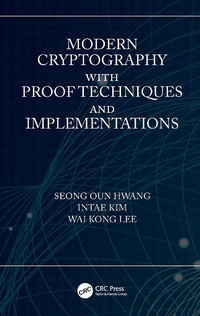
Modern Cryptography with Proof Techniques and Implementations
1st Edition
Published on 28. March 2021
528 pages
978-1-000-36450-7 (ISBN)
Description

Proof techniques in cryptography are very difficult to understand, even for students or researchers who major in cryptography. In addition, in contrast to the excessive emphases on the security proofs of the cryptographic schemes, practical aspects of them have received comparatively less attention. This book addresses these two issues by providing detailed, structured proofs and demonstrating examples, applications and implementations of the schemes, so that students and practitioners may obtain a practical view of the schemes.
Seong Oun Hwang is a professor in the Department of Computer Engineering and director of Artificial Intelligence Security Research Center, Gachon University, Korea. He received the Ph.D. degree in computer science from the Korea Advanced Institute of Science and Technology (KAIST), Korea. His research interests include cryptography, cybersecurity, networks, and machine learning.
Intae Kim is an associate research fellow at the Institute of Cybersecurity and Cryptology, University of Wollongong, Australia. He received the Ph.D. degree in electronics and computer engineering from Hongik University, Korea. His research interests include cryptography, cybersecurity, and networks.
Wai Kong Lee is an assistant professor in UTAR (University Tunku Abdul Rahman), Malaysia. He received the Ph.D. degree in engineering from UTAR, Malaysia. In between 2009 - 2012, he served as an R&D engineer in several multinational companies including Agilent Technologies (now known as Keysight) in Malaysia. His research interests include cryptography engineering, GPU computing, numerical algorithms, Internet of Things (IoT) and energy harvesting.
Seong Oun Hwang is a professor in the Department of Computer Engineering and director of Artificial Intelligence Security Research Center, Gachon University, Korea. He received the Ph.D. degree in computer science from the Korea Advanced Institute of Science and Technology (KAIST), Korea. His research interests include cryptography, cybersecurity, networks, and machine learning.
Intae Kim is an associate research fellow at the Institute of Cybersecurity and Cryptology, University of Wollongong, Australia. He received the Ph.D. degree in electronics and computer engineering from Hongik University, Korea. His research interests include cryptography, cybersecurity, and networks.
Wai Kong Lee is an assistant professor in UTAR (University Tunku Abdul Rahman), Malaysia. He received the Ph.D. degree in engineering from UTAR, Malaysia. In between 2009 - 2012, he served as an R&D engineer in several multinational companies including Agilent Technologies (now known as Keysight) in Malaysia. His research interests include cryptography engineering, GPU computing, numerical algorithms, Internet of Things (IoT) and energy harvesting.
More details
Edition
1. Auflage
Language
English
Place of publication
London
United Kingdom
Publishing group
Taylor & Francis Ltd
Target group
Professional and scholarly
Illustrations
11 Tables, black and white
ISBN-13
978-1-000-36450-7 (9781000364507)
Copyright in bibliographic data and cover images is held by Nielsen Book Services Limited or by the publishers or by their respective licensors: all rights reserved.
Schweitzer Classification
Other editions
Additional editions
Seong Oun Hwang | Intae Kim | Wai Kong Lee
Modern Cryptography with Proof Techniques and Implementations
Book
05/2023
1st Edition
CRC Press
€71.20
Shipment within 15-20 days
Seong Oun Hwang | Intae Kim | Wai Kong Lee
Modern Cryptography with Proof Techniques and Implementations
Book
03/2021
1st Edition
CRC Press
€167.70
Shipment within 10-20 days
Persons
Seong Oun Hwang received the BS degree in Mathematics in 1993 from the Seoul National University, the MS degree in Computer and Communications Engineering in 1998 from the Pohang University of Science and Technology, and the PhD degree in Computer Science from the Korea Advanced Institute of Science and Technology. He worked as a software engineer at the LG-CNS Systems, Inc. from 1994 to 1996. He worked as a senior researcher at the Electronics and Telecommunications Research Institute (ETRI) from 1998 to 2007. Since 2008, he has been working as an associate professor with the Department of Computer and Information Communication Engineering, Hongik University, Korea. His research interests include cryptography, cyber security and mobile network. He is a member of IEEE and IEEE Communications Society. He is also a lifelong member of IEEK (Institute of Electronics and Information Engineers) and KIISC (Korea Institute of Information Security and Cryptology). He has served as a director in IEEK Computer Society and led the Commission of Information Security in the IEEK Computer Society. He has led ICGHIT, one of the famous international conferences as an organizing chair. He has been an editor at ETRI Journal, International Journal of Advanced Research in Computer and Information Security, International Journal of Software Engineering, and Journal of Security Engineering Research Support Center. As an guest editor, he served a lot of journals including Journal of Intelligent and Fuzzy System, Springer's Lecture Notes in Electrical Engineering, International Journal of Computational Vision and Robotics, International Journal of Internet Technology and Secured Transactions. He has also been the reviewers for international journals such as IEEE Computer, IEEE Transactions on Dependable and Secure Computing, Security and Communications Network, Journal of Communications and Networks, Journal of Systems and Software, Nonlinear Dynamics, Computer and Communications, Wireless Personal Communications, and so on. He has authored three books on information security and its applications. He also published a lot of outstanding research papers on information security in premium journals such as IEEE Transactions on Computers and IEEE Transactions on Broadcasting.
Intae Kim is an associate research fellow at the Institute of Cybersecurity and Cryptology, University of Wollongong, Australia. He received the Ph.D. degree in electronics and computer engineering from Hongik University, Korea. His research interests include cryptography, cybersecurity, and networks.
Wai Kong Lee is an assistant professor in UTAR (University Tunku Abdul Rahman), Malaysia. He received the Ph.D. degree in engineering from UTAR, Malaysia. In between 2009 - 2012, he served as an R&D engineer in several multinational companies including Agilent Technologies (now known as Keysight) in Malaysia. His research interests include cryptography engineering, GPU computing, numerical algorithms, Internet of Things (IoT) and energy harvesting.
Intae Kim is an associate research fellow at the Institute of Cybersecurity and Cryptology, University of Wollongong, Australia. He received the Ph.D. degree in electronics and computer engineering from Hongik University, Korea. His research interests include cryptography, cybersecurity, and networks.
Wai Kong Lee is an assistant professor in UTAR (University Tunku Abdul Rahman), Malaysia. He received the Ph.D. degree in engineering from UTAR, Malaysia. In between 2009 - 2012, he served as an R&D engineer in several multinational companies including Agilent Technologies (now known as Keysight) in Malaysia. His research interests include cryptography engineering, GPU computing, numerical algorithms, Internet of Things (IoT) and energy harvesting.
Content
Part 1: Foundations of Cryptography.
1. History of Cryptography.
2. Overview of Provable Security.
3. Private Key Encryption.
4. Message Authentication Code.
5. Hash Function.
6. Public Key Cryptography.
7. Digital Signature.
8. Protocols.
Part 2: Fundamentals of IBE.
9. First Provable IBE (Boneh-Franklin).
10. Selective Security IBE (Boneh-Boyen).
11. Tight Security IBE (Gentry IBE).
12. Dual System Encryption (Waters).
13. Hierarchical IBE (Allison-Waters).
14. Broadcast Encryption.
15. Identity Based Signature.
16. Transformation Techniques.
Part 3: Advanced IBE.
17. Key Policy-Attribute Based Encryption.
18. Ciphertext Policy-Attribute Based Encryption.
19. Predicate Encryption.
20. Functional Encryption.
21. Searchable Encryption.
Part 4: Future Cryptography.
22. Certificate Based Cryptography.
23. Certificate-Less Cryptography.
24. Homomorphic Encryption.
25. Post Quantum Cryptography.
26. Blockchain Applications.
1. History of Cryptography.
2. Overview of Provable Security.
3. Private Key Encryption.
4. Message Authentication Code.
5. Hash Function.
6. Public Key Cryptography.
7. Digital Signature.
8. Protocols.
Part 2: Fundamentals of IBE.
9. First Provable IBE (Boneh-Franklin).
10. Selective Security IBE (Boneh-Boyen).
11. Tight Security IBE (Gentry IBE).
12. Dual System Encryption (Waters).
13. Hierarchical IBE (Allison-Waters).
14. Broadcast Encryption.
15. Identity Based Signature.
16. Transformation Techniques.
Part 3: Advanced IBE.
17. Key Policy-Attribute Based Encryption.
18. Ciphertext Policy-Attribute Based Encryption.
19. Predicate Encryption.
20. Functional Encryption.
21. Searchable Encryption.
Part 4: Future Cryptography.
22. Certificate Based Cryptography.
23. Certificate-Less Cryptography.
24. Homomorphic Encryption.
25. Post Quantum Cryptography.
26. Blockchain Applications.
