

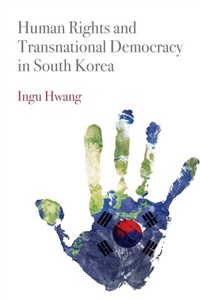
Human Rights and Transnational Democracy in South Korea
1st Edition
Published on 22. March 2022
376 pages
978-0-8122-9821-5 (ISBN)
Description

The first account of the historical intersection between South Korea's democratic transition and the global human rights boom in the 1970s
Drawing on previously unused or underutilized archival sources, this book offers the first account of the historical intersection between South Korea's democratic transition and the global human rights boom in the 1970s. It shows how local pro-democracy activists pragmatically engaged with global advocacy groups, especially Amnesty International and the World Council of Churches, to maximize their socioeconomic and political struggles against the backdrop of South Korea's authoritarian industrialization and U.S. hegemony in East Asia. Ingu Hwang details how local prodemocracy protesters were able to translate their sufferings and causes into international human rights claims that highlighted how U.S. Cold War geopolitics impeded democratization in South Korea. In tracing the increasing coalitional ties between local pro-democracy protests and transnational human rights activism, the book also calls attention to the parallel development of counteraction human rights policies by the South Korean regime and US administrations. These counteractions were designed to safeguard the regime's legitimacy and to ensure the US Cold War security consensus. Thus, Hwang argues that local disputes over democratization in South Korea became transnational contestations on human rights through the development of trans-Pacific human rights politics.
Human Rights and Transnational Democracy in South Korea critically engages with studies on global human rights, contemporary Korea, and U.S. Cold War policy. By presenting a bottom-up approach to the shaping of global human rights activism, it contributes to a growing body of literature that challenges European/U.S. centric accounts of human rights advocacy and moves beyond the national and minjung (people's) framework traditionally used to detail Korea's democratic transition.
Drawing on previously unused or underutilized archival sources, this book offers the first account of the historical intersection between South Korea's democratic transition and the global human rights boom in the 1970s. It shows how local pro-democracy activists pragmatically engaged with global advocacy groups, especially Amnesty International and the World Council of Churches, to maximize their socioeconomic and political struggles against the backdrop of South Korea's authoritarian industrialization and U.S. hegemony in East Asia. Ingu Hwang details how local prodemocracy protesters were able to translate their sufferings and causes into international human rights claims that highlighted how U.S. Cold War geopolitics impeded democratization in South Korea. In tracing the increasing coalitional ties between local pro-democracy protests and transnational human rights activism, the book also calls attention to the parallel development of counteraction human rights policies by the South Korean regime and US administrations. These counteractions were designed to safeguard the regime's legitimacy and to ensure the US Cold War security consensus. Thus, Hwang argues that local disputes over democratization in South Korea became transnational contestations on human rights through the development of trans-Pacific human rights politics.
Human Rights and Transnational Democracy in South Korea critically engages with studies on global human rights, contemporary Korea, and U.S. Cold War policy. By presenting a bottom-up approach to the shaping of global human rights activism, it contributes to a growing body of literature that challenges European/U.S. centric accounts of human rights advocacy and moves beyond the national and minjung (people's) framework traditionally used to detail Korea's democratic transition.
Reviews / Votes
"In this outstanding book, the scholar Ingu Hwang makes a case that the final triumph of South Korea's 40-year struggle for constitutional democracy was made possible in large part by an unprecedented international coalition linking Korean workers, clergy, students, trade unionists, and journalists with their counterparts in the United States, Japan, and Europe." (Asian Studies Review) "Hwang draws needed attention to the transnational nature of South Korea's democratization movement...[A]strong addition to the increasing English-language body of research on the South Korean democracy movement and brings into focus the role of transnational activism in the movement's eventual victory...It should be required reading for any scholar of Korean contemporary history and would be a helpful reminder for Korean policymakers about the role of governments and civil societies throughout the world in democratization as they begin to feel out what South Korea's role should be in the promotion of democracy in the world today.
" (Korean Studies) "[T]his book is an excellent academic accomplishment in the field of Korean modern history. The author's meticulous analysis of Korean social movements and political changes, combined with the exploration of the influence of global human rights organizations and transnational advocacy campaigns, makes this book a must-read for scholars and students who want to obtain a better grasp of civil society movements in South Korea." (Perspectives on Politics) "This innovative book is an excellent addition to the growing body of literature on global human rights history. It is a welcome addition in that it fills a lacuna in the field by focusing on trans national human rights by beautifully interweaving domestic and international narratives. Anyone reading the book will be impressed with Hwang's breadth of knowledge, meticulous research, and detailed analysis of state and nonstate actors." (Journal of Asian Studies)
All prices
More details
Series
Language
English
Place of publication
Pennsylvania
United States
Target group
College/higher education
Illustrations
9 halftones
File size
23,98 MB
ISBN-13
978-0-8122-9821-5 (9780812298215)
Copyright in bibliographic data and cover images is held by Nielsen Book Services Limited or by the publishers or by their respective licensors: all rights reserved.
Schweitzer Classification
Other editions
Additional editions
Book
03/2022
University of Pennsylvania Press
€65.50
Shipment within 10-20 days
Person
Ingu Hwang is Associate Professor of the Practice in the International Studies Program at Boston College.
Content
- Cover
- Title Page
- Copyright
- Dedication
- Contents
- List of Abbreviations
- Timeline of Major Events
- Note on Romanization and Translation
- Introduction. The Human Rights Turn: A Transnational Perspective on Democratization Movements in South Korea
- Chapter 1. Protest Language: Appropriating, Translating, and Transforming the Language of Human Rights
- Chapter 2. Transpacific Politics: Emerging Transnational Human Rights Actions and Counteractions
- Chapter 3. Washington: Emerging Epicenter for Transnational Human Rights Politics
- Chapter 4. The 1976 March 1 Incident: A Transnational Human Rights Issue and a US-ROK Diplomatic Quandary
- Chapter 5. People's Protests: Economic Rights as Human Rights
- Chapter 6. Kwangju: Democratic Struggles and Anti-Americanism
- Chapter 7. Aftermath: Human Rights Talk, Activism, and Politics in the 1980s Democratic Transition
- Epilogue. Human Rights in the Post-Democratization and Global Justice Age
- Notes
- Bibliography
- Index
- Acknowledgments

