

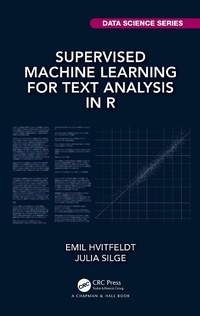
Supervised Machine Learning for Text Analysis in R
1st Edition
Published on 3. November 2021
402 pages
978-1-000-46197-8 (ISBN)
Description

Text data is important for many domains, from healthcare to marketing to the digital humanities, but specialized approaches are necessary to create features for machine learning from language. Supervised Machine Learning for Text Analysis in R explains how to preprocess text data for modeling, train models, and evaluate model performance using tools from the tidyverse and tidymodels ecosystem. Models like these can be used to make predictions for new observations, to understand what natural language features or characteristics contribute to differences in the output, and more. If you are already familiar with the basics of predictive modeling, use the comprehensive, detailed examples in this book to extend your skills to the domain of natural language processing.
This book provides practical guidance and directly applicable knowledge for data scientists and analysts who want to integrate unstructured text data into their modeling pipelines. Learn how to use text data for both regression and classification tasks, and how to apply more straightforward algorithms like regularized regression or support vector machines as well as deep learning approaches. Natural language must be dramatically transformed to be ready for computation, so we explore typical text preprocessing and feature engineering steps like tokenization and word embeddings from the ground up. These steps influence model results in ways we can measure, both in terms of model metrics and other tangible consequences such as how fair or appropriate model results are.
This book provides practical guidance and directly applicable knowledge for data scientists and analysts who want to integrate unstructured text data into their modeling pipelines. Learn how to use text data for both regression and classification tasks, and how to apply more straightforward algorithms like regularized regression or support vector machines as well as deep learning approaches. Natural language must be dramatically transformed to be ready for computation, so we explore typical text preprocessing and feature engineering steps like tokenization and word embeddings from the ground up. These steps influence model results in ways we can measure, both in terms of model metrics and other tangible consequences such as how fair or appropriate model results are.
Reviews / Votes
"I find this book very useful, as predictive modelling with text is an important field in data science and statistics, and yet the one that has been consistently under-represented in technical literature. Given the growing volume, complexity and accessibility of unstructured data sources, as well as the rapid development of NLP algorithms, knowledge and skills in this domain is in increasing demand. In particular, there's a demand for pragmatic guidelines that offer not just the theoretical background to the NLP issues but also explain the end-to-end modelling process and good practices supported with code examples, just like "Supervised Machine Learning for Text Analysis in R" does. Data scientists and computational linguists would be a prime audience for this kind of publication and would most likely use it as both, (coding) reference and a textbook."~Kasia Kulma, data science consultant
"This book fills a critical gap between the plethora of text mining books (even in R) that are too basic for practical use and the more complex text mining books that are not accessible to most data scientists. In addition, this book uses statistical techniques to do text mining and text prediction and classification. Not all text mining books take this approach, and given the level of this book, it is one of its strongest features."
~Carol Haney, Quatrics
"This book would be valuable for advanced undergraduates and early PhD students in a wide range of areas that have started using text as data...The main strength of the book is its connection to the tidyverse environment in R. It's relatively easy to pick up and do powerful things."
~David Mimno, Cornell University
"The authors do a great job of presenting R programmers a variety of deep learning applications to text-based problems. Perhaps one of the best parts of this book is the section on interpretability, where the authors showcase methods to diagnose features on which these complex models rely to make their prediction. Considering how important the area of interpretability is to natural language processing research and is often skipped in applied textbooks, the authors should be commended for incorporating it in this book."
~Kanishka Misra, Purdue University
"In conclusion, the presented book is extremely useful for graduate students, advanced researchers, and practitioners of statistics and data science who are interested in learning cutting-edge supervised ML techniques for text data. By utilizing the tidyverse environment and providing easy-to-understand R code examples with detailed study cases of real-world text mining problems, this book stands out and is a worthwhile read."
-Han-Ming Wu, National Chengchi University, Biometrics, September 2022
"The volume is a valuable methodological resource, primarily for students interested in data science, concerned with: understanding the fundamentals of preprocessing steps required to transform a corpus, not always large, into a structure that is a good fit for modeling; implementation of machine learning and deep learning algorithms for building text predictive models under given research contexts in which they have to be integrated."
-Anca Vitcu ?in ?ISCB Book Reviews, ?September 2022
More details
Series
Edition
1. Auflage
Language
English
Place of publication
London
United Kingdom
Publishing group
Taylor & Francis Ltd
Target group
College/higher education
Professional and scholarly
Illustrations
1 Tables, black and white; 57 Line drawings, color; 8 Line drawings, black and white; 57 Illustrations, color; 8 Illustrations, black and white
ISBN-13
978-1-000-46197-8 (9781000461978)
Copyright in bibliographic data and cover images is held by Nielsen Book Services Limited or by the publishers or by their respective licensors: all rights reserved.
Schweitzer Classification
Other editions
Additional editions
Emil Hvitfeldt | Julia Silge
Supervised Machine Learning for Text Analysis in R
Book
11/2021
1st Edition
Chapman & Hall/CRC
€237.20
Shipment within 15-20 days
Emil Hvitfeldt | Julia Silge
Supervised Machine Learning for Text Analysis in R
Book
10/2021
1st Edition
Chapman & Hall/CRC
€109.10
Shipment within 15-20 days
Emil Hvitfeldt
Supervised Machine Learning for Text Analysis in R
Book
10/2021
CRC Press
Unfortunately, price unknown
Available (delivery time upon request)
Persons
Emil Hvitfeldt is a clinical data analyst working in healthcare, and an adjunct professor at American University where he is teaching statistical machine learning with tidymodels. He is also an open source R developer and author of the textrecipes package.
Julia Silge is a data scientist and software engineer at RStudio PBC where she works on open source modeling tools. She is an author, an international keynote speaker and educator, and a real-world practitioner focusing on data analysis and machine learning practice.
Julia Silge is a data scientist and software engineer at RStudio PBC where she works on open source modeling tools. She is an author, an international keynote speaker and educator, and a real-world practitioner focusing on data analysis and machine learning practice.
Content
1. Language and modeling. 2. Tokenization. 3. Stop words. 4. Stemming. 5. Word Embeddings. 6. Regression. 7. Classification. 8. Dense neural networks. 9. Long short-term memory (LSTM) networks. 10. Convolutional neural networks.
