

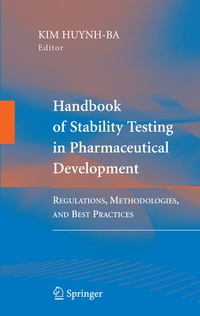
Handbook of Stability Testing in Pharmaceutical Development
Description

Kim Huynh-Ba is Technical Director of Pharmalytik. She has over 20 years of experiences in various analytical areas of pharmaceutical development, especially in Stability Sciences. She has involved with several projects harmonizing or optimizing analytical best practices in several companies, including those are under Consent Decree. Ms. Huynh-Ba has authored numerous technical publications and book chapters. She is a frequent invited speaker at national and international conferences. She has conducted several training courses on stability compliance and quality issues for American Chemical Society, American Association of Pharmaceutical Scientists, Pharmaceutical Training Institute, Eastern Analytical Symposium since 2001. She is the founder of AAPS Stability Focus Group and actively involved with Pharmaceutical Stability Discussion Group. She is an active member of ACS, AAPS, PSDG, ASQ, POMA and serves in the Governing Board of Eastern Analytical Symposium (EAS).
In my professional career as a pharmaceutical scientist, I have been involved with several aspects of the drug development process from pre-IND to commercial and, somehow, I usually found myself coming back to a stability related issue. Stability area seems to draw my utmost interest because in my day-to-day work, my opportunities involved more than one product, and none of the issues was the same. Each situation posed challenges that usually required an exercise of judgment, an understanding of regulations, knowledge of science, a grasp of compliance, and an appreciation of common practices.
Since early 2000, I have also been involved with several training opportunities and I struggled to find good, concise, practical resources, one of which I can just hand to a new scientist who wishes to gain more understanding of stability sciences. In addition, I encountered the same questions posted over and over on different stability best practices discussion forums.
As a book lover, I also have a good collection of technical books. Unfortunately, most of the stability related books are outdated. In addition, many of these materials are theoretical and do not contain much practical information. I understand that the pharmaceutical industry during this period is quite volatile, and guidelines are changing rapidly while regulatory agencies are working closely with the pharmaceutical industry to accommodate these changes; however, the fundamental information continues to remain quite the same as current Good Manufacturing Practices (cGMP) continues to be the standard industry practice. Therefore, I hope to assemble a practical handbook to fill this void.
More details
Other editions
Additional editions
Person
Kim Huynh-Ba is Technical Director of Pharmalytik. She has over 20 years of experiences in various analytical areas of pharmaceutical development, especially in Stability Sciences. She has involved with several projects harmonizing or optimizing analytical best practices in several companies, including those are under Consent Decree. Ms. Huynh-Ba has authored numerous technical publications and book chapters. She is a frequent invited speaker at national and international conferences. She has conducted several training courses on stability compliance and quality issues for American Chemical Society, American Association of Pharmaceutical Scientists, Pharmaceutical Training Institute, Eastern Analytical Symposium since 2001. She is the founder of AAPS Stability Focus Group and actively involved with Pharmaceutical Stability Discussion Group. She is an active member of ACS, AAPS, PSDG, ASQ, POMA and serves in the Governing Board of Eastern Analytical Symposium (EAS).
In my professional career as a pharmaceutical scientist, I have been involved with several aspects of the drug development process from pre-IND to commercial and, somehow, I usually found myself coming back to a stability related issue. Stability area seems to draw my utmost interest because in my day-to-day work, my opportunities involved more than one product, and none of the issues was the same. Each situation posed challenges that usually required an exercise of judgment, an understanding of regulations, knowledge of science, a grasp of compliance, and an appreciation of common practices.
Since early 2000, I have also been involved with several training opportunities and I struggled to find good, concise, practical resources, one of which I can just hand to a new scientist who wishes to gain more understanding of stability sciences. In addition, I encountered the same questions posted over and over on different stability best practices discussion forums.
As a book lover, I also have a good collection of technical books. Unfortunately, most of the stability related books are outdated. In addition, many of these materials are theoretical and do not contain much practical information. I understand that the pharmaceutical industry during this period is quite volatile, and guidelines are changing rapidly while regulatory agencies are working closely with the pharmaceutical industry to accommodate these changes; however, the fundamental information continues to remain quite the same as current Good Manufacturing Practices (cGMP) continues to be the standard industry practice. Therefore, I hope to assemble a practical handbook to fill this void.
