

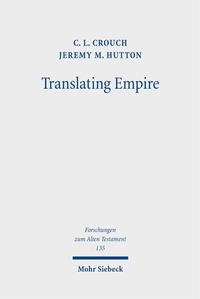
Translating Empire
Tell Fekheriyeh, Deuteronomy, and the Akkadian Treaty Tradition
1st Edition
Published on 21. November 2019
342 pages
978-3-16-159027-6 (ISBN)
Description

C. L. Crouch und Jeremy M. Hutton bieten in diesem Band einen datenbasierten Ansatz für Übersetzungspraktiken in der Eisenzeit, indem sie die "Optimal Translation"-Theorie einsetzen, um die zweisprachige, akkadisch-aramäische Inschrift aus Tell Fecheriye zu untersuchen, und die Ergebnisse auf andere Beispiele von Übersetzungen aus der Eisenzeit anzuwenden, einschließlich Deuteronomium und den Sefire-Verträgen.
More details
Other editions
Additional editions
Jeremy M. Hutton | C. L. Crouch
Translating Empire
Tell Fekheriyeh, Deuteronomy, and the Akkadian Treaty Tradition
Book
11/2019
1st Edition
Mohr Siebeck
€149.00
Article exhausted; check different version
Persons
Author
Born 1976; 1998 BA in Theology and Philosophy, University of Notre Dame; 2002 AM in Hebrew Bible, Harvard University; 2005 PhD in Hebrew Bible and Northwest Semitics, Harvard University; since 2018 Professor of Classical Hebrew Language and Biblical Literature at University of Wisconsin-Madison.
Born 1982; 2004 BA in Religious Studies, Scripps College, CA; 2005 PGDip in Theology, University of Oxford; 2007 MPhil in Theology (Old Testament), University of Oxford; 2008 DPhil in Theology (Old Testament), University of Oxford; 2018-2021 David Allan Hubbard Professor of Old Testament at Fuller Theological Seminary, CA; currently Professor of Hebrew Bible/Old Testament and Ancient Judaism at Radboud University in Nijmegen, The Netherlands.
Content
- Cover
- Titel
- Preface
- Contents
- Abbreviations
- 1. Introduction
- 1.1. Translating Empire
- 1.2. Discovery and Historical Context of the Tell Fekheriyeh Inscription
- 1.3. The Object and Its Inscription
- 1.3.1. The Text of the Inscription(s)
- 1.3.2. The Physical History of the Statue and Its Inscription
- 1.3.3. "Double-Bilingualism" or Multiple Moments of Translation?
- 1.4. Prospectus
- 2. "Optimal Translation": A Theoretical Précis
- 2.1. Optimality Derives from Norms
- 2.2. Descriptive Translation Studies and Optimality Theory: A Comparison
- 2.2.1. Range of Possible Alternatives
- 2.2.2. Assumption of Optimality (~ Equivalence)
- 2.2.3. Assumption of Universal Constraints
- 2.2.4. Limited and Hierarchical Constraint Sets
- 2.2.5. Universal vs. Language- and Culture-Specific Constraints
- 2.3. Optimality Theoretic Constraints on Translation
- 3. Building the Optimal Grammar of Translation in Fekheriyeh A
- 3.1. High-Level Norms: Pairwise Comparison of IDENTITY Constraints
- 3.1.1. TRPROPNS && CHLINGSYS
- 3.1.2. IDENT:SEM && IDENT:LEX
- 3.1.3. IDENT:PRAG.LEX && IDENT:SEM
- 3.1.4. Summary
- 3.2. Mid- and Low-Level Norms: Comparison of MAX, DEP, and LINEAR Constraints
- 3.2.1. EXPLIC-COORD && DEP:MORPH
- 3.2.2. FAVOR-NWS_CONV && MAX:MORPH
- 3.2.3. EXPLIC-PRO && DEP:MORPH
- 3.2.4. EXPLIC-QUANT && DEP:MORPH
- 3.2.5. DEIXISCONS && IDENT:MORPH
- 3.2.6. SYNCONS, NWS-SYN && LINEAR:LEX
- 3.2.7. Summary
- 3.3. Comparison of Multiple Constraints
- 3.3.1. FAVOR-LOC.TTL && IDENT:SEM
- 3.3.2. *NEWLOAN && IDENT:SEM
- 3.3.3. Difficult Assessments and the Use of Multiple Constraints to Evaluate Longer Strings
- 3.3.4. Optimality Theory, Translation, and Philological Reasoning
- 3.3.5. Summary
- 3.4. Summary and Further Implications
- 4. Reevaluating the Relationship between Fekheriyeh A and B
- 4.1. The Composition of Aramaic A and B: Plausible Scenarios
- 4.1.1. Scenario One
- 4.1.2. Scenario Two
- 4.1.3. Scenario Three
- 4.1.4. Scenario Four
- 4.2. Bilingualism and Translation: Theory and Methodology
- 4.2.1. Bilingualism and Translation in Recent Study
- 4.2.2. Bilingualism, Translation, and Cognition
- 4.2.3. Consideration of Fekheriyeh B as a Translation
- 4.3. Translational (Non-)Identity?
- 5. Building the Optimal Grammar of Translation in Fekheriyeh B
- 5.1. Constraint Pairings Shared with Fekheriyeh A
- 5.1.1. TRPROPNS && CHLINGSYS
- 5.1.2. The Importance of IDENT:LEX
- 5.1.3. The Importance of IDENT:SYN
- 5.1.4. IDENT:SEM && IDENT:LEX
- 5.1.5. IDENT:SEM && IDENT:MORPH
- 5.1.6. IDENT:PRAG.LEX && IDENT:SEM
- 5.1.7. FAVOR-NWS_CONV && DEP:SYN as a Cause of IDENT:PRAG.LEX ?? IDENT:SEM
- 5.1.8. EXPLIC-COORD && DEP:MORPH
- 5.1.9. EXPLIC-PRO, EXPLIC-PREP && DEP:MORPH
- 5.1.10. SYNCONS, NWS-SYN && LINEAR:LEX
- 5.1.11. Summary
- 5.2. Constraint Pairings Not Shared with Fekheriyeh A
- 5.2.1. *LEXREP && IDENT:LEX
- 5.2.2. EXPLIC-SEM && DEP:SYN, DEP:MORPH
- 5.2.3. NWS-SYN && MAX:MORPH
- 5.2.4. EXPLIC-FRAME && DEP:MORPH
- 5.2.5. Uncertain Cases
- 5.2.6. FAVOR-GEN-?? ?? DEP:MORPH
- 5.2.7. Extending the Model: Translation Segmentation
- 5.2.8. Summary
- 5.3. Summary and Further Implications
- 6. Evaluating Other Purported Instances of Akkadian-Northwest Semitic Translation
- 6.1. Deut 28 as Translation
- 6.1.1. Deut 28:22 and the Multiplication of Translation Replacements
- 6.1.2. Deut 28:30 and the Transformation of Futility Curses
- 6.1.3. Deut 28:31-32 and the Addition of Clarifying Materials
- 6.1.4. Deut 28:23-24 as a Translation of VTE §§63-64
- 6.1.5. Summary
- 6.2. The Sefire Treaties as Translations
- 6.2.1. The Sefire Treaties
- 6.2.2. Relationships among Sefire I, II, and III
- 6.2.3. The Treaty between Assur-nerari V and Mati'ilu
- 6.2.4. The Treaty between Assur-nerari V and Mati'ilu and the Sefire Treaties
- 6.2.4.1. Structure of the Treaties
- 6.2.4.2. Specific Correspondences
- 6.2.4.3. The God Lists: Syntactic Structure
- 6.2.4.4. The God Lists: Named Deities
- 6.2.5. Other Correspondences between Sefire I and the Assur-nerari Treaty
- 6.2.6. TRPROPNS and the Identification of Bar-Ga'yah
- 6.2.7. Summary
- 7. Conclusions
- 7.1. The Tell Fekheriyeh Inscription
- 7.2. Implications for Other Proposed Translations from the Iron Age II
- 7.3. Conclusion
- Appendix 1: Fekheriyeh A: Akkadian and Aramaic
- Appendix 2: Fekheriyeh B: Akkadian and Aramaic
- Bibliography
- Ancient Texts Index
- Modern Authors Index
- Subject Index
- Constraint Index
