

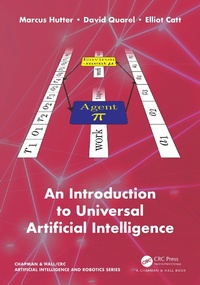
An Introduction to Universal Artificial Intelligence
1st Edition
Published on 28. May 2024
516 pages
978-1-003-82198-4 (ISBN)
Description

An Introduction to Universal Artificial Intelligence provides the formal underpinning of what it means for an agent to act intelligently in an unknown environment. First presented in Universal Algorithmic Intelligence (Hutter, 2000), UAI offers a framework in which virtually all AI problems can be formulated, and a theory of how to solve them. UAI unifies ideas from sequential decision theory, Bayesian inference, and algorithmic information theory to construct AIXI, an optimal reinforcement learning agent that learns to act optimally in unknown environments. AIXI is the theoretical gold standard for intelligent behavior.
The book covers both the theoretical and practical aspects of UAI. Bayesian updating can be done efficiently with context tree weighting, and planning can be approximated by sampling with Monte Carlo tree search. It provides algorithms for the reader to implement, and experimental results to compare against. These algorithms are used to approximate AIXI. The book ends with a philosophical discussion of Artificial General Intelligence: Can super-intelligent agents even be constructed? Is it inevitable that they will be constructed, and what are the potential consequences?
This text is suitable for late undergraduate students. It provides an extensive chapter to fill in the required mathematics, probability, information, and computability theory background. You can also visit the author website: http://www.hutter1.net/ai/uaibook2.htm.
The book covers both the theoretical and practical aspects of UAI. Bayesian updating can be done efficiently with context tree weighting, and planning can be approximated by sampling with Monte Carlo tree search. It provides algorithms for the reader to implement, and experimental results to compare against. These algorithms are used to approximate AIXI. The book ends with a philosophical discussion of Artificial General Intelligence: Can super-intelligent agents even be constructed? Is it inevitable that they will be constructed, and what are the potential consequences?
This text is suitable for late undergraduate students. It provides an extensive chapter to fill in the required mathematics, probability, information, and computability theory background. You can also visit the author website: http://www.hutter1.net/ai/uaibook2.htm.
Reviews / Votes
"Is it possible to mathematically define and study artificial superintelligence? If that sounds like an interesting question, then this is definitely the book for you. Starting with probability theory, complexity theory and sequence prediction, it takes you right through to the safety of superintelligent machines."- Shane Legg, co-founder of DeepMind
"This is seminal work!"
- Roman Yampolskiy, Tenured Associate Professor at the University of Louisville, USA
"This is an important, timely, high-quality book by highly respected authors."
- Juergen Schmidhuber, Director of the AI Initiative at King Abdullah University of Science and Technology, Scientific Director at the Swiss AI Lab IDSIA, Co-Founder & Chief Scientist at NNAISENSE
"Clearly very strongly based on mathematical foundations. This offers a theoretical depth which will be of value in research, education (at an appropriate level), and for advanced practitioners."
- Alan Dix, Director of the Computational Foundry at Swansea University and Professorial Fellow at Cardiff Metropolitan University
More details
Series
Edition
1. Auflage
Language
English
Place of publication
London
United Kingdom
Publishing group
Taylor & Francis Ebooks
Target group
College/higher education
Professional and scholarly
Product notice
Reflowable
Illustrations
6 Tables, black and white; 57 Line drawings, black and white; 6 Halftones, black and white; 63 Illustrations, black and white
ISBN-13
978-1-003-82198-4 (9781003821984)
Copyright in bibliographic data and cover images is held by Nielsen Book Services Limited or by the publishers or by their respective licensors: all rights reserved.
Schweitzer Classification
Other editions
Additional editions
Marcus Hutter | David Quarel | Elliot Catt
An Introduction to Universal Artificial Intelligence
Book
05/2024
1st Edition
Chapman & Hall/CRC
€89.10
Shipment within 10-20 days

Marcus Hutter | David Quarel | Elliot Catt
An Introduction to Universal Artificial Intelligence
Book
05/2024
1st Edition
Chapman & Hall/CRC
€230.60
Shipment within 10-20 days

Marcus Hutter
An Introduction to Universal Artificial Intelligence
Book
11/2023
Chapman & Hall/CRC Press Taylor & Francis Group
Unfortunately, price unknown
Available (delivery time upon request)
Persons
Marcus Hutter is Senior Researcher at DeepMind in London and Professor in the Research School of Computer Science (RSCS) at the Australian National University (ANU) in Canberra, Australia (fulltime till 2019 and honorary since then). He is Chair of the ongoing Human Knowledge Compression Contest. He received a master's degree in computer science in 1992 from the University of Technology in Munich, Germany, a PhD in theoretical particle physics in 1996, and completed his Habilitation in 2003. He worked as an active software developer for various companies in several areas for many years, before he commenced his academic career in 2000 at the Artificial Intelligence (AI) institute IDSIA in Lugano, Switzerland, where he stayed for six years. Since 2000, he has mainly worked on fundamental questions in AI resulting in over 200 peer-reviewed research publications and his book Universal Artificial Intelligence (Springer, EATCS, 2005). He has served (as PC member, chair, organizer) for numerous conferences, and reviews for major conferences and journals. He has given numerous invited lectures, and his work in AI and statistics was nominated for and received several awards (UAI, IJCAI-JAIR, AGI Kurzweil, Lindley). http://www.hutter1.net/
David Quarel is completing a PhD at the ANU. He holds a BSc in mathematics and MSc in computer science, specialising in artificial intelligence and machine learning. David has several years' experience in developing course content and distilling complex topics suitable for a wide range of academic audiences, as well as having delivered guest lectures at the ANU, and spent two years as a full-time tutor before starting his PhD.
Elliot Catt is a Research Scientist at DeepMind London and has previously completed a PhD in Universal Artificial Intelligence. He holds a BSc and MSc in mathematics and a PhD in computer science. Elliot has lectured on the topic of Advanced Artificial Intelligence at the ANU and published several pieces of work on the topic of Universal Artificial Intelligence. https://catt.id/
David Quarel is completing a PhD at the ANU. He holds a BSc in mathematics and MSc in computer science, specialising in artificial intelligence and machine learning. David has several years' experience in developing course content and distilling complex topics suitable for a wide range of academic audiences, as well as having delivered guest lectures at the ANU, and spent two years as a full-time tutor before starting his PhD.
Elliot Catt is a Research Scientist at DeepMind London and has previously completed a PhD in Universal Artificial Intelligence. He holds a BSc and MSc in mathematics and a PhD in computer science. Elliot has lectured on the topic of Advanced Artificial Intelligence at the ANU and published several pieces of work on the topic of Universal Artificial Intelligence. https://catt.id/
Content
Part I: Introduction. 1. Introduction. 2. Background. Part II: Algorithmic Prediction. 3. Bayesian Sequence Prediction. 4. The Context Tree Weighting Algorithm. 5. Variations on CTW. Part III: A Family of Universal Agents. 6. Agency. 7. Universal Artificial Intelligence. 8. Optimality of Universal Agents. 9. Other Universal Agents. 10. Multi-agent Setting. Part IV: Approximating Universal Agents. 11. AIXI-MDP. 12. Monte-Carlo AIXI with Context Tree Weighting. 13. Computational Aspects. Part V: Alternative Approaches. 14. Feature Reinforcement Learning. Part VI: Safety and Discussion. 15. AGI Safety. 16. Philosophy of AI.
