

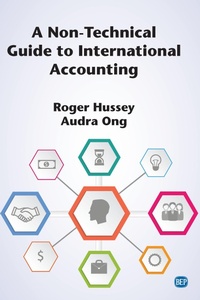
A Non-Technical Guide to International Accounting
Description

Business has become more international and more complex. Whether you are a manager, a student, or someone generally interested in corporate financial information, you want information and you want to understand that information. Companies in all countries are required to generate financial information, if for no other reason than to settle their tax obligations.
If you are interested in the larger companies, such as those listed on a stock exchange, they must make financial information public, and the nature and type of that information is strictly regulated. Companies must comply with accounting standards. Many countries use the International Accounting Standards issued by the IFRS Foundation. This is a not-for-profit international organization that has developed a single set of high-quality global accounting standards. These standards can be complex, but this book explains clearly the main requirements.
More details
Other editions
Additional editions
Persons
Content
- Cover
- A Nontechnical Guide to International Accounting
- Contents
- Preface
- Acknowledgments
- Chapter 1: The Growth of International Accounting
- About This Chapter
- Problems with National Accounting
- The Start of International Accounting
- The Spread of Internationalization
- The U.S. and International Accounting
- The End of Convergence
- Conclusion
- Chapter 2: Setting International Standards
- About This Chapter
- The Language of International Accounting
- The International Accounting Standards Board
- Structure of a Standard
- The Conceptual Framework
- The Main Financial Statements
- The Financial Reporting Council
- Conclusions
- Chapter 3: Measuring Profit and Income
- About This Chapter
- The Calculation of Profit
- IAS 1 Profit and Other Comprehensive Income
- IFRS 15 Revenue from Contracts with Customers
- IAS 2 Inventories
- IAS 16 Property, Plant, and Equipment (Depreciation)
- IAS 11 Construction Contracts (Summary)
- IAS 18 Revenue (Summary)
- Conclusions
- Chapter 4: The Statements of Financial Position (Balance Sheet) and Changes in Equity
- About This Chapter
- The Accounting Equation
- IAS 16 Property, Plant, and Equipment
- IAS 23 Borrowing Costs
- IAS 38 Intangible Assets
- IAS 36 Impairment of Assets
- The Statement of Changes in Equity
- Conclusions
- Chapter 5: The Timing of Events
- About This Chapter
- IAS 7 Statements of Cash Flows
- IAS 34 Interim Financial Reporting
- Main Requirements
- IAS 10 Events after the Reporting Period
- Conclusions
- Chapter 6: Intercompany Relations
- About This Chapter
- IAS 24 Related Party Disclosures
- IAS 27 Separate Financial Statements
- IAS 28 Investments in Associates and Joint Ventures
- IFRS 3 Business Combinations
- IFRS 10 Consolidated and Separate Financial Statements
- IFRS 11 Joint Arrangements
- IFRS 12 Disclosure of Interest in Other Entities
- Conclusions
- Chapter 7: Specific Situations
- About This Chapter
- IAS 8 Accounting Policies, Changes in Accounting Estimates, and Errors
- IAS 19 Employee Benefits
- IAS 29 Financial Reporting in Hyperinflationary Economies
- IAS 37 Provisions and Contingent Liabilities and Contingent Assets
- IFRS 5 Noncurrent Assets Held for Sale and Discontinued Operations
- IFRS 16 Leases
- Conclusions
- Chapter 8: Different Business Activities
- About This Chapter
- IAS 40 Investment Property
- Recognition
- Measurement Models
- IAS 41 Agriculture
- Recognition and Measurement
- IFRS 6 Exploration for and Evaluation of Mineral Assets
- Requirements
- Impaired Assets
- IFRS 8 Operating Segments
- Identifying Segments
- Disclosures
- Conclusions
- Chapter 9: Changing Values
- About This Chapter
- IAS 12 Income Taxes
- IAS 21 Foreign Exchange Rates
- IFRS 2 Share-Based Payments
- IFRS 13 Fair Value Measurement
- IAS 33 Earnings per Share
- Conclusions
- Chapter 10: Financial Instruments
- About This Chapter
- IAS 32 Financial Instruments: Presentation
- Offsetting
- IAS 39 Financial Instruments: Recognition and Measurement
- Hedging Instrument
- Derivatives as Hedging Instruments
- IFRS 7 Financial Instruments: Disclosures
- IFRS 9 Financial Instruments
- Financial Assets
- Financial Liabilities and Equity
- Hedge Accounting
- Conclusions
- References
- About the Authors
- Index
- Ad Page
- Back Cover
