

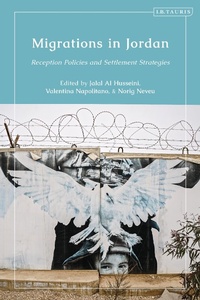
Migrations in Jordan
Reception Policies and Settlement Strategies
1st Edition
Published on 27. June 2024
304 pages
978-0-7556-0686-3 (ISBN)
Description

Jordan currently hosts the second largest percentage of registered refugees in the world: three million out of its eleven million inhabitants. Its experience in hosting migrants and refugees precedes its independence in 1946, with the arrival of Circassians, Chechens, and Armenians from the late 19th century. Jordan thus constitutes a unique observatory for reception policies and long-term settlement of different migrant groups.
Based on original empirical and archival material, this volume focuses on migrations caused by conflicts, wars, and crises underscoring their articulation with longstanding human mobility. It sheds light on the cumulative and processual dimensions of Jordan's reception policies and migrants' settlement strategies. It identifies the multiple actors involved in the management of migrants and, conversely, the latter's contribution to the Jordanian social, economic, political, and urban fabric.
The first part of the volume examines the policies adopted by the Jordanian authorities and international organizations to regulate access to basic services and to the labour market, and explores the economic and political factors underlying them. The second part analyzes the effects of Jordan's policies on the territorial distribution and settlement of migrants. How have these policies, combined with the adaptation strategies of migrants contributed to shaping new urban spaces? The third part focuses on capacity of the migrants to activate, establish, (re)build, and intersect different kinds of solidarity networks within the context of protracted displacement.
Based on original empirical and archival material, this volume focuses on migrations caused by conflicts, wars, and crises underscoring their articulation with longstanding human mobility. It sheds light on the cumulative and processual dimensions of Jordan's reception policies and migrants' settlement strategies. It identifies the multiple actors involved in the management of migrants and, conversely, the latter's contribution to the Jordanian social, economic, political, and urban fabric.
The first part of the volume examines the policies adopted by the Jordanian authorities and international organizations to regulate access to basic services and to the labour market, and explores the economic and political factors underlying them. The second part analyzes the effects of Jordan's policies on the territorial distribution and settlement of migrants. How have these policies, combined with the adaptation strategies of migrants contributed to shaping new urban spaces? The third part focuses on capacity of the migrants to activate, establish, (re)build, and intersect different kinds of solidarity networks within the context of protracted displacement.
Reviews / Votes
Migrations in Jordan is an outstanding contribution to the Refugee Studies literature. Localising the transnational, this groundbreaking collection of interdisciplinary essays provides invaluable insights not only into processes of refugee-making, but also into the ways refugees have shaped, and continue to do so, Jordan's urban and social environment over time and space. * Jordi Tejel, Professor, University of Neuchatel, Switzerland * This volume is an exciting contribution to understanding the extent to which migration - largely forced - has become integral to the evolving nature of the state in the Levant. Focussing on Jordan, the authors of this edited book historicize, excavate, and (re)construct the way in which movements of people from the Caucuses to North Africa engage with the state, with each other, and with their networks in places of origin. Grounded in disciplines as diverse as anthropology, architecture, geography, history, political science and sociology , this volume, made up of contributions largely of European and Jordanian scholars, showcases the interactive relations developed between the migrant and the host society in a contexts of crisis or conflict. * Dawn Chatty, Professor, University of Oxford , UK * With multiple contributors casting a long historic light on the capacities of the state to manage each wave of refugees, the resulting expose of policies expands readers' understanding of the complexities of constant adjustment. * Choice *More details
Edition
1. Auflage
Language
English
Place of publication
London
United Kingdom
Publishing group
Bloomsbury Publishing PLC
Target group
College/higher education
ISBN-13
978-0-7556-0686-3 (9780755606863)
Copyright in bibliographic data and cover images is held by Nielsen Book Services Limited or by the publishers or by their respective licensors: all rights reserved.
Schweitzer Classification
Other editions
Additional editions
Jalal Al Husseini | Valentina Napolitano | Norig Neveu
Migrations in Jordan
Reception Policies and Settlement Strategies
Book
approx. 01/2026
I.B. Tauris
€44.60
Not yet published

Jalal Al Husseini | Valentina Napolitano | Norig Neveu
Migrations in Jordan
Reception Policies and Settlement Strategies
Book
07/2024
I.B. Tauris
€126.48
Shipment within 10-20 days
Persons
Jalal Al Husseini is an associate research fellow at the French Institute of the Near East (Ifpo) in Amman, Jordan.
Valentina Napolitano is a research fellow at the French National Research Institute for Sustainable Development (IRD) in Marseille, France.
Norig Neveu is a research fellow at the French National Center for Scientific Research (CNRS) in Aix-en-Provence, France.
Valentina Napolitano is a research fellow at the French National Research Institute for Sustainable Development (IRD) in Marseille, France.
Norig Neveu is a research fellow at the French National Center for Scientific Research (CNRS) in Aix-en-Provence, France.
Content
Notes on Contributors.
Acknowledgments.
Notes on Transliteration.
Introduction: Jordan, conflicts and migrations.
Rethinking host policies and settlement strategies from a long-term and multiscale perspective.
Part 1 -. Host authorities and international organization policies.
1.1. Beyond Citizenship:
Unpacking Jordan's Relationship with Palestinian Protracted Refugees.
1.2. Sacrosanct Rights, National Interests and Insecure Status: Governing Ex-Gazans in Jordan.
1.3. Non-reception policies and restricted humanitarian assistance: the case of Yemeni refugees in Jordan.
1.4. Host state policies and the changing role of social networks for Syrian refugees in Jordan.
Part 2 -. Urban dynamics, intermingling and space production.
2.5. Questing for Land: Chechen Villages in the Shaping of Transjordan, an Overview.
2.6. The Creation of Syrian Refugee Camps in Jordan: Contextual Factors.
2.7. Social Cohesion Through the Housing of Syrian Refugees. within Jordanian Homes: NRC Shelter Program in the 'Irbid Governorate (2013- 2015)
2.8. Syrian refugee settlement in 'Irbid and urban fragmentation. A case study of Hayy al-Afrah and its surroundings.
Part 3 - Reconfiguration in exile: solidarity networks and humanitarianism.
3.9. Displacing female labour - a gendered perspective on transnational families during the Syrian conflict
3.10. Hosting Syrian refugees in Jordan: refugee-led humanitarianism and national response.
3.11. Post-2014 Christian Iraqis Refugees: Reconfiguration of Faith-based Assistance in Jordan.
3.12. Youth-Oriented Spaces in Amman: Inclusion of National and Refugee Youth.
Conclusion.
Index.
Acknowledgments.
Notes on Transliteration.
Introduction: Jordan, conflicts and migrations.
Rethinking host policies and settlement strategies from a long-term and multiscale perspective.
Part 1 -. Host authorities and international organization policies.
1.1. Beyond Citizenship:
Unpacking Jordan's Relationship with Palestinian Protracted Refugees.
1.2. Sacrosanct Rights, National Interests and Insecure Status: Governing Ex-Gazans in Jordan.
1.3. Non-reception policies and restricted humanitarian assistance: the case of Yemeni refugees in Jordan.
1.4. Host state policies and the changing role of social networks for Syrian refugees in Jordan.
Part 2 -. Urban dynamics, intermingling and space production.
2.5. Questing for Land: Chechen Villages in the Shaping of Transjordan, an Overview.
2.6. The Creation of Syrian Refugee Camps in Jordan: Contextual Factors.
2.7. Social Cohesion Through the Housing of Syrian Refugees. within Jordanian Homes: NRC Shelter Program in the 'Irbid Governorate (2013- 2015)
2.8. Syrian refugee settlement in 'Irbid and urban fragmentation. A case study of Hayy al-Afrah and its surroundings.
Part 3 - Reconfiguration in exile: solidarity networks and humanitarianism.
3.9. Displacing female labour - a gendered perspective on transnational families during the Syrian conflict
3.10. Hosting Syrian refugees in Jordan: refugee-led humanitarianism and national response.
3.11. Post-2014 Christian Iraqis Refugees: Reconfiguration of Faith-based Assistance in Jordan.
3.12. Youth-Oriented Spaces in Amman: Inclusion of National and Refugee Youth.
Conclusion.
Index.
