

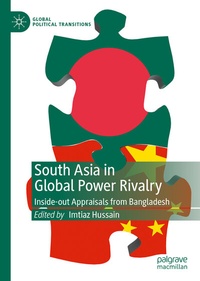
South Asia in Global Power Rivalry
Description

In an atmosphere of short-term gains over-riding long-term considerations, the desperate, widespread search for infrastructural funding inside South Asia enhances China's value, raises local heat, releases new challenges, with costly default consequences looming, issue-specific analysis overtaking formal bilateral relations and a stubborn uncertainty riddling the Bangladeshi air as its policy preferences stubbornly show more certainty.
More details
Other editions
Additional editions
Person
Imtiaz Hussain is the Head of Global Studies & Governance, at Independent University, Bangladesh. Previously Professor of International Relations (Universidad Iberoamericana, Mexico City, 1995-2013) and International Political Economy (Philadelphia University, 1990-94), his publications include: Transatlantic Transitions: Back to a Global Future? (2018), North American Regionalism and Global Spread (2015); Evaluating NAFTA: Theory and Practice (2013); Border Governance and the 'Unruly' South (2013), North America's Soft Security Threat (2013), Afghanistan-Iraq and Post-conflict Governance (2010), The Impact of NAFTA on North America (2010), North American Homeland Security (2008); Running on Empty Across Central America (2006), and Globalization, Indigenous Groups, and Mexico's Plan Puebla Plan (2006); and articles in Handbook of Global Security and Intelligence (2008), South Asian Survey (2008), Politics & Policy (2008), Journal of the Asiatic Society of Bangladesh (2006), Norteamérica (2006), among others. A recipient of over 12 international fellowships and 8 teaching awards, he graduated from the University of Pennsylvania in 1989.
Content
1. Introduction: Bangladesh & the Changing Global Rivalry: An Inside-out Appraisal of Bangladesh.- 2. Bangladesh-India Relations: Transitions at the Core.- 3. "Shining"or "Suffering" South Asia: China's South Asian Footprints.- 4. China, India, Myanmar: Playing Rohingya Roulette.- 5. Encircling India: China Tightens Soth Asian Noose.- 6. Gender-benders in off-shore Production: Bangladesh-China Comparisons.- 7. Trading with China, India, and the United States: Bangladesh's Track-record.- 8. China's and India's Latin Entry: Old-model Revival?.- 9. Asia, Latin America, & Globalization: Close Encounters of a Third Kind.- 10. South Asia in Strategic Competition: Tracing Chinese, Indian, & U.S. Footprints.- 11. Conclusions: Global Leadership of a Glocal Kind?
