

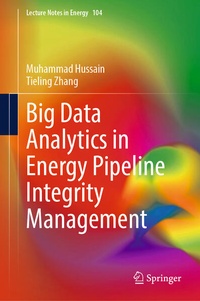
Big Data Analytics in Energy Pipeline Integrity Management
Description

This book offers a comprehensive exploration of the integration of Big Data analytics into the management of energy pipeline integrity. Its primary aim is to enhance pipeline safety, reduce operational costs, and ensure long-term sustainability by leveraging data-driven technologies in the monitoring and maintenance of pipelines. Aimed at professionals and researchers in the energy, oil, and gas sectors, as well as those involved in infrastructure management and data science, the book presents how emerging technologies, such as Big Data, Machine Learning (ML), Internet of Things (IoT), and Artificial Intelligence (AI), can revolutionize pipeline integrity management systems (PIMS).
More details
Other editions
Additional editions
Persons
Dr. Muhammad Hussain is a distinguished Consultant specializing in Asset Management, Reliability, Predictive Analytics, and Pipeline Integrity, with a focus on the oil and gas, energy, and petrochemical industries around the world.With deep expertise in asset integrity management and reliability engineering, Dr. Hussain leverages machine learning, predictive analytics, and data-driven decision-making to optimize asset performance, mitigate risks, and enhance operational efficiency. He has led several groundbreaking research projects, contributing significantly to industry knowledge through numerous publications in top-tier journals and conferences, advancing the global discourse in asset integrity and management systems.
Dr. Hussain is renowned for his innovative approach to pipeline integrity management, reliability analysis, asset management, corrosion management, and risk-based inspection. His strategic insights continue to shape the future of asset management and influence both academic and industrial advancements on a global scale.
Content
Chapter 1: Introduction.- Chapter 2: Fundamentals of Big Data Analytics in the Energy Sector.- Chapter 3: Data Collection Methods in Pipeline Integrity Management.- Chapter 4: Data Integration and Preprocessing Techniques.- Chapter 5: Literature Review.- Chapter 6: Using Big Data Analytics in PIMS.- Chapter 7: Data Quality Issues in Model Testing.- Chapter 8: Energy Pipeline Defect Growth Prediction Using Degradation Modelling.- Chapter 9: Predictive Maintenance and Pipeline Integrity.- Chapter 10: Machine Learning Applications in Pipeline Integrity Management.- Chapter 11: Risk Assessment and Big Data Analytics.- Chapter 12: Data Visualization and Reporting for Pipeline Integrity.
