

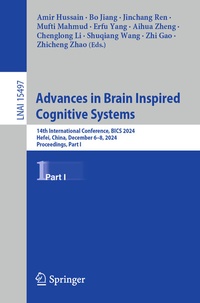
Advances in Brain Inspired Cognitive Systems
Description

The two-volume set LNAI 15497 and LNAI 15498 constitutes the refereed proceedings of the 14th International Conference on Brain Inspired Cognitive Systems, BICS 2024, held in Hefei, China, during December 6-8, 2024.
The 56 full papers presented in these two volumes were carefully reviewed and selected from 124 submissions.
These papers deal with various aspects of brain inspired cognitive systems, focusing on latest advancements in brain-inspired computing; artificial intelligence; and cognitive systems.
More details
Other editions
Additional editions
Content
.- A Lightweight Neural Network for SAR Ship Detection Based on YOLOv8 and Swin-Transformer.
.- RA-BLS: a sequential BLSs integrated with residual attention mechanism.
.- EEG-based Emotion Recognition Using Similarity Measures of Brain Rhythm Entropy Matrix.
.- Intensity controllable emotional speech synthesis based on Valence-Arousal-Dominance.
.- Unsupervised person re-identification with random occlusion and ContrastiveCrop.
.- Dynamic Prompt Adjustment for Multi-Label Class-Incremental Learning.
.- Using Decision Tree Classification to Identify Cost Drivers of Hospitalization Expenses for Elderly Patients.
.- Adversarial Attacks on Facial Images Based on Attribute-Conditioned High-Camouflage Editing.
.- A High Accuracy Text CAPTCHA Recognition Approach through Opertimized Vision Transformer.
.- LightMamba-UNet: Lightweight Mamba with U-Net for Efficient Skin Lesion Segmentation.
.- Exploiting Memory-aware Q-distribution Prediction for Nuclear Fusion via Modern Hopfield Network.
.- Multi-modal Fusion based Q-distribution Prediction for Controlled Nuclear Fusion.
.- Deformable Transformer for 3D Medical Image Segmentation.
.- On the Gap between AI-generated and Human-written Patent Texts.
.- MRI-CT Brain Image Registration Based on SuperPCA and Block-matching Algorithm.
.- Multi-teacher Knowledge Distillation with Triplet Loss for Cross-modal Object Tracking.
.- Enhanced Comprehensive Competition Network for Domain Adaptive Palmprint Recognition.
.- MBDR-V2: A Network for MRI Brain Tumor Image Segmentation with Incomplete Modalities.
.- An Innovative Eco-Friendly Weighing System for Reusable Bags Incorporating K210 and QR Code Technology.
.- Focal Consistency Network for Developmental Stage Classification of Embryos with Time-Lapse Embryo Video Datasets.
.- Chest X-ray Image Rib Segmentation via Disentanglement Enhancement Network.
.- Instance-Level 3D Model Reassembling from CLuttered Fragments.
.- Brain-inspired Action Generation with Spiking Transformer Diffusion Policy Model.
.- Single-Stage Dual-Task Joint Learning Framework for Hand Hygiene Assessment.
.- Enhancing Few-Shot Learning in Spiking Neural Networks through Hebbian-Augmented Associative Memory.
.- Palmprint Texture Fusion Method Based on TinyViT for Recognition.
.- Novel Device Placement Approach with Neighbor Effect Aware Graph Mamba Networks.
.- Research on Improved PointPillars Algorithm Based on Attention Mechanism and Feature Fusion.
