

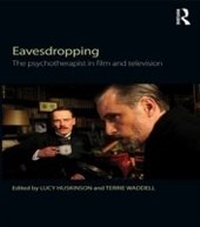
Eavesdropping
The psychotherapist in film and television
1st Edition
Published on 27. November 2014
200 pages
978-1-317-57703-4 (ISBN)
Description

What can depictions of psychotherapy on screen teach us about ourselves?
In Eavesdropping, a selection of contributions from internationally-based film consultants, practicing psychotherapists and interdisciplinary scholars investigate the curious dynamics that occur when films and television programmes attempt to portray the psychotherapist, and the complexities of psychotherapy, for popular audiences.
The book evaluates the potential mismatch between the onscreen psychotherapist, whose raison d'etre is to entertain and engage global audiences, and the professional, real-life counterpart, who becomes intimately involved with the dramas of their patients. While several contributors conclude that actual psychotherapy, and the way psychotherapists and their clients grapple with notions of fantasy and reality, would make a rather poor show, Eavesdropping demonstrates the importance of psychotherapy and psychotherapists on-screen in assisting us to wrestle with the discomfort - and humour - of our lives.
Offering a unique insight into perceptions of psychotherapy, Eavesdropping will be essential and insightful reading for analytical psychologists, psychoanalysts, academics and students of depth psychology, film and television studies, media studies and literature, as well as filmmakers.
In Eavesdropping, a selection of contributions from internationally-based film consultants, practicing psychotherapists and interdisciplinary scholars investigate the curious dynamics that occur when films and television programmes attempt to portray the psychotherapist, and the complexities of psychotherapy, for popular audiences.
The book evaluates the potential mismatch between the onscreen psychotherapist, whose raison d'etre is to entertain and engage global audiences, and the professional, real-life counterpart, who becomes intimately involved with the dramas of their patients. While several contributors conclude that actual psychotherapy, and the way psychotherapists and their clients grapple with notions of fantasy and reality, would make a rather poor show, Eavesdropping demonstrates the importance of psychotherapy and psychotherapists on-screen in assisting us to wrestle with the discomfort - and humour - of our lives.
Offering a unique insight into perceptions of psychotherapy, Eavesdropping will be essential and insightful reading for analytical psychologists, psychoanalysts, academics and students of depth psychology, film and television studies, media studies and literature, as well as filmmakers.
Reviews / Votes
"An interesting investigation of the connections between film and therapy that focuses on the portrayed character and performance of the therapist, rather than on plotlines or therapeutic themes." - Colin Feltham, Therapy Today'There is a lack in psychoanalytic criticism as remarkably it has overlooked the figure of the therapist. This fascinating book redresses that situation. Looking at both fictional therapy and fictional therapists, and with a global view, the essays weave in and out of the consulting room. In so doing each contributor casts light on the representation of the therapist and therapy itself. This is a wonderful collection that offers a range of fresh perspectives - a much needed and insightful addition to psychoanalytic criticism that makes for compelling reading.' - Dr Luke Hockley, Professor of Media Analysis and Psychotherapist, University of Bedfordshire, UK
"Eavesdropping is an interesting collection of essays that coversa a variety of themes relevant to thew ays in which psychotherapists and the process of psychotherapy are portrayed in film and television. One of the strengths of this book is that it takes both cinema and psychotherapy seriously, considering the challegnes, aims, and technical dilemmas of both endeavors. [...] [T]here is enough material here to provide a comprehensive discussion of the broader implications of portraying psychotherapists practicing their craft on the big screen." -James M. Hepburn, PsycCRITIQUES, 2014 'There is a lack in psychoanalytic criticism as remarkably it has overlooked the figure of the therapist. This fascinating book redresses that situation. Looking at both fictional therapy and fictional therapists, and with a global view, the essays weave in and out of the consulting room. In so doing each contributor casts light on the representation of the therapist and therapy itself. This is a wonderful collection that offers a range of fresh perspectives - a much needed and insightful addition to psychoanalytic criticism that makes for compelling reading.' - Dr Luke Hockley, Professor of Media Analysis and Psychotherapist, University of Bedfordshire, UK
More details
Language
English
Place of publication
London
United Kingdom
Publishing group
Taylor & Francis Ltd
Target group
College/higher education
Professional and scholarly
Product notice
Reflowable
File size
1,02 MB
ISBN-13
978-1-317-57703-4 (9781317577034)
Copyright in bibliographic data and cover images is held by Nielsen Book Services Limited or by the publishers or by their respective licensors: all rights reserved.
Schweitzer Classification
Other editions
Additional editions
Book
12/2014
1st Edition
Routledge
€263.50
Shipment within 15-20 days
Book
12/2014
1st Edition
Routledge
€63.40
Shipment within 15-20 days
Persons
Lucy Huskinson, PhD, is a senior lecturer in the School of Philosophy and Religion at Bangor University, UK. She is coeditor in chief of the International Journal of Jungian Studies and author and editor of numerous books and articles, including Dreaming the Myth Onwards: New Interpretations of Jungian Therapy and Thought?(Routledge, 2009).
Terrie Waddell, PhD, is associate professor of Media: Screen and Sound at La Trobe University, Australia. She researches and publishes on the relationships among screen media, myth, literature, gender, popular culture, and analytical psychology. Wild/lives: Trickster, Place and Liminality on Screen (Routledge, 2010) is her most recent monograph.
Terrie Waddell, PhD, is associate professor of Media: Screen and Sound at La Trobe University, Australia. She researches and publishes on the relationships among screen media, myth, literature, gender, popular culture, and analytical psychology. Wild/lives: Trickster, Place and Liminality on Screen (Routledge, 2010) is her most recent monograph.
Content
Acknowledgements. Introduction. Part I: Erotic Transference 1. Andrea Sabbadini, The (Mis)representation of Psychoanalysis in Film 2. Lucy Huskinson, Challenging Freud on the Realities of Erotic Transference with Fictional Case Study: The Sopranos (1999-2007) and In Treatment (2008-2010) 3. Elisabeth Hanscombe, The Real Psychotherapist: An Impossibility for Film Part II: The Psychoanalytic Approach 4. Barbara Creed, Equus: Ecstasy, Therapy and the Animal 5. Mark Nicholls, A Conversation Between Enlightened Friends: The Mutual Reassurances of the Arts and sciences in Freud (BBC TV, 1984 6. Dinesh Bhugra and Gurvinder Kalra, Applying Psychoanalysis to Hindi Cinema) 7. Patricia Gherovici and Jamieson Webster, The Bad Psychoanalyst: Watching the Success of Failure Part III: A Contest of Wills 8. Terrie Waddell, Shrink Wrapped Television: Simulated Therapy, Disclosure, and the Lure of Plausible Doubt 9. Helena Bassil-Morozow, Crossing the River Styx in a Small Boat 10. Donald Fredericksen, Remarks on the Functions of the Psychiatrist in Hitchcock's Psycho and Bergman's Persona 11. Irene Oestrich, Romance or Psychotherapy? Screen References. Notes on Contributors. Index.
