

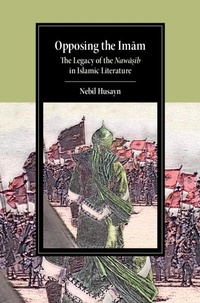
Opposing the Imam
The Legacy of the Nawasib in Islamic Literature
Published on 21. April 2021
252 pages
978-1-108-96731-0 (ISBN)
Description

Islam's fourth caliph, Ali, can be considered one of the most revered figures in Islamic history. His nearly universal portrayal in Muslim literature as a pious authority obscures centuries of contestation and the eventual rehabilitation of his character. In this book, Nebil Husayn examines the enduring legacy of the nawasib, early Muslims who disliked Ali and his descendants. The nawasib participated in politics and scholarly discussions on religion at least until the ninth century. However, their virtual disappearance in Muslim societies has led many to ignore their existence and the subtle ways in which their views subsequently affected Islamic historiography and theology. By surveying medieval Muslim literature across multiple genres and traditions including the Sunni, Mu'tazili, and Ibadi, Husayn reconstructs the claims and arguments of the nawasib and illuminates the methods that Sunni scholars employed to gradually rehabilitate the image of Ali from a villainous character to a righteous one.
Reviews / Votes
'A valuable contribution to a sensitive topic concerning the development of sectarian identity in Islam. Husayn compellingly examines assumptions about the place of ?Ali in Islamic thought and carefully analyzes the complex process through which his image was formed, based on representative voices from the Sunni, Iba?i and Mu?tazili traditions.' Hussein Abdulsater, University of Notre Dame 'A welcome addition to the field. Inasmuch as opinions about ?Ali 's role are already diverse, Husayn not only shows that there was a much wider range of opinions about him in the past, but explores - across the variety of genres that comprise the Islamic literary traditions - how those opinions came to be, and also how they came to disappear.' Aaron Hagler, Troy University 'An innovative elucidation of a persistent epistemological and theological Sunni? conundrum: the simultaneous appropriation and suppression of pro-'Alid sentiment. By enriching our understanding of this ambivalence, and in charting how it changed over time, Husayn's work compels us to reconceptualize the nature and development of sectarianism itself.' Nancy Khalek, Brown University 'Analyzing Umayyad and Khariji hostility toward ?Ali ibn Abi ?alib in the early centuries of Islam, Nebil Husayn uncovers a very real, yet suppressed strand in Muslim collective memory. This carefully researched and persuasively argued book is a vital contribution to the study of Islamic history and Sunni? doctrine.' Tahera Qutbuddin, University of Chicago 'A major contribution to the historiography of Islamic identity construction. More than just a simple trajectory of anti-Shi?i sectarianism, it demonstrates the unease that developing Sunni normativity had with praise of ?Ali and the desire to oppose Shi?i claims of his saintly authority. Through this creative study of historical texts as rhetorical glimpses of memory, myth and self-fashioning, we can interrogate convenient histories of the erasure and oblivion of negativity in the formation of identity.' Sajjad Rizvi, University of Exeter 'Nebil Husayn's meticulously researched and lucid book provides a rich and detailed description of the multiple ways in which a figure as central as ?Ali b. Abi ?alib was variously imagined and re-imagined in early and classical Muslim thought. It is a model of Islamic intellectual and religious history and ought to benefit specialists as well as non-specialists interested in parallel cases, such as that of Paul of Tarsus.' Hadi Qazwini, Shii Studies Review 'In all, this is an excellent book, an important contribution to the field, and a valuable addition for both scholars and students to the bibliography on Muslim sects, the instrumental uses of historiography, and the formation of orthodoxy, especially in (but not limited to) the Sunni context.' Edmund Hayes, Journal of Near Eastern Studies 'This study makes a valuable contribution to the discourse surrounding the construction and formation of Islamic history, offering a hypothesis into the decisions that were taken in formulating Sunni orthodoxy ...' Rebecca Masterton, Journal of Shi'a Islamic StudiesMore details
Series
Language
English
Place of publication
Cambridge
United Kingdom
Target group
Professional and scholarly
Illustrations
Worked examples or Exercises
File size
2,85 MB
ISBN-13
978-1-108-96731-0 (9781108967310)
Copyright in bibliographic data and cover images is held by Nielsen Book Services Limited or by the publishers or by their respective licensors: all rights reserved.
Schweitzer Classification
Other editions
Additional editions
Book
04/2021
Cambridge University Press
€111.30
Shipment within 15-20 days
Person
Content
Introduction; 1. 'Ali: A Contested Legacy; 2. The Umayyads and the 'Uthmanis; 3. The Mu'tazili: al-Jahiz; 4. The Ibadi: al-Warjalani; 5. The Sunni: Ibn Taymiyya; 6. The Rehabilitation of 'Ali in Sunni Hadith and Historiography; Afterword; Chapter 1 Appendix: Anti-'Alid Statements in Historical Literature; Chapter 2 Appendix: Reports about the Umayyads and the 'Uthmanis; Chapter 5 Appendix: Ibn Taymiyya's Minhaj al-sunna.
