

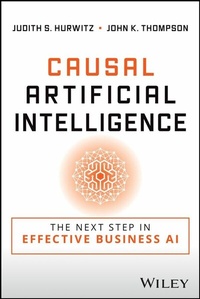
Causal Artificial Intelligence
Description

Discover the next major revolution in data science and AI and how it applies to your organization
In Causal Artificial Intelligence: The Next Step in Effective, Efficient, and Practical AI, a team of dedicated tech executives delivers a business-focused approach based on a deep and engaging exploration of the models and data used in causal AI. The book's discussions include both accessible and understandable technical detail and business context and concepts that frame causal AI in familiar business settings.
Useful for both data scientists and business-side professionals, the book offers:
- Clear and compelling descriptions of the concept of causality and how it can benefit your organization
- Detailed use cases and examples that vividly demonstrate the value of causality for solving business problems
- Useful strategies for deciding when to use correlation-based approaches and when to use causal inference
An enlightening and easy-to-understand treatment of an essential business topic, Causal Artificial Intelligence is a must-read for data scientists, subject matter experts, and business leaders seeking to familiarize themselves with a rapidly growing area of AI application and research.
More details
Other editions
Additional editions
Persons
JOHN K. THOMPSON is an international technology executive with over 37 years of experience in the fields of data, advanced analytics, and artificial intelligence (AI). John is responsible for the global AI function at EY. He has previously led the global Artificial Intelligence and Rapid Data Lab teams at CSL Behring and is the bestselling author of three books on data analytics.
Content
Foreword xix
Preface xxiii
Introduction xxix
Chapter 1 Setting the Stage for Causal AI 1
Why Causality Is a Game Changer 2
Causal AI in Perspective with Analytics 7
Analytical Sophistication Model 8
Analytics Enablers 10
Analytics 10
Advanced Analytics 11
Scope of Services to Support Causal AI 11
The Value of the Hybrid Team 13
The Promise of AI 14
Understanding the Core Concepts of Causal AI 15
Explainability and Bias Detection 15
Explainability 17
Detecting Bias in a Model 17
Directed Acyclic Graphs 18
Structural Causal Model 19
Observed and Unobserved Variables 20
Counterfactuals 21
Confounders 21
Colliders 22
Front- Door and Backdoor Paths 23
Correlation 24
Causal Libraries and Tools 25
Propensity Score 25
Augmented Intelligence and Causal AI 26
Summary 27
Note 27
Chapter 2 Understanding the Value of Causal AI 29
Defining Causal AI 30
The Origins of Causal AI 33
Why Causality? 34
Expressing Relationships 37
The Ladder of Causation 38
Rung 1: Association, or Passive Observation 40
Rung 2: Intervention, or Taking Action 40
Rung 3: Counterfactuals, or Imagining What If 42
Why Causal AI Is the Next Generation of AI 43
Deep Learning and Neural Networks 43
Neural Networks 44
Establishing Ground Truth 45
The Business Imperative of a Causal Model 46
The Importance of Augmented Intelligence 51
The Importance of Data, Visualization, and Frameworks 52
Getting the Appropriate Data 52
Applying Data and Model Visualization 55
Applying Frameworks After Creating a Model 56
Getting Started with Causal AI 57
Summary 58
Notes 59
Chapter 3 Elements of Causal AI 61
Conceptual Models 62
Correlation vs. Causal Models 63
Correlation- Based AI 63
Causal AI 63
Understanding the Relationship Between Correlation and Causality 64
Process Models 66
Correlation- Based AI Process Model 67
Causal- Based AI Process Model 69
Collaboration Between Business and Analytics Professionals 72
The Fundamental Building Blocks of Causal AI Models 75
The Relations Between DAGs and SCMs 76
Explaining DAGs 76
Causal Notation: The Language of DAGs 78
Operationalizing a DAG with an SCM 79
The Elements of Visual Modeling 81
Nodes 83
Variables 83
Endogenous and Exogenous Variables 83
Observed and Unobserved Variables 84
Paths/Relationships 84
Weights 86
Summary 88
Notes 89
Chapter 4 Creating Practical Causal AI Models and Systems 91
Understanding Complex Models 92
Causal Modeling Process: Part 1 94
Step 1: What Are the Intended Outcomes? 95
Step 2: What Are the Proposed Interventions? 97
Step 3: What Are the Confounding Factors? 99
Step 4: What Are the Factors Creating the Effects and Changes? 102
Common/Universal Effects in a Causal Model 102
Refined Effects in a Causal Model 103
Step 5: Creating a Directed Acyclic Graph 105
Step 6: Paths and Relationships 105
Types of Paths 106
Path Connecting an Unobserved Variable 107
Front- Door Paths 108
Backdoor Paths 108
Modeling for Simplicity to Understand Complexity 109
Step 7: Data Acquisition 110
Causal- Based Approach: Part 2 112
Step 8: Data Integration 113
Step 9: Model Modification 114
Step 10: Data Transformation 115
Step 11: Preparing for Deployment in Business 118
Summary 121
Notes 122
Chapter 5 Creating a Model with a Hybrid Team 125
The Hybrid Team 126
Why a Hybrid Team? 127
The Benefits of a Hybrid Team 128
Establishing the Hybrid Team as a Center of Excellence 129
How Teams Collaborate 131
But Why? 132
Defining Roles 134
Leaders and Business Strategists 137
Subject- Matter Experts 138
Data Experts 140
Software Developers 142
Business Process Analysts 143
Information Technology Expertise 143
Project Manager(s) 144
The Basics Steps for a Hybrid Team Project 145
An Overview of Model Creation 146
It Depends on Your Destination 150
Understanding the Root Cause of a Problem 151
Understanding What Happened and Why 153
The Importance of the Iterative Process 154
Summary 155
Chapter 6 Explainability, Bias Detection, and AI Responsibility in Causal AI 157
Explainability 158
The Ramifications of the Lack of Explainability 159
What Is Explainable AI in Causal AI Models? 161
Black Boxes 162
Internal Workings of Black-Box Models 162
Deep Learning at the Heart of Black Boxes 163
Is Code Understandable? 163
The Value of White-Box Models 166
Understanding Causal AI Code 167
Techniques for Achieving Explainability 169
Challenges of Complex Causal Models 169
Methods for Understanding and Explaining Complex Causal AI Models 171
The Importance of the SHAP Explainability Method 172
Detecting Bias and Ensuring Responsible AI 175
Bias in Causal AI Systems 176
Responsible AI: Trust and Fairness 178
How Causal AI Addresses Bias Detection 180
Tools for Assessing Fairness and Bias 182
The Human Factor in Bias Detection and Responsible AI 183
Summary 184
Note 184
Chapter 7 Tools, Practices, and Techniques to Enable Causal AI 185
The Causal AI Pipeline 187
Define Business Objectives 190
Model Development 193
Data Identification and Collection 195
Data Privacy, Governance, and Security 197
Synthetic Data 198
Model Validation 199
Deployment/Production 201
Monitor and Evaluate 203
Update and Iterate 205
Continuous Learning 208
The Importance of Synthetic Data 210
Why Create Synthetic Data? 210
Overcoming Data Limitations 211
Enhancing Data Privacy and Security 211
Model Validation and Testing 211
Expanding the Range of Possible Scenarios 212
Reducing the Cost of Data Collection 212
Improving Data Imbalance 213
Encouraging Collaboration and Openness 213
Streamlining Data Preprocessing 213
Supporting Counterfactual Analysis 213
Fostering Innovation and Experimentation 214
Creating Synthetic Data 214
Generative Models 214
Agent-Based Modeling 215
Data Augmentation 215
Data Synthesis Tools and Platforms 215
Conditional Synthetic Data Generation 216
Synthetic Data from Text 216
The Limitations of Synthetic Data 217
Current State of Tools and Software in Causal AI 218
The Role of Open Source in Causal AI 218
Commercial Causal AI Software 221
CausaLens 221
Geminos Software 223
Summary 223
Chapter 8 Causal AI in Action 225
Enterprise Marketing in a Business- to- Consumer Scenario 226
DDCo Marketing Causal Model: Annual Pricing Review and Update Cycle 228
Incorporating Internal and External Factors in the Model and DAG 230
Easily Enabling Iterating 231
End-User-Driven Exploration 232
Bench Testing 234
DDCo Marketing Causal Model: Semiannual Product Planning Cycle 236
Always Consider Model Reuse 237
Give and Take in Building a New Model 239
Typical Model and Process Operation: Iterating 239
Keeping the Process/Model Scope Manageable and Understandable 240
Moving from Strategy to Building and Implementing Causal AI Solutions 241
Agriculture: Enhancing Crop Yield 242
Key Causal Variables 244
Creating the DAG 246
Moving from the DAG to Implementing the Causal AI Model 247
Commercial Real Estate: Valuing Warehouse Space 250
Key Causal Variables 251
Implementing the Causal AI Model 253
Video Streaming: Enhancing Content Recommendations 254
Key Causal Variables 255
Implementing the Causal AI Model 256
Healthcare: Reducing Infant Mortality 258
Key Causal Variables 259
Implementing the Causal AI Model 261
Retail: Providing Executives Actionable Information 263
Key Causal Variables 264
Implementing the Causal Model 265
Summary 267
Chapter 9 The Future of Causal AI 271
Where We Stand Today 271
Foundations of Causal AI 273
The Causal AI Journey 274
Causal AI Today 274
What's Next for Causal AI 276
Integrating Causal AI and Traditional AI 278
The Imperative for Managing Data 279
Ensembles of Data 279
Generative AI Is Emerging as a Game Changer for Causal AI 281
The Future of Causal Discovery 282
The Emergence of Causal AI Reinforcement Learning Will Accelerate Model Training 284
Causal AI as a Common Language Between Business Leaders and Data Scientists 284
The Emergence of Probabilistic Programming Languages 286
The Predictable Model Evolution Cycle 286
The Emergence of the Digital Twin 287
Improving the Ability to Understand Ground Truth 289
The Development of More Sophisticated DAGs 289
Visualizing Complex Relationships in the DAGs 290
The Merging of Causal and Traditional AI Models 291
The Future of Explainability 291
The Evolution of Responsible AI 292
Advances in Data Security and Privacy 293
Integration Will Be Between Models and Business Applications 294
Summary 295
Glossary 299
Appendix 313
Selected Resources 329
Acknowledgments 331
About the authors 335
About the contributor 339
Index 341
Preface
In my view, causal AI is the next stage in the evolution of software because it is focused on being able to understand the causes and effects of events. As we discuss in this book, what has caused a marketing campaign to achieve the revenue objectives? Is the problem the campaign itself, or are there underlying issues that are impacting results? Is the cause of the disappointing marketing campaign because of a sudden competitive threat? Is there a problem with the company's reputation? What would the impact on revenue if the product price was reduced by 10 percent? Would a different type of marketing campaign result in better results? The underlying casual technology needed to address these problems is complex, and the approach is instrumental for business leaders to understand the potential impact. Therefore, unlike some earlier evolutions of AI, the value of a causal AI approach can have a direct and profound effect on business outcomes.
A plethora of books and articles already address causal inference-a field that must recognize Judea Pearl as a pioneer and visionary in causality. So, why write yet another book on the topic? The reason is straightforward-this book is written for technology-focused leaders who are not developers but are responsible for bringing new technology into their companies to gain a competitive edge. In writing this book, I have spent countless hours speaking with leaders in the field and reading many articles and books. The goal of this book is to provide an understanding of why the field of causal AI is so important. It has the potential to truly transform how we use artificial intelligence to digitally transform business.
My journey through the complex world of software started more than 35 years ago. My experience in technology began when I joined a financial services company and was tasked with introducing emerging technology to various business units. The goal was to evaluate how the technology could help transform the competitiveness of the business. From that beginning, I went on to spend many years as a developer, strategy IT consultant, industry analyst, thought leader, and writer. Most recently, I joined Geminos Software, a causal AI company, as their chief evangelist. I credit my ability to begin to understand this amazing and complex technology to the insights and wisdom of the Geminos team.
While I have spent years delving into some of the most complex technologies, I have always put solutions in perspective by focusing on the needs of the business organization. No matter what position I have been in, I always asked some variation of the same questions: What is the purpose of a software platform, and how does it help the business flourish? Why is the technology important?
Since I have always focused on those key issues, it is not surprising that I have paid particular attention to some of the most complex emerging technologies. During my pursuit of learning and understanding the value of new offerings, I have coauthored 10 books and dozens of customized e-books all focused on explaining complex technologies to both business and technical audiences. My goal has long been to bridge the gap of how business and technology leaders must collaborate to be able to succeed. I have always believed that customers will not buy technology that they do not understand. Topics of the books I have coauthored include service-oriented architecture, big data, machine learning, and cloud computing. My two most recent books focused on cognitive computing and augmented intelligence. Both books have informed my journey to an exploration of causal AI.
As with any emerging technology, causal AI will evolve over the coming decade. The goal of this book is to provide guidance and an understanding for a business audience of the foundation of this important technology. As a participant in the world of emerging technologies, I felt it was the right time to put causal AI in perspective.
-Judith Hurwitz
May 2023
While writing this book on causal AI, generative AI burst onto the market with great excitement, fanfare, and disruption. I was asked by more than a few people who knew that I was involved in writing a book on causal AI if I should put this book on hold and focus my current efforts on generative AI. As with all reasonable suggestions and questions, I considered the change in direction. My conclusion was that while generative AI is transformative in relation to how people are employed, how work will be executed, the impact on productivity, and more, generative AI is not a new field of AI. Generative AI is an extension of, and a new way of combining, neural networks, unsupervised learning, supervised learning, reinforcement learning, and much larger models than we have seen before, but it is not a new field of AI, not the way causal AI is. Hence, my conclusion was that while my day job is dominated by determining how to design, leverage, govern, deploy, and use generative AI in an enterprise environment, this book on causal AI was still needed to raise the awareness of the power, value, and transformative nature of causal AI.
My main motivation for writing this book was to put an original book into the market that takes the dialogue relating to causal AI in a new direction-a direction that begins to draw the business, technical, and analytical communities into the dialogue.
In my research to expand my fundamental understanding of causal AI and the stage of development of this completely new field of AI, before the writing process began, I read nearly 100 pieces of original writing. All of the books, research papers, most of the blogs, and more, on causal AI immediately dove into the details of the calculus and related math underlying causal AI. I refreshed my understanding of calculus that I learned in graduate school. My knowledge of calculus was extended, sharpened, and revived, but I knew that this type of writing was a barrier to broadening and deepening my understanding of causal AI. I also knew that if it was a high barrier for me, then it was a complete showstopper for most people.
I knew that the audiences that I felt needed to know about causal AI were not, for the most part, going to wade through even a 10th of what I had read. I became excited about the opportunity to be among the first people in the field of data, analytics, and AI to develop and carry the message forward that causal AI was being developed, was a powerful new tool, and would be a significant advance in our arsenal of tools in our quest to document, model, and understand our world in a more complete manner.
I wrote Building Analytics Teams (BAT) after having built multiple analytics teams over the previous 37 years as a technologist and an AI practitioner. One of my goals, and my primary objective, in writing BAT was to help people from all walks of life who have more than a passing interest in being part of the fields of data, analytics, and AI to understand the real-world environment, the environment in the majority of enterprise-class organizations, and the real constraints and opportunities that are at play in working in the field of analytics. I wanted to help new college graduates to understand what working in analytics really looked and felt like. I wanted new managers to have a "how to" book on how to design, build, manage, and grow, their analytics teams, and I wanted, most of all, to help analytics professionals to not make the same mistakes that I made. I wanted to make their lives and journeys better. In BAT, I accomplished that goal.
My primary goal in writing this book is to help draw the business, technical, and analytical communities into an exploration of the emerging field of causal AI. I want those practitioners to buy and read this book to understand what is coming next. I want them to engage with the content to fire their imaginations about what they can do with causal AI and how causal AI is an entirely novel and new approach to AI that expands their toolset and puts the power of AI in the hands of the business users. In that respect, putting the power of AI in the hands of business users, causal AI has some similarities to generative AI, but only at a conceptual level.
I recognized that causal AI was a completely new field of AI, and I wanted to be part of the evolution, to be a messenger that raises the awareness of this impressive new area. I knew, and know, that once causal AI moves beyond the research phase into the early adopter phase, there will be a flurry of activity enabling early-mover companies to build and maintain a defensible and significant competitive advantage. This book is a call to action for those early-stage enterprise-class innovators to take notice of causal AI and to begin their process of investigating the potential of this technology and approach.
One of the early epiphanies that I experienced in researching the topic was that the underlying causal approach could be applied to any process. Historically, the causal approach was applied to agriculture, healthcare, and specialty use cases such as dog breeding. But, as I looked back in time, all the way to ancient Greece, and then forward again to ages like the Renaissance and the Reformation, it was clear that philosophers, mathematicians, and academics of all types were touching on causality and slowly but consistently adding to the global corpus of knowledge related to causality.
This aggregation of knowledge reached an acceleration point in the past century, and causal AI gained a dedicated and devout following that drove the development of casual AI to a new level. Once I realized that the field of causal AI was racing forward,...
