

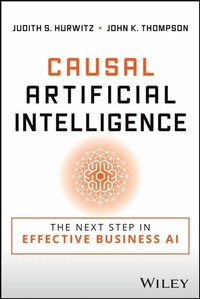
Causal Artificial Intelligence
The Next Step in Effective Business AI
1st Edition
Published on 23. August 2023
384 pages
978-1-394-18414-9 (ISBN)
Description

Discover the next major revolution in data science and AI and how it applies to your organization
In Causal Artificial Intelligence: The Next Step in Effective, Efficient, and Practical AI, a team of dedicated tech executives delivers a business-focused approach based on a deep and engaging exploration of the models and data used in causal AI. The book's discussions include both accessible and understandable technical detail and business context and concepts that frame causal AI in familiar business settings.
Useful for both data scientists and business-side professionals, the book offers:
* Clear and compelling descriptions of the concept of causality and how it can benefit your organization
* Detailed use cases and examples that vividly demonstrate the value of causality for solving business problems
* Useful strategies for deciding when to use correlation-based approaches and when to use causal inference
An enlightening and easy-to-understand treatment of an essential business topic, Causal Artificial Intelligence is a must-read for data scientists, subject matter experts, and business leaders seeking to familiarize themselves with a rapidly growing area of AI application and research.
In Causal Artificial Intelligence: The Next Step in Effective, Efficient, and Practical AI, a team of dedicated tech executives delivers a business-focused approach based on a deep and engaging exploration of the models and data used in causal AI. The book's discussions include both accessible and understandable technical detail and business context and concepts that frame causal AI in familiar business settings.
Useful for both data scientists and business-side professionals, the book offers:
* Clear and compelling descriptions of the concept of causality and how it can benefit your organization
* Detailed use cases and examples that vividly demonstrate the value of causality for solving business problems
* Useful strategies for deciding when to use correlation-based approaches and when to use causal inference
An enlightening and easy-to-understand treatment of an essential business topic, Causal Artificial Intelligence is a must-read for data scientists, subject matter experts, and business leaders seeking to familiarize themselves with a rapidly growing area of AI application and research.
More details
Other editions
Additional editions
Judith S. Hurwitz | John K. Thompson
Causal Artificial Intelligence
The Next Step in Effective Business AI
Book
09/2023
1st Edition
Wiley
€33.00
Shipment within 15-20 days
Persons
JUDITH S. HURWITZ is the chief evangelist at Geminos Software, a causal AI platform company. For more than 35 years she has been a strategist, technology consultant to software providers, and a thought leader having authored 10 books in topics ranging from augmented intelligence, data analytics, and cloud computing.
JOHN K. THOMPSON is an international technology executive with over 37 years of experience in the fields of data, advanced analytics, and artificial intelligence (AI). John is responsible for the global AI function at EY. He has previously led the global Artificial Intelligence and Rapid Data Lab teams at CSL Behring and is the bestselling author of three books on data analytics.
JOHN K. THOMPSON is an international technology executive with over 37 years of experience in the fields of data, advanced analytics, and artificial intelligence (AI). John is responsible for the global AI function at EY. He has previously led the global Artificial Intelligence and Rapid Data Lab teams at CSL Behring and is the bestselling author of three books on data analytics.
Content
- Cover Page
- Title Page
- Contents
- Foreword
- Preface
- Introduction
- Chapter 1 Setting the Stage for Causal AI
- Why Causality Is a Game Changer
- Causal AI in Perspective with Analytics
- Analytical Sophistication Model
- Analytics Enablers
- Analytics
- Advanced Analytics
- Scope of Services to Support Causal AI
- The Value of the Hybrid Team
- The Promise of AI
- Understanding the Core Concepts of Causal AI
- Explainability and Bias Detection
- Directed Acyclic Graphs
- Structural Causal Model
- Observed and Unobserved Variables
- Counterfactuals
- Confounders
- Colliders
- Front-Door and Backdoor Paths
- Correlation
- Causal Libraries and Tools
- Propensity Score
- Augmented Intelligence and Causal AI
- Summary
- Note
- Chapter 2 Understanding the Valueof Causal AI
- Defining Causal AI
- The Origins of Causal AI
- Why Causality?
- Expressing Relationships
- The Ladder of Causation
- Why Causal AI Is the Next Generation of AI
- Deep Learning and Neural Networks
- Neural Networks
- Establishing Ground Truth
- The Business Imperative of a Causal Model
- The Importance of Augmented Intelligence
- The Importance of Data, Visualization, and Frameworks
- Getting the Appropriate Data
- Applying Data and Model Visualization
- Applying Frameworks After Creating a Model
- Getting Started with Causal AI
- Summary
- Notes
- Chapter 3 Elements of Causal AI
- Conceptual Models
- Correlation vs. Causal Models
- Understanding the Relationship Between Correlation and Causality
- Process Models
- Correlation-Based AI Process Model
- Causal-Based AI Process Model
- Collaboration Between Business and Analytics Professionals
- The Fundamental Building Blocks of Causal AI Models
- The Relations Between DAGs and SCMs
- Explaining DAGs
- Causal Notation: The Language of DAGs
- Operationalizing a DAG with an SCM
- The Elements of Visual Modeling
- Nodes
- Variables
- Paths/Relationships
- Weights
- Summary
- Notes
- Chapter 4 Creating Practical Causal AI Models and Systems
- Understanding Complex Models
- Causal Modeling Process: Part 1
- Step 1: What Are the Intended Outcomes?
- Step 2: What Are the Proposed Interventions?
- Step 3: What Are the Confounding Factors?
- Step 4: What Are the Factors Creating the Effects and Changes?
- Step 5: Creating a Directed Acyclic Graph
- Step 6: Paths and Relationships
- Step 7: Data Acquisition
- Causal-Based Approach: Part 2
- Step 8: Data Integration
- Step 9: Model Modification
- Step 10: Data Transformation
- Step 11: Preparing for Deployment in Business
- Summary
- Notes
- Chapter 5 Creating a Model with a Hybrid Team
- The Hybrid Team
- Why a Hybrid Team?
- The Benefits of a Hybrid Team
- Establishing the Hybrid Team as a Center of Excellence
- How Teams Collaborate
- But Why?
- Defining Roles
- Leaders and Business Strategists
- Subject-Matter Experts
- Data Experts
- Software Developers
- Business Process Analysts
- Information Technology Expertise
- Project Manager(s)
- The Basics Steps for a Hybrid Team Project
- An Overview of Model Creation
- It Depends on Your Destination
- Understanding the Root Cause of a Problem
- Understanding What Happened and Why
- The Importance of the Iterative Process
- Summary
- Chapter 6 Explainability, Bias Detection, and AI Responsibility in Causal AI
- Explainability
- The Ramifications of the Lack of Explainability
- What Is Explainable AI in Causal AI Models?
- Black Boxes
- The Value of White-Box Models
- Understanding Causal AI Code
- Techniques for Achieving Explainability
- Detecting Bias and Ensuring Responsible AI
- Bias in Causal AI Systems
- Responsible AI: Trust and Fairness
- How Causal AI Addresses Bias Detection
- Tools for Assessing Fairness and Bias
- The Human Factor in Bias Detection and Responsible AI
- Summary
- Note
- Chapter 7 Tools, Practices, and Techniques to Enable Causal AI
- The Causal AI Pipeline
- Define Business Objectives
- Model Development
- Data Identification and Collection
- Model Validation
- Deployment/Production
- Monitor and Evaluate
- Update and Iterate
- Continuous Learning
- The Importance of Synthetic Data
- Why Create Synthetic Data?
- Creating Synthetic Data
- Data Synthesis Tools and Platforms
- The Limitations of Synthetic Data
- Current State of Tools and Software in Causal AI
- The Role of Open Source in Causal AI
- Commercial Causal AI Software
- Summary
- Chapter 8 Causal AI in Action
- Enterprise Marketing in a Business-to-Consumer Scenario
- DDCo Marketing Causal Model: Annual Pricing Review and Update Cycle
- DDCo Marketing Causal Model: Semiannual Product Planning Cycle
- Moving from Strategy to Building and Implementing Causal AI Solutions
- Agriculture: Enhancing Crop Yield
- Commercial Real Estate: Valuing Warehouse Space
- Video Streaming: Enhancing Content Recommendations
- Healthcare: Reducing Infant Mortality
- Retail: Providing Executives Actionable Information
- Summary
- Chapter 9 The Future of Causal AI
- Where We Stand Today
- Foundations of Causal AI
- The Causal AI Journey
- Causal AI Today
- What's Next for Causal AI
- Integrating Causal AI and Traditional AI
- The Imperative for Managing Data
- Ensembles of Data
- Generative AI Is Emerging as a Game Changer for Causal AI
- The Future of Causal Discovery
- The Emergence of Causal AI Reinforcement Learning Will Accelerate Model Training
- Causal AI as a Common Language Between Business Leaders and Data Scientists
- The Emergence of Probabilistic Programming Languages
- The Predictable Model Evolution Cycle
- The Emergence of the Digital Twin
- Improving the Ability to Understand Ground Truth
- The Development of More Sophisticated DAGs
- Visualizing Complex Relationships in the DAGs
- The Merging of Causal and Traditional AI Models
- The Future of Explainability
- The Evolution of Responsible AI
- Advances in Data Security and Privacy
- Integration Will Be Between Models and Business Applications
- Summary
- Glossary
- Appendix: Causal AI Tools and Libraries
- Selected Resources
- Index
- EULA
