

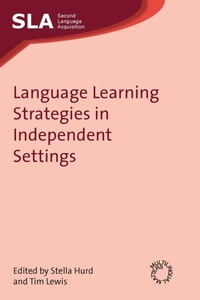
Language Learning Strategies in Independent Settings
Published on 3. October 2008
352 pages
978-1-78892-062-9 (ISBN)
Description

Language learning strategies have been a topic of research for roughly three decades. Broadly speaking, that research has focused on classroom tuition, predominantly at secondary level. Increasingly, however, language learning occurs in independent settings, whether at distance, on Institution-Wide Language Programmes (IWLPs), or in virtual environments. Success in independent language learning is achieved by autonomous individuals with a capacity for self-regulation. Yet we still know relatively little about the specific means they use to learn effectively, whether in terms of the affective strategies they employ to sustain motivation, the metacognitive strategies required for planning, monitoring and evaluating their learning, or the specific cognitive strategies applied to difficult learning tasks. These are all discussed and evaluated in Language Learning Strategies in Independent Settings.
Reviews / Votes
The book has a good balance between theory, research and reports on practice, with useful illustration of tools and resources, and variety in the language and cultural contexts discussed. -- Dr Ema Ushioda, Centre for English Language Teacher Education (CELTE), University of Warwick This book extends the field of language learning strategies to ILL contexts through overviews of pertinent research to date. Its strength is in venturing to present theoretical frameworks and methodological examples for fields of focus in ILL that are frankly begging for more research. The book provides an informed foundation as a jumping off point. -- Lynn Erler, University of Oxford, UK * System 37 (2009) *More details
Series
Language
English
Place of publication
Bristol
United Kingdom
Target group
Professional and scholarly
ISBN-13
978-1-78892-062-9 (9781788920629)
Copyright in bibliographic data and cover images is held by Nielsen Book Services Limited or by the publishers or by their respective licensors: all rights reserved.
Schweitzer Classification
Other editions
Additional editions
Stella Hurd | Tim Lewis
Language Learning Strategies in Independent Settings
Book
10/2008
Multilingual Matters
€49.00
Shipment within 10-20 days
Stella Hurd | Tim Lewis
Language Learning Strategies in Independent Settings
E-Book
10/2008
1st Edition
Multilingual Matters
€24.49
Available for download
Persons
Stella Hurd is a Senior Lecturer in French at the Open University, where she has developed materials at all levels since 1994. As a member of the Open Universitya??s Centre for Research into Education and Educational Technology, her main research focus is distance language learning and teaching, which embraces autonomy, affect, learning strategies and learner support. She has published on all these topics in refereed journals and books and has also co-edited three books on adult language learning.
Tim Lewis is currently a Lecturer in French in the Department of Languages of the Open University. From 1993 to 2001 he was Director of the Modern Languages Teaching Centre of the University of Sheffield where he introduced Tandem learning into UK Higher Education. A member of the Open Universitya??s Centre for Research into Education and Educational Technology, he has co-edited two previous books on technology-based language learning and on tandem learning.
Tim Lewis is currently a Lecturer in French in the Department of Languages of the Open University. From 1993 to 2001 he was Director of the Modern Languages Teaching Centre of the University of Sheffield where he introduced Tandem learning into UK Higher Education. A member of the Open Universitya??s Centre for Research into Education and Educational Technology, he has co-edited two previous books on technology-based language learning and on tandem learning.
Content
Introduction
Notes on Contributors
Part A: Language Learning Strategies: Theory, Research and Practice
1. Language Learning Strategies in Independent Language Learning: An Overview - Cynthia White
2. Individual Variation and Language Learning Strategies - Phil Benson and Xuesong Gao
3. Hero with a Thousand Faces: Learner Autonomy, Learning Strategies, and Learning Tactics in Independent Language Learning - Rebecca L. Oxford
Part B: Strategies for Skills Development in Independent Language Learning
4. Independent Second Language Reading as an Interdependent Process - Carolyn Gascoigne
5. Learning Strategies for Listening Comprehension - Larry Vandergrift
6. Second Language Composition in Independent Settings: Supporting the Writing Process with Cognitive Strategies - Melanie Bloom
7. Speaking Strategies for Independent Learning: Speech Acts and Pragmatic Performance - Andrew D. Cohen
8. Bringing the Learner Back into the Process - Identifying Learner Strategies for Grammatical Development in Independent Language Learning - Elspeth Broady and Nick Dwyer
9. Deliberate and Incidental: Vocabulary Learning Strategies in Independent Second Language Learning - John Klapper
10. Strategies for Acquiring Intercultural Competence - Inma Alvarez, Tita Beaven and Cecilia Garrido
Part C: Strategies for Learner Self-management
11. Learning Logs and Strategy Development for Distance and Other Independent Language Learners - Linda Murphy
12. Affect and Strategy Use in Independent Language Learning - Stella Hurd
13. Collaborative Language Learning Strategies in an Email Tandem Exchange - Ursula Stickler and Tim Lewis
14. Self-correction Strategies in Distance Language Learning - Mike Truman
15. Strategies for Online Learning Environments - Mirjam Hauck and Regine Hampel
16. Integrating Strategy Instruction into Learning Materials - Linda Murphy
Notes on Contributors
Part A: Language Learning Strategies: Theory, Research and Practice
1. Language Learning Strategies in Independent Language Learning: An Overview - Cynthia White
2. Individual Variation and Language Learning Strategies - Phil Benson and Xuesong Gao
3. Hero with a Thousand Faces: Learner Autonomy, Learning Strategies, and Learning Tactics in Independent Language Learning - Rebecca L. Oxford
Part B: Strategies for Skills Development in Independent Language Learning
4. Independent Second Language Reading as an Interdependent Process - Carolyn Gascoigne
5. Learning Strategies for Listening Comprehension - Larry Vandergrift
6. Second Language Composition in Independent Settings: Supporting the Writing Process with Cognitive Strategies - Melanie Bloom
7. Speaking Strategies for Independent Learning: Speech Acts and Pragmatic Performance - Andrew D. Cohen
8. Bringing the Learner Back into the Process - Identifying Learner Strategies for Grammatical Development in Independent Language Learning - Elspeth Broady and Nick Dwyer
9. Deliberate and Incidental: Vocabulary Learning Strategies in Independent Second Language Learning - John Klapper
10. Strategies for Acquiring Intercultural Competence - Inma Alvarez, Tita Beaven and Cecilia Garrido
Part C: Strategies for Learner Self-management
11. Learning Logs and Strategy Development for Distance and Other Independent Language Learners - Linda Murphy
12. Affect and Strategy Use in Independent Language Learning - Stella Hurd
13. Collaborative Language Learning Strategies in an Email Tandem Exchange - Ursula Stickler and Tim Lewis
14. Self-correction Strategies in Distance Language Learning - Mike Truman
15. Strategies for Online Learning Environments - Mirjam Hauck and Regine Hampel
16. Integrating Strategy Instruction into Learning Materials - Linda Murphy
