

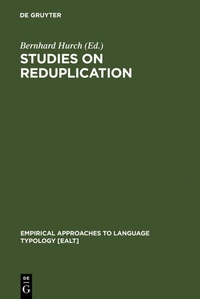
Studies on Reduplication
Description

For several reasons, mostly inherent to the different developments of generative grammar, an increasing number of publications have dealt with reduplication in the past 20 years. Reduplication lends itself perfectly as a test field for theories that opt for a non-segmental organization of phonology and morphology. As it happens frequently, then, the discussion centers around a rather small set of data for which alternative analysis are offered, and which themselves are intended to contribute to the foundation of new theoretical developments.
The present volume (which goes back to a conference on reduplication at the University of Graz, Austria) offers a broader approach to reduplication not only from different theoretical viewpoints, but especially for its phenomenology. Across theories a number of highly qualified authors deal with formal and functional perspectives, with typological properties, with semantics, comparative issues, the role of reduplication in language acquisition, the acquisition of reduplicative systems, sign languages, creoles and pidgins, general grammatical and cognitive principles; the picture is completed by a series of language or language-family specific studies as on Uto-Aztecan, Salish, Tupi-Guarani, Moroccan and Cairene Arabic, various African languages, Chinese, Turkish, Indo-European, languages from India, etc. The overall scope of the conference was to contribute to a new level of discussion of the phenomenon, across theories and across specializations and interests.
Update on Contributor's addresses (PDF)
Reviews / Votes
"[...] the book is not to be missed by those who wish to be updated on the latest advancements in the field of reduplication."Haritini Kallergi in: Linguistics 4/2007 "In the indroduction, Bernhard Hurch provides a detailed summary of the articles publishesd in Studies on reduplication - which thus almost fulfils the function of a review article itself! [...] I strongly recommend this collection of articles to all students of reduplication, morphology, phonology and related subject matters."Thomas Stolz in: STUF 3/2007More details
Other editions
Additional editions
Persons
Content
- Intro
- Editorial Preface
- Introduction
- Reduplication: Form, function and distribution
- From repetition to reduplication in Riau Indonesian
- Morphological Doubling Theory: Evidence for morphological doubling in reduplication
- The Emergence of the Marked: Tone in some African reduplicative systems
- Reduplication and consonant mutation in the Northern Atlantic languages
- Wrong side reduplication is epiphenomenal: Evidence from Yoruba
- Non-adjacency in reduplication
- Enhancing contrast in reduplication
- Phrasal reduplication and dual description
- Reduplication in Modern Hindi and the theory of reduplication
- On the grammaticalization of verbal reduplication in Japanese
- Reduplicative allomorphy and language prehistory in Uto-Aztecan
- Reduplication in Tupi-Guarani languages: Going into opposite directions
- On the borderline of reduplication: Gemination and other consonant doubling in Arabic morphology
- Syntactic reduplication in Arabic
- Reduplication in the Vedic verb: Indo-European inheritance, analogy and iconicity
- Reduplication in child language
- Reduplication before age two
- Acquisition of reduplication in Turkish
- Reduplication in Pidgins and Creoles
- Less is more: Evidence from diminutive reduplication in Caribbean Creole languages
- Intensity and diminution triggered by reduplicating morphology: Janus-faced iconicity
- Backward and sideward reduplication in German Sign Language
- A reanalysis of reduplication in American Sign Language
- List of key words
- List of languages
- List of contributors
