

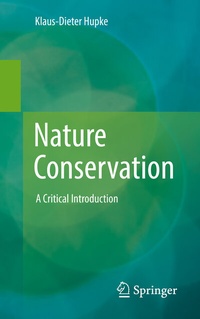
Nature Conservation
Description

The updated second edition now explicitly includes the consequences of climate change for nature conservation and has also incorporated a stronger reference to Austria as well as to the central Alpine region in some places for the relevant readers.
More details
Other editions
Additional editions
Person
Content
1 What is "nature" for us?.- 2 Why "nature conservation"?.- 3 Why "nature conservation" has the worse cards compared to "environmental protection" and "animal protection".- 4 Nature conservation - on which areas?.- 5 "Extreme locations" - avoided by the economy, preferred by nature conservation?.- 6 Confusing diversity - area categories of nature and landscape conservation: Nature reserves, national parks, natural monuments, landscape conservation areas, nature parks.-7 Which nature do we want to protect and how?.- 8 The construction of natural balances - Ideal starting point of the demand for nature conservation.- 9 Help for endangered species? Red lists and endangerment categories.- 10 Of birds and butterflies: How nature conservation distributes its sympathies.- 11 What endangers nature?.- 12 "Outlaws" and "helpers": the actors in nature conservation.- 13 Nature that does not deserve protection: spontaneous vegetation, ruderal communities, neophytes and neozoa.- 14 "Process conservation" as an alternative and a silver bullet?.- 15 Nature where no one expects it: in the city.- 16 Land used for military purposes - a nature idyll?.- 17 Second-hand nature: renaturation of quarries and open-cast mines.- 18 Is nature only intact if all species increase equally?.- 19 Nature conservation is successful: the example of large animal species.- 20 Habitats for land conservation in Central Europe.- 21 Small biotopes: their importance for biodiversity and nature conservation.- 22 Geological landscape objects in nature conservation.- 23 River straightening vs. river renaturation.- 24 Nature conservation in the forest: natural forest - permanent forest - clear-cutting?.- 25 Agricultural accompanying programs of nature conservation in Germany.- 26 Europe also gets involved: Federal Nature Conservation Act, FFH and Natura 2000.- 27 On the role of non-governmental organizations (NGOs) in nature conservation.- 28 The silverware of the GDR? Nature conservation in the eastern Germanstates.- 29 The world's oceans and Antarctica: international, therefore unprotected?.- 30 Nature conservation outside Europe.- 31 Nature conservation in the "Third World - a pillar of "neo-colonialism"?.- 32 Nature disappears, nature conservation arrives? - On the token function of nature conservation and nature-protected areas.- 33 Nature conservation in times of climate change.- 34 Hikers, cyclists, motorists: How leisure modalities shape our view of nature.- 35 Man and nature - a constructed opposition?.- 36) Search for ideas: How can "nature conservation" be socially justified and anchored?.- 37 Nature conservation versus zeitgeist?.- 38 The benefits of diversity: reality, poetry or esotericism?.- 39 On the future of nature conservation.- 40 Epilogue: Nature conservation expertise concerns everyone!
