

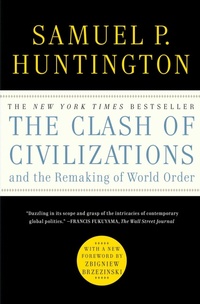
The Clash of Civilizations and the Remaking of World Order
Published on 31. May 2007
368 pages
978-1-4165-6124-8 (ISBN)
Description

The classic study of post-Cold War international relations, more relevant than ever in the post-9/11 world, with a new foreword by Zbigniew Brzezinski.
Since its initial publication, The Clash of Civilizations and the Remaking of World Order has become a classic work of international relations and one of the most influential books ever written about foreign affairs. An insightful and powerful analysis of the forces driving global politics, it is as indispensable to our understanding of American foreign policy today as the day it was published. As former National Security Adviser Zbigniew Brzezinski says in his new foreword to the book, it ?has earned a place on the shelf of only about a dozen or so truly enduring works that provide the quintessential insights necessary for a broad understanding of world affairs in our time.?
Samuel Huntington explains how clashes between civilizations are the greatest threat to world peace but also how an international order based on civilizations is the best safeguard against war. Events since the publication of the book have proved the wisdom of that analysis. The 9/11 attacks and wars in Iraq and Afghanistan have demonstrated the threat of civilizations but have also shown how vital international cross-civilization cooperation is to restoring peace. As ideological distinctions among nations have been replaced by cultural differences, world politics has been reconfigured. Across the globe, new conflicts?and new cooperation?have replaced the old order of the Cold War era.
The Clash of Civilizations and the Remaking of World Order explains how the population explosion in Muslim countries and the economic rise of East Asia are changing global politics. These developments challenge Western dominance, promote opposition to supposedly ?universal? Western ideals, and intensify intercivilization conflict over such issues as nuclear proliferation, immigration, human rights, and democracy. The Muslim population surge has led to many small wars throughout Eurasia, and the rise of China could lead to a global war of civilizations. Huntington offers a strategy for the West to preserve its unique culture and emphasizes the need for people everywhere to learn to coexist in a complex, multipolar, muliticivilizational world.
Since its initial publication, The Clash of Civilizations and the Remaking of World Order has become a classic work of international relations and one of the most influential books ever written about foreign affairs. An insightful and powerful analysis of the forces driving global politics, it is as indispensable to our understanding of American foreign policy today as the day it was published. As former National Security Adviser Zbigniew Brzezinski says in his new foreword to the book, it ?has earned a place on the shelf of only about a dozen or so truly enduring works that provide the quintessential insights necessary for a broad understanding of world affairs in our time.?
Samuel Huntington explains how clashes between civilizations are the greatest threat to world peace but also how an international order based on civilizations is the best safeguard against war. Events since the publication of the book have proved the wisdom of that analysis. The 9/11 attacks and wars in Iraq and Afghanistan have demonstrated the threat of civilizations but have also shown how vital international cross-civilization cooperation is to restoring peace. As ideological distinctions among nations have been replaced by cultural differences, world politics has been reconfigured. Across the globe, new conflicts?and new cooperation?have replaced the old order of the Cold War era.
The Clash of Civilizations and the Remaking of World Order explains how the population explosion in Muslim countries and the economic rise of East Asia are changing global politics. These developments challenge Western dominance, promote opposition to supposedly ?universal? Western ideals, and intensify intercivilization conflict over such issues as nuclear proliferation, immigration, human rights, and democracy. The Muslim population surge has led to many small wars throughout Eurasia, and the rise of China could lead to a global war of civilizations. Huntington offers a strategy for the West to preserve its unique culture and emphasizes the need for people everywhere to learn to coexist in a complex, multipolar, muliticivilizational world.
More details
Other editions
Additional editions
Samuel P. Huntington
The Clash of Civilizations and the Remaking of World Order
Book
08/2011
Simon & Schuster
€19.00
Shipment within 10-20 days

Huntington
The Clash of Civilizations
Book
01/1998
Pocket Books
€35.04
Article exhausted; check for reprint
Person
Samuel P. Huntington was the Albert J. Weatherhead III University Professor at Harvard University, where he was also the director of the John M. Olin Institute for Stategic Studies and the chairman of the Harvard Academy for International and Area Studies. He was the director of security planning for the National Security Council in the Carter administration, the founder and coeditor of Foreign Policy, and the president of the American Political Science Association.
Content
- Cover
- Title Page
- Dedication
- Copyright Page
- Foreword
- Contents
- List of Illustrations: Tables, Figures, Maps
- Preface
- Part I: A World of Civilizations
- Chapter 1: The New Era in World Politics
- Introduction: Flags and Cultural Identity
- A Multipolar, Multicivilizational World
- Other Worlds?
- Comparing Worlds: Realism, Parsimony, And Predictions
- Chapter 2: Civilizations in History and Today
- The Nature of Civilizations
- Relations Among Civilizations
- Chapter 3: A Universal Civilization? Modernization and Westernization
- Universal Civilization: Meanings
- Universal Civilization: Sources
- The West and Modernization
- Responses to the West and Modernization
- Part II: The Shifting Balance of Civilizations
- Chapter 4: The Fading of the West: Power, Culture, And Indigenization
- Western Power: Dominance and Decline
- Indigenization: The Resurgence of Non-Western Cultures
- La Revanche De Dieu
- Chapter 5: Economics, Demography, and the Challenger Civilizations
- The Asian Affirmation
- The Islamic Resurgence
- Changing Challenges
- Part III: The Emerging Order of Civilizations
- Chapter 6: The Cultural Reconfiguration of Global Politics
- Groping For Groupings: The Politics of Identity
- Culture And Economic Cooperation
- The Structure of Civilizations
- Torn Countries: The Failure of Civilization Shifting
- Chapter 7: Core States, Concentric Circles, and Civilizational Order
- Civilizations and Order
- Bounding the West
- Russia and its Near Abroad
- Greater China and Its Co-Prosperity Sphere
- Islam: Consciousness Without Cohesion
- Part IV: Clashes of Civilizations
- Chapter 8: The West and the Rest: Intercivilizational Issues
- Western Universalism
- Weapons Proliferation
- Human Rights and Democracy
- Immigration
- Chapter 9: The Global Politics Of Civilizations
- Core State and Fault Line Conflicts
- Islam and the West
- Asia, China, and America
- Civilizations and Core States: Emerging Alignments
- Chapter 10: From Transition Wars to Fault Line Wars
- Transition Wars: Afghanistan and the Gulf
- Characteristics of Fault Line Wars
- Incidence: Islam'S Bloody Borders
- Causes: History, Demography, Politics
- Chapter 11: The Dynamics of Fault Line Wars
- Identity: The Rise of Civilization Consciousness
- Civilization Rallying: Kin Countries and Diasporas
- Halting Fault Line Wars
- Part V: The Future of Civilizations
- Chapter 12: The West, Civilizations, and Civilization
- The Renewal of the West?
- The West in the World
- Civilizational War and Order
- The Commonalities of Civilization
- Notes
- Index
- Footnotes
- footnote 1
- footnote 2
- footnote 3
- footnote 4
- footnote 5
- footnote 6
- footnote 7
- footnote 8
- footnote 9
