

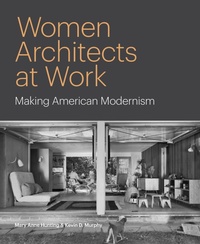
Women Architects at Work
Making American Modernism
1st Edition
Published on 18. February 2025
320 pages
978-0-691-26150-8 (ISBN)
Description

A comprehensive history of the women architects who left their enduring mark on American Modernism
In the decades preceding World War II, professional architecture schools enrolled increasing numbers of women, but career success did not come easily. Women Architects at Work tells the stories of the resilient and resourceful women who surmounted barriers of sexism, racism, and classism to take on crucial roles in the establishment and growth of Modernism across the United States.
Mary Anne Hunting and Kevin D. Murphy describe how the Cambridge School of Architecture and Landscape Architecture in Massachusetts evolved for the professional education of women between 1916 and 1942. While alumnae such as Eleanor Agnes Raymond, Victorine du Pont Homsey, and Sarah Pillsbury Harkness achieved some notoriety, others like Elizabeth-Ann Campbell Knapp and Louisa Vaughan Conrad have been largely absent from histories of Modernism. Hunting and Murphy describe how these innovative practitioners capitalized on social, educational, and professional ties to achieve success and used architecture to address social concerns, including how modernist ideas could engage with community and the environment. Some joined women-led architectural firms while others partnered with men or contributed to Modernism as retailers of household furnishings, writers and educators, photographers and designers, or fine artists.
With stunning illustrations, Women Architects at Work offers new histories of recognized figures while recovering the stories of previously unsung women, all of whom contributed to the modernization of American architecture and design.
In the decades preceding World War II, professional architecture schools enrolled increasing numbers of women, but career success did not come easily. Women Architects at Work tells the stories of the resilient and resourceful women who surmounted barriers of sexism, racism, and classism to take on crucial roles in the establishment and growth of Modernism across the United States.
Mary Anne Hunting and Kevin D. Murphy describe how the Cambridge School of Architecture and Landscape Architecture in Massachusetts evolved for the professional education of women between 1916 and 1942. While alumnae such as Eleanor Agnes Raymond, Victorine du Pont Homsey, and Sarah Pillsbury Harkness achieved some notoriety, others like Elizabeth-Ann Campbell Knapp and Louisa Vaughan Conrad have been largely absent from histories of Modernism. Hunting and Murphy describe how these innovative practitioners capitalized on social, educational, and professional ties to achieve success and used architecture to address social concerns, including how modernist ideas could engage with community and the environment. Some joined women-led architectural firms while others partnered with men or contributed to Modernism as retailers of household furnishings, writers and educators, photographers and designers, or fine artists.
With stunning illustrations, Women Architects at Work offers new histories of recognized figures while recovering the stories of previously unsung women, all of whom contributed to the modernization of American architecture and design.
More details
Other editions
Additional editions
Book
02/2025
Princeton University Press
€60.50
Shipment within 10-20 days
Persons
Mary Anne Hunting is an architectural historian and the author of Edward Durell Stone: Modernism's Populist Architect. Kevin D. Murphy is the Andrew W. Mellon Chair in the Humanities and professor and chair in the Department of the History of Art and Architecture at Vanderbilt University. His books include Jonathan Fisher of Blue Hill, Maine: Commerce, Culture, and Community on the Eastern Frontier.
Content
- Cover
- Contents
- Preface
- Introduction
- I. Early Experience and Education
- II. International Exchanges
- III. Forging Networks
- IV. Collaboration as a Primary Strategy
- V. The Enterprising Spirit
- VI. Houses and Housing
- VII. Creating Community
- VIII. Singular Statements
- Conclusion
- Acknowledgments
- Appendixes
- Notes
- Bibliography
- Index
- Illustration Credits
