

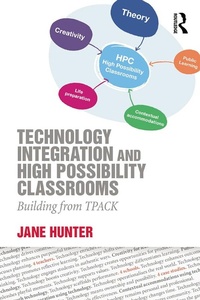
Technology Integration and High Possibility Classrooms
Building from TPACK
Published on 2. March 2015
218 pages
978-1-317-67096-4 (ISBN)
Description

Technology Integration and High Possibility Classrooms provides a fresh vision for education in schools based on new research from in-depth studies of technology integration in exemplary teachers' classrooms. This timely book meets the demand for more examples of effective technology integration by providing a new conceptual understanding that builds on the popular and highly influential theoretical framework of technological, pedagogical and content knowledge (TPACK).
Technology Integration and High Possibility Classrooms details four rich case studies set in different contexts with students ranging from age 6 to 16. Each case study articulates in very practical terms what characterizes exemplary teachers' knowledge of technology integration and how that is applied in classrooms. This highly accessible book clearly demonstrates how theory informs practice and provides new possibilities for learning in twenty-first-century schools.
Technology Integration and High Possibility Classrooms details four rich case studies set in different contexts with students ranging from age 6 to 16. Each case study articulates in very practical terms what characterizes exemplary teachers' knowledge of technology integration and how that is applied in classrooms. This highly accessible book clearly demonstrates how theory informs practice and provides new possibilities for learning in twenty-first-century schools.
Reviews / Votes
"Technology Integration and High Possibility Classrooms provides a wonderful look into classrooms to help readers understand how ambitious, effective teachers integrate technology into their teaching. Rather than focusing primarily on the tools, however, Hunter helps the reader to see technology integration through a robust theoretical lens in an approachable, engaging way. This significant contribution to the TPACK literature base is a must-read for doctoral students and classroom teachers who want to approach technology integration in a thoughtful, meaningful manner."Mark Hofer, Associate Professor of Educational Technology in the School of Education at the College of William & Mary, USA.
"Dr. Hunter's book is a valuable contribution to the field of technologies in education. Well-positioned in research and theory while offering a pleasant, engaging read, it uses an accessible framework to explore what occurs in the classroom and what is possible as we move into changing educational contexts. The cases used illustrate both the affordances and limitations of technologies in classrooms, as well as the need for strong professional learning to support teachers in choosing the most effective means for facilitating and representing student learning."
Debra Bateman, Associate Professor and Deputy Dean, Learning & Teaching, School of Global, Urban and Social Studies, RMIT University, Melbourne, Australia
"Hunter's text is an excellent exemplar for faculty teaching case study research, educational technology, or how theory impacts practice."
Gregory Zobel, Technical Communication
More details
Language
English
Place of publication
London
United Kingdom
Publishing group
Taylor & Francis Ltd
Target group
College/higher education
Illustrations
5 Tables, black and white
File size
1,60 MB
ISBN-13
978-1-317-67096-4 (9781317670964)
Copyright in bibliographic data and cover images is held by Nielsen Book Services Limited or by the publishers or by their respective licensors: all rights reserved.
Schweitzer Classification
Other editions
Additional editions
Book
03/2015
1st Edition
Routledge
€231.50
Shipment within 10-20 days
Book
03/2015
1st Edition
Routledge
€76.30
Shipment within 10-20 days
Person
Jane Hunter is a postdoctoral researcher in STEM education at the University of Technology Sydney, Australia. Prior to her appointment to UTS in early February 2016, she taught in teacher education at Western Sydney University and the University of Sydney and in many K-12 schools; more recently, she worked as a senior education officer in various technology, professional teaching standards, and curriculum projects in the NSW Department of Education.
Content
List of Illustrations
Foreword
Acknowledgments
Introduction: Why this book on technology integration now?
Global policy and education trends in technology integration in schools
Models of technology integration: TPACK, SAMR and HPC
Gabby's classroom: The early years
Gina's classroom: The elementary space
Nina's classroom: The middle years
Kitty's classroom: The high school
Creating high possibility classrooms: Using the model
Where to from here: Can all schools create high possibility classrooms?
Index
Foreword
Acknowledgments
Introduction: Why this book on technology integration now?
Global policy and education trends in technology integration in schools
Models of technology integration: TPACK, SAMR and HPC
Gabby's classroom: The early years
Gina's classroom: The elementary space
Nina's classroom: The middle years
Kitty's classroom: The high school
Creating high possibility classrooms: Using the model
Where to from here: Can all schools create high possibility classrooms?
Index
