

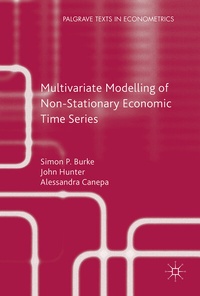
Multivariate Modelling of Non-Stationary Economic Time Series
Description

This book examines conventional time series in the context of stationary data prior to a discussion of cointegration, with a focus on multivariate models. The authors provide a detailed and extensive study of impulse responses and forecasting in the stationary and non-stationary context, considering small sample correction, volatility and the impact of different orders of integration. Models with expectations are considered along with alternate methods such as Singular Spectrum Analysis (SSA), the Kalman Filter and Structural Time Series, all in relation to cointegration. Using single equations methods to develop topics, and as examples of the notion of cointegration, Burke, Hunter, and Canepa provide direction and guidance to the now vast literature facing students and graduate economists.
More details
Other editions
Additional editions
Persons
Simon P. Burke studied econometrics at the University of Reading, UK. He has published in the International Journal of Forecasting , Journal of Financial Econometrics and The Oxford Bulletin of Economics & Statistics . He has taught econometrics, mathematics and statistics at Reading and Surrey Universities.
John Hunter studied econometrics at the London School of Economics, UK, under Denis Sargan. He published recently in the International Review of Financial Analysis, Economic Modelling and developed the notion of Cointegrating Exogeneity. He taught econometrics and financial modelling at Brunel, City, Queen Mary, Southampton and Surrey. He has consulted for HM Treasury, Oftel, OFT and KPN Mobile.
Alessandra Canepa studied econometrics at Southampton University, UK. She has published in Statistics & Probability Letters , the European Journal of Operational Research and Oxford Economic Papers . She currently lectures in econometrics and Risk Management at Brunel University, UK, and is a member of CARISMA in the Department of Mathematics at Brunel.
