

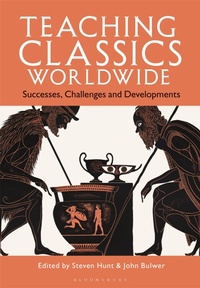
Teaching Classics Worldwide
Successes, Challenges and Developments
1st Edition
Published on 6. February 2025
480 pages
978-1-350-42763-1 (ISBN)
Description

Designed for instructors in schools and universities, as well as stakeholders and policy-makers in education everywhere, this book is a systematic guide to contemporary school teaching of classical languages, literature and civilisation in major countries across the world. This book examines the trends and assesses the rationale for such diversity in programmes of study and asks the question: What are classical subjects for in today's schools?
Each chapter is arranged by geographical area and draws on the experiences of teachers and other education experts in each country, commenting on contemporary practices. Themes such as the impact of national education policies, enrolment, assessment, accessibility and inclusion are discussed. The teaching of Classics has wide variations in practices and purposes from one education system to another: in some, the teaching of Classics continues to be focused on the mastery of language and grammar; in others, active use of the ancient languages is growing in popularity; and yet in others, the focus is shifting towards the study of the languages and civilisations in translation. Presenting an overview survey and comparison of practices across the world, this book is essential reading for instructors and teaching training courses in the world of classical education.
Each chapter is arranged by geographical area and draws on the experiences of teachers and other education experts in each country, commenting on contemporary practices. Themes such as the impact of national education policies, enrolment, assessment, accessibility and inclusion are discussed. The teaching of Classics has wide variations in practices and purposes from one education system to another: in some, the teaching of Classics continues to be focused on the mastery of language and grammar; in others, active use of the ancient languages is growing in popularity; and yet in others, the focus is shifting towards the study of the languages and civilisations in translation. Presenting an overview survey and comparison of practices across the world, this book is essential reading for instructors and teaching training courses in the world of classical education.
More details
Edition
1. Auflage
Language
English
Place of publication
London
United Kingdom
Publishing group
Bloomsbury Publishing PLC
Illustrations
30 bw illus
ISBN-13
978-1-350-42763-1 (9781350427631)
Copyright in bibliographic data and cover images is held by Nielsen Book Services Limited or by the publishers or by their respective licensors: all rights reserved.
Schweitzer Classification
Other editions
Additional editions
Book
02/2025
Bloomsbury Academic
€37.50
Shipment within 15-20 days
Persons
Steven Hunt is Associate Teaching Professor in Classics Education at the University of Cambridge, UK. He is Subject Lead for the PGCE in Latin and Classics and is editor of the Journal of Classics Teaching. He works extensively with the charity Classics for All to develop Classics in state schools in the UK. He is author of Starting to Teach Latin (Bloomsbury Academic, 2023) and Teaching Latin: Contexts, Theories and Practices (Bloomsbury Academic, 2022).He is co-editor of Communicative Approaches to Teaching Classical Languages (2021), Teaching Classics with Technology (Bloomsbury Academic, 2019) and Forward with Classics (Bloomsbury Academic, 2018).
John Bulwer is a former teacher of Latin at the European School, Brussels, Belgium, and former President of Euroclassica (2015-2019). He has been active in promoting Classics teaching in Europe over many years. He is editor of Classics Teaching in Europe (Bloomsbury Academic, 2006). He is currently Chief Examiner and Adviser for Latin for the European Baccalaureate and the European Schools.
John Bulwer is a former teacher of Latin at the European School, Brussels, Belgium, and former President of Euroclassica (2015-2019). He has been active in promoting Classics teaching in Europe over many years. He is editor of Classics Teaching in Europe (Bloomsbury Academic, 2006). He is currently Chief Examiner and Adviser for Latin for the European Baccalaureate and the European Schools.
Content
List of Figures
List of Contributors
Acknowledgements
Introduction, John Bulwer (Euroclassica, UK) and Steven Hunt (University of Cambridge, UK)
Part One: Europe and Russia
1. Austria, Peter Glatz (Sodalitas, Austria)
2. Belgium, Evelien Bracke (Ghent University, Belgium), Katja De Herdt, (Ghent University, Belgium), Paul Pietquin (University of Namur, Belgium), Nicolas Meunier (Université Catholique de Louvain, Belgium) and Charlotte Vanhalme (Université Libre de Bruxelles, Belgium)
3. Bosnia-Herzegovina, Drago Zuparic (University of Sarajevo, Bosnia and Herzegovina) and Sanja LjubiSic (University of Banja Luka, Bosnia and Herzegovina)
4. Bulgaria, Dimitar Dragnev (Sofia University St. Kliment Ohridski; New Bulgarian University, Bulgaria)
5. Croatia, Nada Bulic and Zdravka Martinic-Jercic (Philologorum Classicorum Societas Croatica, Croatia)
6. Cyprus, Pantelis Iacovou (Independent Scholar, Cyprus)
7. Czech Republic, Martina Vaníková (Univerzity Karlovy, Czech Republic)
8. Denmark, Rasmus Gottschalck (Klassikerforeningen, Denmark) and Anders Jensen (Gefion Gymnasium, Denmark)
9. Finland, Ilkka Kuivalainen, Robert Luther and Arto Rantamaa (Independent Scholars, Finland)
10. France, Florence Turpin (Coordination Nationale des Associations Régionales des Enseignants de Langues Anciennes, France)
11. Georgia, Irine Darchia (Tbilisi State University, Georgia)
12. Germany, Barbel Flaig (Deutscher Altphilologenverband, Germany)
13. Greece, Dimitrios Stamatis (National and Kapodistrian University of Athens, Greece)
14. Hungary, Attila Ferenczi (Eötvös Loránd University, Hungary) and Zoltán Gloviczki (Apor Vilmos Catholic College, Hungary)
15. Iceland, Geir Þ. Þórarinsson (University of Iceland, Iceland)
16. Ireland, Louise Maguire (Blackrock College, Ireland)
17. Italy, Daniela Canfarotta (Independent Scholar, Italy)
18. Lithuania, Nijole Juchneviciene (Vilnius University, Lithuania) and Raimonda Bruneviciute Independent Scholar, Lithuania)
19. Luxembourg, Frank Colotte (Association Luxembourgeoise des Professeurs de Latin et de Grec, Luxembourg)
20. Malta, Horatio Vella (Malta Classics Association, Malta)
21. The Netherlands, Suzanne Adema (Vereniging Classici Nederland, The Netherlands)
22. North Macedonia, Vesna Dimovska (ANTIKA Association of Classical Philologists, Macedonia) and Svetlana Kocovska-Stevovi? (Ss. Cyril and Methodius University in Skopje, North Macedonia)
23. Norway, Vibeke Roggen (University of Oslo, Norway) and Eirik Welo (Norsk Klassisk Forbund, Norway)
24. Poland, Katarzyna Marciniak (University of Warsaw, Poland), Janusz Ryba (Jagiellonian University, Poland), Barbara Strycharczyk (Liceum Strumienie Stowarzyszenia Sternik, Poland) and Anna Wojciechowska (Mikolaj Rej High School No. XI, Poland)
25. Portugal, Susana Marta Pereira (University of Lisbon, Portugal)
26. Romania, Theodor Georgescu (Societatea de Studii Clasice din Romania, Romania)
27. Russia, Elena Ermolaeva (Societas Russica Magistrorum Linguarum Classicarum, Russia)
28. Serbia, Boris Pendelj and Goran Vidovic (University of Belgrade, Serbia)
29. Slovenia, Miran Sajovic (Università Pontifica Salesiana, Italy)
30. Spain, Jose Luis Navarro (Sociedad Española de Estudios Clásicos, Spain)
31. Sweden, Axel Hörstedt (Independent Scholar, Sweden)
32. Switzerland, Antje-Marianne Kolde (Schweizerischer Altphilologenverband - Association Suisse des Philologues Classiques, Switzerland)
33. Turkey, Seda Sen (Baskent University, Turkey)
34. UK England, Aisha Khan-Evans (King's College London, UK)
35. UK Northern Ireland, Amber Taylor (Independent Scholar, UK) and Arlene Holmes-Henderson (Durham University, UK)
36. UK Scotland, Alex Imrie (University of Edinburgh, UK)
37. UK Wales, Danny Pucknell (Independent Scholar, UK)
38. Europe and Russia, Further Reading; Steven Hunt (University of Cambridge, UK) and John Bulwer (Euroclassica, UK)
Part Two: The Americas
39. Canada, Margaret-Anne Gillis (Classical Association of Ontario, Canada)
40. USA, Teresa Ramsby (University of Massachusetts Amherst, USA)
41. USA Hawaii, Arlene Holmes-Henderson (Durham University, UK)
41. Argentina, Alvaro Matias Moreno Leoni (Universidad Nacional de Córdoba, Argentina), Diego Alexander Olivera (Universidad Autónoma de Entre Ríos, Argentina) and Natalia Maria Ruiz de los Llanos (Universidad Nacional de Salta, Argentina)
42. Bolivia, Tatiana Alvarado Teodorika (Universidad Complutense de Madrid, Spain)
43. Brazil, Paula Corrêa (Universidade de São Paul, Brazil)
44. Chile, Leslie Lagos Aburto (Universidad de Concepción, Chile)
45. Venezuela, Mariano Nava (Universidad de Los Andes, Venezuela)
46. The Americas: Further Reading, Steven Hunt (University of Cambridge, UK)
Part Three: Australasia
47. Australia, Louella Perrett (Independent Scholar, Australia)
48. New Zealand, John Hayden (New Zealand Classical Association, New Zealand)
49. Australasia: Further Reading, Steven Hunt (University of Cambridge, UK)
Part Four: Middle East and Asia
50. China, Li Qiang (Northeast Normal University, China), Liu Jianchang (Northeast Normal University, China) and Li Hui (Beijing Foreign Studies University, China)
51. India, Mali Skotheim (Ashoka University, India)
52. Israel, Lisa Maurice (Bar-Ilan University, Israel)
53. Japan, Shiro Kawasima (Kyoto University, Japan)
54. Kurdistan (Iraq), Botan Maghdid (Soran University, Iraq)
55. Singapore and Malaysia, Steven Hunt (University of Cambridge, UK)
56. South Korea, Steven Hunt (University of Cambridge, UK) and Margaret Baird (Independent Scholar, South Korea)
57. Sri Lanka, Chandima Wickramasinghe (University of Peradeniya, Sri Lanka)
58. Middle East and Asia: Further Reading, Steven Hunt (University of Cambridge, UK)
Part Five: Africa
59. Egypt, Leslie Ivings (Independent Scholar, South Africa)
60. Ghana, Gifty Etornam Katahena (University of Ghana, Ghana)
61. Nigeria, Malawi, Uganda, Tanzania and Ivory Coast, Leslie Ivings (Independent Scholar, South Africa)
62. Senegal, John Bulwer (Euroclassica, UK)
63. South Africa, Simon Idema (Independent Scholar, South Africa)
64. Zimbabwe, Obert Mlambo (Rhodes University, South Africa)
65. Africa: Further Reading, Steven Hunt (University of Cambridge, UK)
Part Six: Other
66. International Schools, John Bulwer (Euroclassica, UK)
67. Informal and Online Learning, Steven Hunt (University of Cambridge, UK)
Index
List of Contributors
Acknowledgements
Introduction, John Bulwer (Euroclassica, UK) and Steven Hunt (University of Cambridge, UK)
Part One: Europe and Russia
1. Austria, Peter Glatz (Sodalitas, Austria)
2. Belgium, Evelien Bracke (Ghent University, Belgium), Katja De Herdt, (Ghent University, Belgium), Paul Pietquin (University of Namur, Belgium), Nicolas Meunier (Université Catholique de Louvain, Belgium) and Charlotte Vanhalme (Université Libre de Bruxelles, Belgium)
3. Bosnia-Herzegovina, Drago Zuparic (University of Sarajevo, Bosnia and Herzegovina) and Sanja LjubiSic (University of Banja Luka, Bosnia and Herzegovina)
4. Bulgaria, Dimitar Dragnev (Sofia University St. Kliment Ohridski; New Bulgarian University, Bulgaria)
5. Croatia, Nada Bulic and Zdravka Martinic-Jercic (Philologorum Classicorum Societas Croatica, Croatia)
6. Cyprus, Pantelis Iacovou (Independent Scholar, Cyprus)
7. Czech Republic, Martina Vaníková (Univerzity Karlovy, Czech Republic)
8. Denmark, Rasmus Gottschalck (Klassikerforeningen, Denmark) and Anders Jensen (Gefion Gymnasium, Denmark)
9. Finland, Ilkka Kuivalainen, Robert Luther and Arto Rantamaa (Independent Scholars, Finland)
10. France, Florence Turpin (Coordination Nationale des Associations Régionales des Enseignants de Langues Anciennes, France)
11. Georgia, Irine Darchia (Tbilisi State University, Georgia)
12. Germany, Barbel Flaig (Deutscher Altphilologenverband, Germany)
13. Greece, Dimitrios Stamatis (National and Kapodistrian University of Athens, Greece)
14. Hungary, Attila Ferenczi (Eötvös Loránd University, Hungary) and Zoltán Gloviczki (Apor Vilmos Catholic College, Hungary)
15. Iceland, Geir Þ. Þórarinsson (University of Iceland, Iceland)
16. Ireland, Louise Maguire (Blackrock College, Ireland)
17. Italy, Daniela Canfarotta (Independent Scholar, Italy)
18. Lithuania, Nijole Juchneviciene (Vilnius University, Lithuania) and Raimonda Bruneviciute Independent Scholar, Lithuania)
19. Luxembourg, Frank Colotte (Association Luxembourgeoise des Professeurs de Latin et de Grec, Luxembourg)
20. Malta, Horatio Vella (Malta Classics Association, Malta)
21. The Netherlands, Suzanne Adema (Vereniging Classici Nederland, The Netherlands)
22. North Macedonia, Vesna Dimovska (ANTIKA Association of Classical Philologists, Macedonia) and Svetlana Kocovska-Stevovi? (Ss. Cyril and Methodius University in Skopje, North Macedonia)
23. Norway, Vibeke Roggen (University of Oslo, Norway) and Eirik Welo (Norsk Klassisk Forbund, Norway)
24. Poland, Katarzyna Marciniak (University of Warsaw, Poland), Janusz Ryba (Jagiellonian University, Poland), Barbara Strycharczyk (Liceum Strumienie Stowarzyszenia Sternik, Poland) and Anna Wojciechowska (Mikolaj Rej High School No. XI, Poland)
25. Portugal, Susana Marta Pereira (University of Lisbon, Portugal)
26. Romania, Theodor Georgescu (Societatea de Studii Clasice din Romania, Romania)
27. Russia, Elena Ermolaeva (Societas Russica Magistrorum Linguarum Classicarum, Russia)
28. Serbia, Boris Pendelj and Goran Vidovic (University of Belgrade, Serbia)
29. Slovenia, Miran Sajovic (Università Pontifica Salesiana, Italy)
30. Spain, Jose Luis Navarro (Sociedad Española de Estudios Clásicos, Spain)
31. Sweden, Axel Hörstedt (Independent Scholar, Sweden)
32. Switzerland, Antje-Marianne Kolde (Schweizerischer Altphilologenverband - Association Suisse des Philologues Classiques, Switzerland)
33. Turkey, Seda Sen (Baskent University, Turkey)
34. UK England, Aisha Khan-Evans (King's College London, UK)
35. UK Northern Ireland, Amber Taylor (Independent Scholar, UK) and Arlene Holmes-Henderson (Durham University, UK)
36. UK Scotland, Alex Imrie (University of Edinburgh, UK)
37. UK Wales, Danny Pucknell (Independent Scholar, UK)
38. Europe and Russia, Further Reading; Steven Hunt (University of Cambridge, UK) and John Bulwer (Euroclassica, UK)
Part Two: The Americas
39. Canada, Margaret-Anne Gillis (Classical Association of Ontario, Canada)
40. USA, Teresa Ramsby (University of Massachusetts Amherst, USA)
41. USA Hawaii, Arlene Holmes-Henderson (Durham University, UK)
41. Argentina, Alvaro Matias Moreno Leoni (Universidad Nacional de Córdoba, Argentina), Diego Alexander Olivera (Universidad Autónoma de Entre Ríos, Argentina) and Natalia Maria Ruiz de los Llanos (Universidad Nacional de Salta, Argentina)
42. Bolivia, Tatiana Alvarado Teodorika (Universidad Complutense de Madrid, Spain)
43. Brazil, Paula Corrêa (Universidade de São Paul, Brazil)
44. Chile, Leslie Lagos Aburto (Universidad de Concepción, Chile)
45. Venezuela, Mariano Nava (Universidad de Los Andes, Venezuela)
46. The Americas: Further Reading, Steven Hunt (University of Cambridge, UK)
Part Three: Australasia
47. Australia, Louella Perrett (Independent Scholar, Australia)
48. New Zealand, John Hayden (New Zealand Classical Association, New Zealand)
49. Australasia: Further Reading, Steven Hunt (University of Cambridge, UK)
Part Four: Middle East and Asia
50. China, Li Qiang (Northeast Normal University, China), Liu Jianchang (Northeast Normal University, China) and Li Hui (Beijing Foreign Studies University, China)
51. India, Mali Skotheim (Ashoka University, India)
52. Israel, Lisa Maurice (Bar-Ilan University, Israel)
53. Japan, Shiro Kawasima (Kyoto University, Japan)
54. Kurdistan (Iraq), Botan Maghdid (Soran University, Iraq)
55. Singapore and Malaysia, Steven Hunt (University of Cambridge, UK)
56. South Korea, Steven Hunt (University of Cambridge, UK) and Margaret Baird (Independent Scholar, South Korea)
57. Sri Lanka, Chandima Wickramasinghe (University of Peradeniya, Sri Lanka)
58. Middle East and Asia: Further Reading, Steven Hunt (University of Cambridge, UK)
Part Five: Africa
59. Egypt, Leslie Ivings (Independent Scholar, South Africa)
60. Ghana, Gifty Etornam Katahena (University of Ghana, Ghana)
61. Nigeria, Malawi, Uganda, Tanzania and Ivory Coast, Leslie Ivings (Independent Scholar, South Africa)
62. Senegal, John Bulwer (Euroclassica, UK)
63. South Africa, Simon Idema (Independent Scholar, South Africa)
64. Zimbabwe, Obert Mlambo (Rhodes University, South Africa)
65. Africa: Further Reading, Steven Hunt (University of Cambridge, UK)
Part Six: Other
66. International Schools, John Bulwer (Euroclassica, UK)
67. Informal and Online Learning, Steven Hunt (University of Cambridge, UK)
Index
