

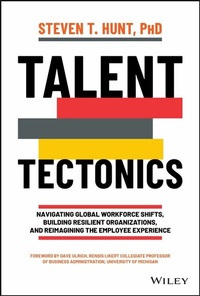
Talent Tectonics
Description

Shifting demographics combined with the digitalization of all aspects of life are transforming the nature of work. This is forcing companies to rethink how they design jobs and recruit, develop, and engage employees.
In Talent Tectonics: Navigating Global Workforce Shifts, Building Resilient Organizations, and Reimagining the Employee Experience, Dr. Steven Hunt explains how technology is changing the purpose of work and why creating effective employee experiences is critical to building organizations that can thrive in a world of accelerating change and growing skill shortages.
In the book, you'll find insights from the perspective of a person who has worked with thousands of companies around the globe using technology to build effective workforces. The book explores how business strategy, organizational psychology, and work technology interact to create nimble companies. The book discusses the future, but its focus is on the present, identifying things companies can do now to attract critical talent and create resilient organizations including:
* How to manage different types of employee experiences to create engaged and adaptable workforces
* How technology can enable large organizations to act more like small, agile, entrepreneurial companies.
* Rethinking employee recruitment, development, and engagement to create supportive, inclusive, and resilient organizational cultures
Perfect for human resources professionals, employee experience managers, and business leaders responsible for building effective workforces, Talent Tectonics belongs in the libraries of every leader, employee, and professional invested in ensuring that their organization can attract, retain, and develop the talent needed to achieve its strategic goals.
More details
Other editions
Additional editions
Person
STEVEN T. HUNT, PHD, is the Chief Expert of Work & Technology at SAP. His work focuses on the design and use of technology-enabled processes to improve workforce agility, productivity, experience, engagement, and well-being. He is an internationally renowned industrial-organizational psychologist.
Content
Acknowledgments 7
Foreword by Dave Ulrich 9
Introduction: How We Managed People in the Past Will Not Work in the Future 11
Content Overview 14
The Vocabulary Used in This Book 20
Applying These Concepts to the World You Live and Work In 22
Chapter 1: Talent Tectonics: Forces Reshaping Work and Workforces 23
The Impacts of Digitalization 26
The Impacts of Demographics 33
Applying These Concepts to the World You Live In 41
Chapter 2: Employee Experience and Workforce Adaptability 42
People: A Constant Resource in a Changing World 44
Employee Experience and Workforce Adaptability 47
Creating Effective Employee Experiences 49
Employee Experience Management and Business Performance 51
Understanding and Improving Employee Experiences 52
Addressing the Subjective Nature of Employee Experience 55
Employee Experience and Organizational Stakeholders 57
Applying the Concepts in This Chapter to Your Organization and Work Environment 60
Chapter 3: Work Technology and Organizational Agility 62
What It Means to Act like a Small, Agile Entrepreneurial Company 65
What Needs to Be Automated and Augmented to Create More Agile Organizations 68
How Work Technology Is Transforming Workforce Management 72
Workforce Orchestration Technology Solutions 75
Workforce Collaboration Technology Solutions 78
General Workforce Technology Applications 80
Linking Work Technology to Business Operations Technology 84
Adaptability, Technology, and Culture 86
Applying These Concepts to the World You Live In 88
Chapter 4: Designing Organizations to Provide Positive Employee Experiences 90
Why People Join Organizations 93
How Job Design Affects Employee Experience 95
How the Design of Groups, Teams, and Departments Affects Employee Experience 102
How Management and Leadership Structures Affect Employee Experience 105
Managing Restructurings and Downsizings with Experience in Mind 108
How Work Technology Is Influencing the Design of Organizations 111
Applying These Concepts to the World You Live In 113
Chapter 5: Filling Positions and the Experience of Moving into New Roles 114
How Job Design Affects Staffing 117
Selecting Candidates and Getting the Right Fit 125
Transitioning, Welcoming, and Departing 126
Dynamic and Temporary Staffing 129
How Work Technology Is Changing the Ways Organizations Fill Positions 131
Applying These Concepts to the World You Live In 133
Chapter 6: Developing Capabilities and the Employee Experience of Learning 135
Context: Designing Jobs That Motivate and Enable People to Develop 138
Capabilities: Helping Employees Define Development Goals 142
Content: Giving Employees Access to Resources to Build New Capabilities 148
Culture: Creating an Organizational Environment That Supports Development 150
Applying These Concepts to the World You Live In 152
Chapter 7: Creating Engagement and Employee Experiences That Inspire Successful Performance 153
The Performance Management Dilemma 156
Aligning Performance Expectations 159
Increasing Awareness of Performance 161
Managing Differences in Performance 166
Compensation and Performance 173
Applying These Concepts to the World You Live In 179
Chapter 8: Increasing Efficiency, Ensuring Compliance and Security, and Building Culture 181
What It Means for an Organization to Value Something 183
Increasing Efficiency: Valuing Employees' Time 185
Managing Risks: Valuing Employees' Security, Legal Rights, and Safety 188
Employee Experience and Organizational Safety Climate 192
Employee Experience and Corporate Ethics 193
Building Socially Responsible Cultures: Valuing the Wellbeing of Employees and Their Communities 193
Applying These Concepts to the World You Live In 200
Chapter 9: Using Employee Data to Guide Business Decisions 202
Understanding the Value of Employee Data 204
Having Useful Employee Data 206
Being Aware of Employee Data 208
Knowing How to Interpret Employee Data 211
Managing Employee Data Risks 214
Linking Employee Data to Business Results 216
Applying Concepts in This Chapter to the World You Live In 217
Chapter 10: Changing Employee Experience 220
Knowing What to Change 222
Expertise and Influence 225
Understanding Available Technology 228
Gaining Support and Cooperation 231
Applying Concepts in This Chapter to the World You Live In 235
Chapter 11: Employee Experience and the External Environment 237
Blending Education and Work 240
Maximizing Labor Force Potential 244
Technological Accessibility 247
Corporate Social Advocacy 248
Applying Concepts in This Chapter to the World You Live In 249
Chapter 12: Where Do We Go from Here? Shaping the Future of Employee Experience 251
Applying Concepts in This Chapter to the World You Live In 254
Appendix: The Peloton Model of Team Performance 259
References 263
About the Author 8
Index
Introduction: How We Managed People in the Past Will Not Work in the Future
Why Are We Still Using Management Methods Created During the Roman Empire?
Many roads and buildings in Europe can be traced to the Roman Empire. In some cases, people literally walk on stones placed more than 2,000 years ago. Many other inventions created by the Romans also continue to shape our lives. Some endured because they still work, such as crop rotation in farming. Others are still used because they are familiar, even if they are not very effective. Hierarchical organization structures and the associated "org charts" used by companies belong in this category (see Figure I.1). Org charts categorize workforces based on how they are connected via higher level leadership positions. If the person in the role of "Governor of Imperial Provinces" on the left of Figure I.1 had an issue with the "Administrator of Rome and Italy" on the right they would first go to their leader the "Amici Caesaris," who would talk to the "Proco. Imp. Maius," who would then communicate to the "Consilium Semestre," who would finally tell the "Admin of Rome and Italy." This top-down method for workforce management has been familiar to leaders since the Roman Empire, but it has significant limitations when applied to the modern workforce.
Hierarchical organizational structures were created to manage workforces during a time when work was largely defined by geography. Prior to the 21st century, where people physically lived heavily influenced the work they did and whom they worked with. Team members all worked in the same building with their immediate leaders. Org charts usually mirrored how the workforce was structured geographically.
The rise of the internet economy has created a split among people's location, roles, and work relationships. Teams are no longer constrained by geography. It is common for people to work in one city, report to a manager in another city, and collaborate with people across the world. Org charts might accurately reflect how a company reports financial numbers, but they contain little information about the roles, social interactions, and relationships that drive profit and loss. Where an employee is placed on an org chart, it may tell little about what they do or who they work with. The continued use of org charts also reflects a top-down leadership style that is antithetical to the cross-functional nature of most modern organizations. It implies that decision-making authority resides in roles higher up the chart, which disempowers frontline employees to act quickly. Because org charts often provide little insight into what people actually do or how they work together, using org charts to guide workforce decisions can also result in inadvertently firing the wrong people and disrupting team relationships that are critical to a company's performance. I have known multiple companies that let employees go based on their positions on an org chart, only to discover these people were doing work that was critical to the company's performance. In several cases, they had to rehire the people as contractors at much higher pay rates with much lower levels of organizational commitment.
FIGURE I.1 Roman hierarchical organizational leadership structure.1
Source: The Government of the Roman Empire Under early Principate. (n.d.). [Gif]. Fordham University. https://sourcebooks.fordham.edu/ancient/spqr-under-augustus.gif
Innovations in technology have created tools that are far superior to org charts for capturing information about the employee roles, skills, and relationships that make a company function.2 Relatively few companies have adopted these tools largely because it would require leaders to change how they make decisions. At some point, leaders will stop clinging to their love of org charts. When that day comes, employees will rejoice in seeing org charts jettisoned to join bronze swords, lead plumbing, and other things from the Romans that were once useful but are now at best inefficient and at worst harmful.
The purpose of this book is to help organizations build workforces for a future that is very different from the past. It discusses how the twin "talent tectonic" forces of digitalization and demographics are changing the nature and purpose of work. It explains the psychology of employee experience and why it is critical to building adaptable organizations that can thrive in a world of accelerating change and frequent skill shortages. It discusses how to integrate business strategy, psychology, and technology to create more nimble companies. And it explains why we must move beyond ineffective workforce management methods based on outdated technology such as hierarchical org charts.
This book discusses the future, but its focus is on the present, identifying things companies can do now to attract talent and create resilient organizations. It also talks about the one thing about work that is not changing: the psychology of the people who work in organizations and how employee experience influences their engagement, performance, and adaptability. This book looks at these topics from the perspective of an industrial-organizational psychologist who has helped thousands of companies around the world use technology to build effective workforces. Few people have viewed the future of work from this particular angle. The book is based on engagements with organizations spanning virtually every industry.i It also incorporates a range of research from industrial-organizational psychology, management science, socioeconomics, and related fields. The book is a product of extensive experience working at the intersection of people, technology, and work. My goal as an author is to draw on this experience to share business insights you may not have considered and practical psychological knowledge you may not have encountered. The book includes fairly extensive citations if you wish to dive more deeply into the science and data underlying many of these concepts and observations.
The book provides guidance on how to attract, retain, develop, engage, and manage people for a new world of work, keeping in mind there is no one best way to manage workforces. My career involves working with companies over multiple years and I have seen how workforce management techniques play out over time. Theoretically well-designed processes often fail in application. Methods that work in one company fail in others, and methods that worked in one company at one time may not work later based on changing technologies, leadership characteristics, and company resources. It is critical to determine what solutions are appropriate for an organization given its unique culture, business needs, and resource constraints. Each chapter in the book ends with a set of questions to discuss with company leaders, managers, and/or employees to determine what makes sense for the organizations you work with. A goal of this book is to help you understand why these questions matter, when they are important to discuss, and what to consider when answering them.
Content Overview
The book is meant to be read from front to back. However, each chapter stands on its own for readers who are interested in specific topics. The first three chapters address changes reshaping work and workforce management. The remaining chapters provide guidance on how to respond to these changes. The content of the chapters is summarized next.
Forces Reshaping Work and Workforces (Chapter 1). The phrase talent tectonics describes fundamental shifts reshaping work and organizations. The two biggest shifts are the accelerating pace of change caused by digitalization and the reshaping of labor markets caused by demographic changes in birth rates and life spans.
- Digitalization. As technological innovation expands into every facet of life it increases the speed of change. This affects multiple aspects of corporate life including company survival. The life span of companies is growing shorter while the acquisition rate of companies has steadily increased.3 Companies are restructuring faster than ever before. Industries are being altered with changes in one industry creating changes in another. For example, the shift to electric cars is transforming the automotive industry but also has massive implications for the energy, transportation, mining, oil and gas, and manufacturing industries.4 This level of change is also playing out at the level of individual jobs. Automation is eliminating long-standing tasks while creating new types of work.5 Even enduring professions such as land surveying, which dates back to the ancient Egyptians, are being completely altered by inventions such as satellite and drone technology. Whatever a company or job looks like now, it will almost certainly be different in three years.
- Demographics. People are living longer and having fewer children, and not just by a small amount. The life expectancy in the US has increased by 38 years since 1910.6 The generation of workers currently entering the economy can expect to live about one-third longer than their great-grandparents. At the same time, the global birth rate has declined by 51% since 1950.7 In many countries more people are leaving the labor market than entering it.8 Barring catastrophic events such as wars, this has never happened in modern history. It is creating growing labor shortages and redefining job markets. Companies are already struggling to find...
