

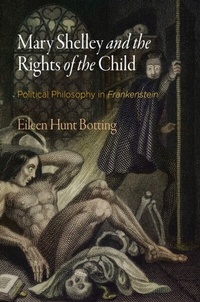
Mary Shelley and the Rights of the Child
Political Philosophy in "Frankenstein"
1st Edition
Published on 9. October 2017
232 pages
978-0-8122-9447-7 (ISBN)
Description

From her youth, Mary Shelley immersed herself in the social contract tradition, particularly the educational and political theories of John Locke and Jean-Jacques Rousseau, as well as the radical philosophies of her parents, the feminist Mary Wollstonecraft and the anarchist William Godwin. Against this background, Shelley wrote Frankenstein; or, the Modern Prometheus, first published in 1818. In the two centuries since, her masterpiece has been celebrated as a Gothic classic and its symbolic resonance has driven the global success of its publication, translation, and adaptation in theater, film, art, and literature. However, in Mary Shelley and the Rights of the Child, Eileen Hunt Botting argues that Frankenstein is more than an original and paradigmatic work of science fiction-it is a profound reflection on a radical moral and political question: do children have rights?
Botting contends that Frankenstein invites its readers to reason through the ethical consequences of a counterfactual premise: what if a man had used science to create a human life without a woman? Immediately after the Creature's "birth," his scientist-father abandons him and the unjust and tragic consequences that follow form the basis of Frankenstein's plot. Botting finds in the novel's narrative structure a series of interconnected thought experiments that reveal how Shelley viewed Frankenstein's Creature for what he really was-a stateless orphan abandoned by family, abused by society, and ignored by law. The novel, therefore, compels readers to consider whether children have the right to the fundamental means for their development as humans-namely, rights to food, clothing, shelter, care, love, education, and community.
In Botting's analysis, Frankenstein emerges as a conceptual resource for exploring the rights of children today, especially those who are disabled, stateless, or genetically modified by medical technologies such as three-parent in vitro fertilization and, perhaps in the near future, gene editing. Mary Shelley and the Rights of the Child concludes that the right to share love and community, especially with parents or fitting substitutes, belongs to all children, regardless of their genesis, membership, or social status.
Botting contends that Frankenstein invites its readers to reason through the ethical consequences of a counterfactual premise: what if a man had used science to create a human life without a woman? Immediately after the Creature's "birth," his scientist-father abandons him and the unjust and tragic consequences that follow form the basis of Frankenstein's plot. Botting finds in the novel's narrative structure a series of interconnected thought experiments that reveal how Shelley viewed Frankenstein's Creature for what he really was-a stateless orphan abandoned by family, abused by society, and ignored by law. The novel, therefore, compels readers to consider whether children have the right to the fundamental means for their development as humans-namely, rights to food, clothing, shelter, care, love, education, and community.
In Botting's analysis, Frankenstein emerges as a conceptual resource for exploring the rights of children today, especially those who are disabled, stateless, or genetically modified by medical technologies such as three-parent in vitro fertilization and, perhaps in the near future, gene editing. Mary Shelley and the Rights of the Child concludes that the right to share love and community, especially with parents or fitting substitutes, belongs to all children, regardless of their genesis, membership, or social status.
Reviews / Votes
"Botting's intervention in Frankenstudies is an important one." (Times Literary Supplement) "Mary Shelley and the Rights of the Child, in its passion and commitments, vividly illustrates Frankenstein's continuing power, two hundred years on, to comment on the pressing political issues of the day." (Modern Philology) ""One sets a very high bar in claiming that a book on Frankenstein advances a new, important reading-especially one appearing in 2018, when worldwide commemorations of the bicentenary of the first edition are focusing unprecedented attention on Shelley's novel. But such a feat is ventured and gained by Eileen Hunt Botting's Mary Shelley and the Rights of the Child"" (The Modern Language Review) "Treating the creature as an abandoned and abused child, Eileen Hunt Botting brilliantly uses the novel Frankenstein to mount a series of thought experiments that interrogate the enduring political questions of whether children have rights and, if so, which ones. Deftly summarizing the positions of such writers as Hobbes, Rousseau, Wollstonecraft, and Onora O'Neill, Botting persuasively argues for a child's universal rights to care, identity, and love-rights that Botting here extends to disabled, stateless, and genetically modified children." (Anne K. Mellor, University of California, Los Angeles) "While there has been a great deal written within literary theory and criticism on the novel Frankenstein, and there is a substantial, and growing, literature within moral and political philosophy on the rights of children and the obligations of parents, Mary Shelley and the Rights of the Child is the first book to bring these two areas of inquiry together. Eileen Hunt Botting's fascinating analysis shows how literary texts, suitably reinterpreted, can make better sense of key philosophical claims." (David Archard, Queen's University Belfast) "Readers of Mary Shelley and the Rights of the Child will never again be able to read Frankenstein simply as a work of Gothic fiction that questioned the counter-theology and scientific bravado of its day. Eileen Hunt Botting, more thoroughly than any previous commentator, has revealed the philosophical content of Mary Shelley's Frankenstein and has firmly placed it in the context of modern political thought." (Gordon Schochet, Rutgers University)More details
Series
Language
English
Place of publication
Pennsylvania
United States
Target group
College/higher education
File size
1,08 MB
ISBN-13
978-0-8122-9447-7 (9780812294477)
Copyright in bibliographic data and cover images is held by Nielsen Book Services Limited or by the publishers or by their respective licensors: all rights reserved.
Schweitzer Classification
Other editions
Additional editions
Book
09/2019
University of Pennsylvania Press
€28.50
Shipment within 10-20 days
Book
11/2017
University of Pennsylvania Press
€42.00
Shipment within 10-20 days
Person
Eileen Hunt Botting is Professor of Political Science at the University of Notre Dame and author of Wollstonecraft, Mill, and Women's Human Rights and Family Feuds: Wollstonecraft, Burke, and Rousseau on the Transformation of the Family.
Content
Preface. Welcome to the Creature Double Feature
Introduction. Frankenstein and the Question of Children's Rights
Chapter 1. The Specter of the Stateless Orphan from Hobbes to Shelley
Chapter 2. Wollstonecraft's Philosophy of Children's Rights
Chapter 3. Shelley's Thought Experiments on the Rights of the Child
Chapter 4. Three Applications of Shelley's Thought Experiments: The Rights of Disabled, Stateless, and Posthuman Children
Notes
Index
Acknowledgments
Introduction. Frankenstein and the Question of Children's Rights
Chapter 1. The Specter of the Stateless Orphan from Hobbes to Shelley
Chapter 2. Wollstonecraft's Philosophy of Children's Rights
Chapter 3. Shelley's Thought Experiments on the Rights of the Child
Chapter 4. Three Applications of Shelley's Thought Experiments: The Rights of Disabled, Stateless, and Posthuman Children
Notes
Index
Acknowledgments
