

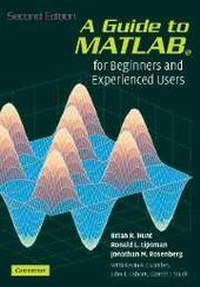
A Guide to MATLAB
For Beginners and Experienced Users
2nd Edition
Published on 27. June 2006
978-0-511-21775-3 (ISBN)
Description

This is a short, focused introduction to MATLAB, a comprehensive software system for mathematical and technical computing. It contains concise explanations of essential MATLAB commands, as well as easily understood instructions for using MATLAB's programming features, graphical capabilities, simulation models, and rich desktop interface. Written for MATLAB 7, it can also be used with earlier (and later) versions of MATLAB. This book teaches how to graph functions, solve equations, manipulate images, and much more. It contains explicit instructions for using MATLAB's companion software, Simulink, which allows graphical models to be built for dynamical systems. MATLAB's new "publish" feature is discussed, which allows mathematical computations to be combined with text and graphics, to produce polished, integrated, interactive documents. For the beginner it explains everything needed to start using MATLAB, while experienced users making the switch to MATLAB 7 from an earlier version will also find much useful information here.
This is a short, focused introduction to MATLAB, a comprehensive software system for mathematical and technical computing. It contains concise explanations of essential MATLAB commands, as well as easily understood instructions for using MATLAB's programming features, graphical capabilities, simulation models, and rich desktop interface. Written for MATLAB 7, it can also be used with earlier (and later) versions of MATLAB. This book teaches how to graph functions, solve equations, manipulate images, and much more. It contains explicit instructions for using MATLAB's companion software, Simulink, which allows graphical models to be built for dynamical systems. MATLAB's new "publish" feature is discussed, which allows mathematical computations to be combined with text and graphics, to produce polished, integrated, interactive documents. For the beginner it explains everything needed to start using MATLAB, while experienced users making the switch to MATLAB 7 from an earlier version will also find much useful information here.
This is a short, focused introduction to MATLAB, a comprehensive software system for mathematical and technical computing. It contains concise explanations of essential MATLAB commands, as well as easily understood instructions for using MATLAB's programming features, graphical capabilities, simulation models, and rich desktop interface. Written for MATLAB 7, it can also be used with earlier (and later) versions of MATLAB. This book teaches how to graph functions, solve equations, manipulate images, and much more. It contains explicit instructions for using MATLAB's companion software, Simulink, which allows graphical models to be built for dynamical systems. MATLAB's new "publish" feature is discussed, which allows mathematical computations to be combined with text and graphics, to produce polished, integrated, interactive documents. For the beginner it explains everything needed to start using MATLAB, while experienced users making the switch to MATLAB 7 from an earlier version will also find much useful information here.
Reviews / Votes
'Major highlights of the book are completely transparent examples of classical yet always intriguing mathematical, statistical, engineering, economics, and physics problems. In addition, the book explains a seamless use with Microsoft Word for integrating MATLAB outputs with documents, reports, presentations, or other on-line processes. Advanced topics with examples include: Monte Carlo simulation, population dynamics, and Linear Programming. Overall, it is an outstanding textbook, and, likewise, should be an integral part of the technical reference shelf for most IT professionals. It is a great resource for wherever MATLAB is available!' ACM Ubiquity 'This is a short, focused introduction to MATLAB, a comprehensive software system for mathematical and technical computing. For the beginner it explains everything needed to start using MATLAB, while experienced users making the switch to MATLAB 7 from an earlier version will find much useful information here.' L'enseignement mathematique'Major highlights of the book are completely transparent examples of classical yet always intriguing mathematical, statistical, engineering, economics, and physics problems. In addition, the book explains a seamless use with Microsoft Word for integrating MATLAB outputs with documents, reports, presentations, or other on-line processes. Advanced topics with examples include: Monte Carlo simulation, population dynamics, and Linear Programming. Overall, it is an outstanding textbook, and, likewise, should be an integral part of the technical reference shelf for most IT professionals. It is a great resource for wherever MATLAB is available!' ACM Ubiquity
'This is a short, focused introduction to MATLAB, a comprehensive software system for mathematical and technical computing. For the beginner it explains everything needed to start using MATLAB, while experienced users making the switch to MATLAB 7 from an earlier version will find much useful information here.' L'enseignement mathematique
More details
Edition
2nd Revised edition
Language
English
Place of publication
Cambridge
United Kingdom
Publishing group
Cambridge University Press
Target group
College/higher education
Professional and scholarly
Edition type
Revised edition
Illustrations
Worked examples or Exercises; 145 Line drawings, unspecified
File size
2,68 MB
ISBN-13
978-0-511-21775-3 (9780511217753)
Copyright in bibliographic data and cover images is held by Nielsen Book Services Limited or by the publishers or by their respective licensors: all rights reserved.
Schweitzer Classification
Other editions
Additional editions
Brian R. Hunt | Ronald L. Lipsman | Jonathan M. Rosenberg
A Guide to MATLAB
For Beginners and Experienced Users
Book
06/2006
2nd Edition
Cambridge University Press
€49.51
Article exhausted; check for reprint
Persons
Brian R. Hunt is an Associate Professor of Mathematics at the University of Maryland. Ronald L. Lipsman is a Professor of Mathematics and Associate Dean of the College of Computer, Mathematical and Physical Sciences at the University of Maryland. Jonathon M. Rosenberg is a Professor of Mathematics at the University of Maryland. Kevin R. Coombes is an Associate Professor of Biostatistics and Biomathematics at the M.D. Anderson Cancer Center, University of Texas. John E. Osborn is a Professor of Mathematics at the University of Maryland. Garrett J. Stuck is a Professor of Mathematics at the University of Maryland.
Brian R. Hunt is an Associate Professor of Mathematics at the University of Maryland. Ronald L. Lipsman is a Professor of Mathematics and Associate Dean of the College of Computer, Mathematical and Physical Sciences at the University of Maryland. Jonathon M. Rosenberg is a Professor of Mathematics at the University of Maryland. Kevin R. Coombes is an Associate Professor of Biostatistics and Biomathematics at the M.D. Anderson Cancer Center, University of Texas. John E. Osborn is a Professor of Mathematics at the University of Maryland. Garrett J. Stuck is a Professor of Mathematics at the University of Maryland.
Brian R. Hunt is an Associate Professor of Mathematics at the University of Maryland. Ronald L. Lipsman is a Professor of Mathematics and Associate Dean of the College of Computer, Mathematical and Physical Sciences at the University of Maryland. Jonathon M. Rosenberg is a Professor of Mathematics at the University of Maryland. Kevin R. Coombes is an Associate Professor of Biostatistics and Biomathematics at the M.D. Anderson Cancer Center, University of Texas. John E. Osborn is a Professor of Mathematics at the University of Maryland. Garrett J. Stuck is a Professor of Mathematics at the University of Maryland.
Content
Preface; 1. Getting started; 2. MATLAB basics; 3. Interacting with MATLAB; 4. Beyond the basics; 5. MATLAB graphics; 6. M-Books; 7. MATLAB programming; 8. SIMULINK and GUIs; 9. Applications; 10. MATLAB and the internet; 11. Troubleshooting; Solutions to the practice sets; Glossary; Index.
