
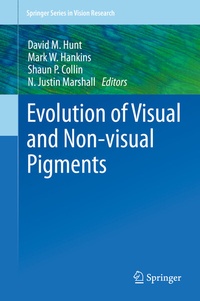
Evolution of Visual and Non-visual Pigments
Description
Alles über E-Books | Antworten auf Fragen rund um E-Books, Kopierschutz und Dateiformate finden Sie in unserem Info- & Hilfebereich.
Photopigments are molecules that react to light and mediate a number of processes and behaviours in animals. Visual pigments housed within the photoreceptors of the eye, such as the rods and cones in vertebrates are the best known, however, visual pigments are increasingly being found in other tissues, including other retinal cells, the skin and the brain. Other closely related molecules from the G protein family, such as melanopsin mediate light driven processes including circadian rhythmicity and pupil constriction. This Volume examines the enormous diversity of visual pigments and traces the evolution of these G protein coupled receptors in both invertebrates and vertebrates in the context of the visual and non-visual demands dictated by a species' ecological niche.
Reviews / Votes
"This is a bible of current research into the photochemistry, photobiology, and evolution of the visual systems and the pineal gland in vertebrates and invertebrates. . The book will benefit graduate students, seasoned investigators, and vision scientists interested in photoreceptors." (Joseph J. Grenier, Amazon.com, January, 2017)More details
Other editions
Additional editions

Content
System requirements
File format: PDF
Copy protection: Watermark-DRM (Digital Rights Management)
System requirements:
- Computer (Windows; MacOS X; Linux): Use the free software Adobe Reader, Adobe Digital Editions, or any other PDF viewer of your choice (see eBook Help).
- Tablet/Smartphone (Android; iOS): Install the free app Adobe Digital Editions or another reading app for eBooks, e.g., PocketBook (see eBook Help).
- E-reader: Bookeen, Kobo, Pocketbook, Sony, Tolino and many more (only limited: Kindle).
The file format PDF always displays a book page identically on any hardware. This makes PDF suitable for complex layouts such as those used in textbooks and reference books (images, tables, columns, footnotes). Unfortunately, on the small screens of e-readers or smartphones, PDFs are rather annoying, requiring too much scrolling.
This eBook uses Watermark-DRM, a „soft” copy protection. This means that there are no technical restrictions to prevent illegal distribution. However, there is a personalised watermark embedded in the eBook that can be used to identify the purchaser of the eBook in the event of misuse and to provide evidence for legal purposes.
For more information, see our eBook Help page.