

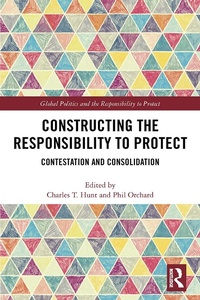
Constructing the Responsibility to Protect
Contestation and Consolidation
1st Edition
Published on 7. February 2020
206 pages
978-1-000-03568-1 (ISBN)
Description

This volume examines the ongoing construction of the Responsibility to Protect (R2P) doctrine, elaborating on areas of both consolidation and contestation.
The book focuses on how the R2P doctrine has been both consolidated and contested along three dimensions, regarding its meaning, status and application. The first focuses on how the R2P should be understood in a theoretical sense, exploring it through the lens of the International Relations constructivist approach and through different toolkits available to conventional and critical constructivists. The second focuses on how the R2P interacts with other normative frameworks, and how this interaction can lead to a range of effects from mutual reinforcement and co-evolution through to unanticipated feedback that can undermine consensus and flexibility. The third focuses on how key state actors - including the United States, China and Russia - understand, use and contest the R2P. Together, the book's chapters demonstrate that broad aspects of the R2P are consolidated in the sense that they are accepted by states even while other, specific aspects, remain subject to contestation in practice and in policy.
This book will be of much interest to students of the R2P, human rights, peace studies and international relations.
The book focuses on how the R2P doctrine has been both consolidated and contested along three dimensions, regarding its meaning, status and application. The first focuses on how the R2P should be understood in a theoretical sense, exploring it through the lens of the International Relations constructivist approach and through different toolkits available to conventional and critical constructivists. The second focuses on how the R2P interacts with other normative frameworks, and how this interaction can lead to a range of effects from mutual reinforcement and co-evolution through to unanticipated feedback that can undermine consensus and flexibility. The third focuses on how key state actors - including the United States, China and Russia - understand, use and contest the R2P. Together, the book's chapters demonstrate that broad aspects of the R2P are consolidated in the sense that they are accepted by states even while other, specific aspects, remain subject to contestation in practice and in policy.
This book will be of much interest to students of the R2P, human rights, peace studies and international relations.
More details
Series
Edition
1. Auflage
Language
English
Place of publication
London
United Kingdom
Publishing group
Taylor & Francis Ltd
Target group
College/higher education
Professional and scholarly
Illustrations
9 Tables, black and white; 1 Line drawings, black and white; 1 Illustrations, black and white
ISBN-13
978-1-000-03568-1 (9781000035681)
Copyright in bibliographic data and cover images is held by Nielsen Book Services Limited or by the publishers or by their respective licensors: all rights reserved.
Schweitzer Classification
Other editions
Additional editions
Charles T. Hunt | Phil Orchard
Constructing the Responsibility to Protect
Contestation and Consolidation
Book
09/2021
1st Edition
Routledge
€65.10
Shipment within 10-20 days
Charles T. Hunt | Phil Orchard
Constructing the Responsibility to Protect
Contestation and Consolidation
Book
02/2020
1st Edition
Routledge
€179.51
Shipment within 15-20 days
Persons
Charles T. Hunt is Vice-Chancellor's Senior Research Fellow and Australian Research Council DECRA Fellow at the Social & Global Studies Centre, RMIT University, Australia.
Phil Orchard is an Associate Professor of International Relations at the University of Wollongong, Australia.
Phil Orchard is an Associate Professor of International Relations at the University of Wollongong, Australia.
Content
Introduction: Consolidation and Contestation of the Responsibility to Protect Charles T. Hunt and Phil Orchard 1. Contestation, Norms, and the Responsibility to Protect as a Regime Phil Orchard 2. R2P and the Benefits of Norm Ambiguity Luke Glanville and Wesley W. Widmaier 3. Telling the Story of R2P: The Emplotment of R2P in the UN Security Council's debates on Libya Sassan Gholiagha and Bastian Loges 4. The Responsibility to Protect and the Protection of Civilians in UN Peace Operations: Interaction, feedback and co-evolution Charles T. Hunt 5. R2P and WPS: Operationalizing Prevention from Alignment Sara E. Davies and Sarah Hewitt 6. Strange Bedfellows: Terrorism/Counter-terrorism and the Responsibility to Protect Shannon Zimmerman 7. Resistance and Accommodation in China's Approach toward R2P Sarah Teitt 8. Russia and the R2P: Norm Entrepreneur, Anti-Preneur, or Violator? Phil Orchard and Heather Rae
