
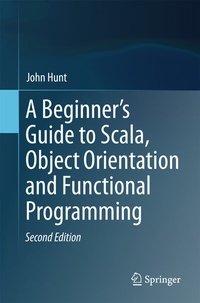
A Beginner's Guide to Scala, Object Orientation and Functional Programming
Description
Alles über E-Books | Antworten auf Fragen rund um E-Books, Kopierschutz und Dateiformate finden Sie in unserem Info- & Hilfebereich.
Scala is now an established programming language developed by Martin Oderskey and his team at the EPFL. The name Scala is derived from Sca(lable) La(nguage). Scala is a multi-paradigm language, incorporating object oriented approaches with functional programming.
Although some familiarity with standard computing concepts is assumed (such as the idea of compiling a program and executing this compiled from etc.) and with basic procedural language concepts (such as variables and allocation of values to these variables) the early chapters of the book do not assume any familiarity with object orientation nor with functional programming These chapters also step through other concepts with which the reader may not be familiar (such as list processing).
From this background, the book provides a practical introduction to both object and functional approaches using Scala. These concepts are introduced through practical experience taking the reader beyondthe level of the language syntax to the philosophy and practice of object oriented development and functional programming.Students and those actively involved in the software industry will find this comprehensive introduction to Scala invaluable.
More details
Other editions
Additional editions

Person
Content
System requirements
File format: PDF
Copy protection: Watermark-DRM (Digital Rights Management)
System requirements:
- Computer (Windows; MacOS X; Linux): Use the free software Adobe Reader, Adobe Digital Editions, or any other PDF viewer of your choice (see eBook Help).
- Tablet/Smartphone (Android; iOS): Install the free app Adobe Digital Editions or another reading app for eBooks, e.g., PocketBook (see eBook Help).
- E-reader: Bookeen, Kobo, Pocketbook, Sony, Tolino and many more (only limited: Kindle).
The file format PDF always displays a book page identically on any hardware. This makes PDF suitable for complex layouts such as those used in textbooks and reference books (images, tables, columns, footnotes). Unfortunately, on the small screens of e-readers or smartphones, PDFs are rather annoying, requiring too much scrolling.
This eBook uses Watermark-DRM, a „soft” copy protection. This means that there are no technical restrictions to prevent illegal distribution. However, there is a personalised watermark embedded in the eBook that can be used to identify the purchaser of the eBook in the event of misuse and to provide evidence for legal purposes.
For more information, see our eBook Help page.