

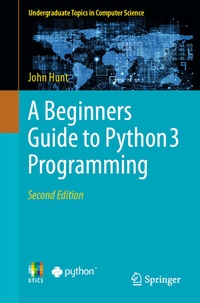
A Beginners Guide to Python 3 Programming
Description

This textbook is aimed at readers who have little or no knowledge of computer programming but want to learn to program in Python. It starts from the very basics including how to install your Python environment, how to write a very simple program and run it, what a variable is, what an if statement is, how iteration works using for and while loops as well as important key concepts such as functions, classes and modules. Each subject area is prefaced with an introductory chapter, before continuing with how these ideas work in Python.
The second edition has been completely updated for the latest versions of Python including Python 3.11 and Python 3.12. New chapters have been added such as those that consider where and how Python is used, the use of Frozensets, how data can be sorted, enumerated types in Python, structural pattern matching and how (and why) Python Virtual Environments are configured. A new chapter 'The Python Bites back' is introduced to present the fourteen most common / biggest gotchas for someone new to Python. Other sections have been updated with new features such as Exception Groups, string operations and dictionary operations.
A Beginners Guide to Python 3 Programming second Edition
provides all you need to know about Python, with numerous examples provided throughout including several larger worked case studies illustrating the ideas presented in the previous chapters.
More details
Other editions
Additional editions
Previous edition
Person
John Hunt is a technology trainer, consultant, mentor and author who has 35 years experience within the computing industry. He has worked extensively in Object Oriented and Functional technologies using language from Java through C# to Scala and of course Python. John was first involved with Python while working with a FinTech company in 2010. Since then he has been involved in numerous Python projects and has worked with a number of companies helping to develop their Python skills.
