

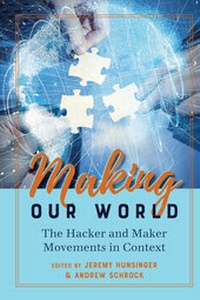
Making Our World
Description

Making Our World: The Hacker and Maker Movements in Context describes and situates the political, historical, national, and organizational elements of hacking and making. Hackers and makers are often mythologized, leading to people misunderstanding them as folk heroes for the modern age. In response, this book describes and critiques these movements from a variety of interdisciplinary perspectives to help readers appreciate their worldwide scope and highly localized interpretations. Making Our World is essential reading for students and scholars of technology and society, particularly those interested in social movements and DIY cultures.
More details
Other editions
Additional editions
Persons
Jeremy Hunsinger is Associate Professor of Communication Studies at Wilfrid Laurier University. He has co-edited several special issues of journals and books, including two volumes of the International Handbook of Internet Research. For more information and articles, visit his website at tmttlt.com.
Andrew Schrock is a post-doctoral fellow at Chapman University. His research broadly considers how people use communication technologies to reconfigure family, community, and democratic institutions. Most recently, he has written extensively on the "civic tech" movement and political participation around data. His research has appeared in New Media & Society, the International Journal of Communication, and Big Data & Society. For more information and articles, please visit his website at aschrock.com.
Content
Jeremy Hunsinger/Andrew R. Schrock: Introduction - Andrew R. Schrock: Section I: Histories Introduction - T. Philip Nichols/Debora Lui: Learning by Doing: The Tenuous Alliance of the "Maker Movement" and Education Reform - Molly R. Sauter: Kevin Mitnick, The New York Times, and the Media's Conception of the Hacker - Yasuhito Abe: Making Civic Media in the Post-Fukushima Japanese Media Ecology - Rhea Vichot: Project Chanology and the Formation of Anonymous as an Activist Movement - Andrew R. Schrock: Section II: Politics Introduction - Nathanael Bassett: Conscientious Hacking and the Weak Collective - Arne Hintz: Policy Hacking: Opening Up the Code of Media and Communications Regulation - Morgan Currie: Hacking Administration-A Report From Los Angeles - Sebastian Kubitschko: Why Locality and Presence (Still) Matter for Political Activism - Jeremy Hunsinger: Section: III: Organizing Introduction - Alexander von Lünen: Basteln, Tinkering, and Bricolage: A Cultural History of Hacking - Jennifer Maher: Women's Hacking of the Poison Gift of Free/Libre/Open Source Software - Alison E. Vogelaar/Charlotte M. McKernan: Making Space for a Revolution: Occupy Wall Street as a Maker Movement - Ann Light: The Détente Model of Managing Divergent Values in the Maker-Sphere - Jeremy Hunsinger: Section IV: Case Studies Introduction - Pip Shea: Hacker Agency and the Raspberry Pi: Informal Education and Social Innovation in a Belfast Makerspace - Nicholas Balaisis: Hacking as a Way of Life: "Makers" at the Margins of Global Digital Culture - Xin Gu: The Paradox of Maker Movement in China - Karen Louise Smith: Our Community Hacks: Exploring Hive Toronto's Open Infrastructures - Andrew R. Schrock: Afterword: Hackers and Makers are Ordinary.
