

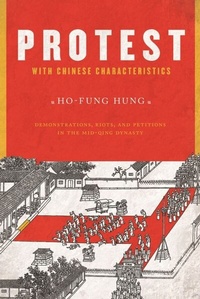
Protest with Chinese Characteristics
Demonstrations, Riots, and Petitions in the Mid-Qing Dynasty
1st Edition
Published on 25. September 2015
288 pages
978-0-231-52545-9 (ISBN)
Description

The origin of political modernity has long been tied to the Western history of protest and revolution, the currents of which many believe sparked popular dissent worldwide. Reviewing nearly one thousand instances of protest in China from the eighteenth to the early-nineteenth centuries, Ho-fung Hung charts an evolution of Chinese dissent that stands apart from Western trends.
Hung samples from mid-Qing petitions and humble plaints to the emperor. He revisits rallies, riots, market strikes, and other forms of contention rarely considered in previous studies. Drawing on new world history, which accommodates parallels and divergences between political-economic and cultural developments East and West, Hung shows how the centralization of political power and an expanding market, coupled with a persistent Confucianist orthodoxy, shaped protesters' strategies and appeals in Qing China.
This unique form of mid-Qing protest combined a quest for justice and autonomy with a filial-loyal respect for the imperial center, and Hung's careful research ties this distinct characteristic to popular protest in China today. As Hung makes clear, the nature of these protests prove late imperial China was anything but a stagnant and tranquil empire before the West cracked it open. In fact, the origins of modern popular politics in China predate the 1911 Revolution. Hung's work ultimately establishes a framework others can use to compare popular protest among different cultural fabrics. His book fundamentally recasts the evolution of such acts worldwide.
Hung samples from mid-Qing petitions and humble plaints to the emperor. He revisits rallies, riots, market strikes, and other forms of contention rarely considered in previous studies. Drawing on new world history, which accommodates parallels and divergences between political-economic and cultural developments East and West, Hung shows how the centralization of political power and an expanding market, coupled with a persistent Confucianist orthodoxy, shaped protesters' strategies and appeals in Qing China.
This unique form of mid-Qing protest combined a quest for justice and autonomy with a filial-loyal respect for the imperial center, and Hung's careful research ties this distinct characteristic to popular protest in China today. As Hung makes clear, the nature of these protests prove late imperial China was anything but a stagnant and tranquil empire before the West cracked it open. In fact, the origins of modern popular politics in China predate the 1911 Revolution. Hung's work ultimately establishes a framework others can use to compare popular protest among different cultural fabrics. His book fundamentally recasts the evolution of such acts worldwide.
All prices
More details
Other editions
Additional editions
Ho-fung Hung
Protest with Chinese Characteristics
Demonstrations, Riots, and Petitions in the Mid-Qing Dynasty
Book
04/2013
Columbia University Press
€34.66
Shipment within 10-20 days
Ho-fung Hung
Protest with Chinese Characteristics
Demonstrations, Riots, and Petitions in the Mid-Qing Dynasty
Book
05/2011
Columbia University Press
€108.94
Article not available at the moment
Person
Ho-fung Hung is associate professor of sociology at the Johns Hopkins University and the editor of China and the Transformation of Global Capitalism.
Content
List of Figures
List of Tables
Illustrations of Chinese Protest from Qing Times to Present
Preface
Introduction
Chapter 1. Market Expansion, State Centralization, and Neo-Confucianism in Qing China
Chapter 2. Documenting the Three Waves of Mid-Qing Protest
Chapter 3. Filial-Loyal Demonstrations, 1740-1759
Chapter 4. Riots Into Rebellion, 1776-1795
Chapter 5. Resistance and Petitions, 1820-1839
Chapter 6. Mid-Qing Protests in Comparative Perspective
Epilogue. The Past in the Present
Notes
References
Index
List of Tables
Illustrations of Chinese Protest from Qing Times to Present
Preface
Introduction
Chapter 1. Market Expansion, State Centralization, and Neo-Confucianism in Qing China
Chapter 2. Documenting the Three Waves of Mid-Qing Protest
Chapter 3. Filial-Loyal Demonstrations, 1740-1759
Chapter 4. Riots Into Rebellion, 1776-1795
Chapter 5. Resistance and Petitions, 1820-1839
Chapter 6. Mid-Qing Protests in Comparative Perspective
Epilogue. The Past in the Present
Notes
References
Index

