

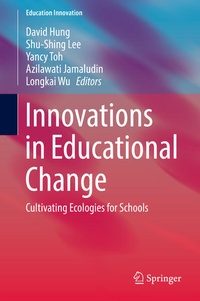
Innovations in Educational Change
Cultivating Ecologies for Schools
1st Edition
Published on 7. August 2019
XX, 295 pages
978-981-13-6330-6 (ISBN)
Description

This book offers an ecological perspective to understand the opportunities and complexities of spreading and sustaining educational innovations. It explores the imperatives underpinning educational reforms and identifies the role of schools in developing, disseminating, and sustaining changes in Singapore's educational context. It also includes international case studies that examine the dialectical relationships between structure, people and culture and demonstrate that cultivating ecologies involves leveraging affordances and resources across the education system to create new contexts, synergies and capacities. Further, it argues that educational innovations and reforms also need to consider tacit knowledge and conditions of transfer, which may be ambiguous and challenging.
Few books address the nuances and interactions of innovation and change across levels of the education ecology - from the micro (classroom), meso (organisation / school), exo (partners), macro (policy) and chrono (time scales) levels. The ecological perspective adopted in this book explores the dynamic tensions in order to understand the interplays of policy and school-level influences that contextualize school innovations. By presenting multiple voices and views, it allows impediments and affordances of innovation diffusion to be discussed holistically, which is an integral caveat for nurturing a sustainable ecology that enables innovations.
Few books address the nuances and interactions of innovation and change across levels of the education ecology - from the micro (classroom), meso (organisation / school), exo (partners), macro (policy) and chrono (time scales) levels. The ecological perspective adopted in this book explores the dynamic tensions in order to understand the interplays of policy and school-level influences that contextualize school innovations. By presenting multiple voices and views, it allows impediments and affordances of innovation diffusion to be discussed holistically, which is an integral caveat for nurturing a sustainable ecology that enables innovations.
More details
Series
Language
English
Place of publication
Singapore
Singapore
Publishing group
Springer Singapore
Target group
Professional and scholarly
Product notice
Reflowable
Illustrations
XX, 295 p. 33 illus.
File size
7,39 MB
ISBN-13
978-981-13-6330-6 (9789811363306)
DOI
10.1007/978-981-13-6330-6
Schweitzer Classification
Other editions
Additional editions
David Hung | Shu-Shing Lee | Yancy Toh
Innovations in Educational Change
Cultivating Ecologies for Schools
Book
08/2019
Springer
€106.99
Shipment within 15-20 days
Persons
David Hung is Dean of Education Research at the National Institute of Education, Singapore. He has served as Contributing Editor and Associate Editor for several well-read international academic publications in the learning sciences field and appointed as journal reviewer for various well-established international academic journals. His research interests are in learning and instructional technologies; constructivism, in particular, social constructivism; social cultural orientations to cognition; and communities of practice.
Shu-Shing Lee is a Research Scientist at the NIE, Singapore. Her research interests include teacher learning as well as understanding contextual factors and leverages for spreading and sustaining technology-mediated educational innovations.
Yancy Toh was a Research Scientist at the Centre for Research in Pedagogy and Practice (CRPP), Office of Education Research (OER). Her research interests include leadership studies, school reforms, innovation diffusion, complex systems, and seamless learning. She is particularly interested in examining the systemic influences that impinge on a school's capacity to sustain technology-enabled pedagogical innovations for student-centred learning.
Yancy Toh was a Research Scientist at the Centre for Research in Pedagogy and Practice (CRPP), Office of Education Research (OER). Her research interests include leadership studies, school reforms, innovation diffusion, complex systems, and seamless learning. She is particularly interested in examining the systemic influences that impinge on a school's capacity to sustain technology-enabled pedagogical innovations for student-centred learning.
Azilawati Jamaludin is an Assistant Professor at the Curriculum, Teaching and Learning Academic Group, National Institute of Education. Her research interests include progressive pedagogies, reform pedagogies, institutional innovations, gamification, game-based interactivity, immersive environments, argumentative knowledge construction, trans-contextual learning, embodiment, embodied knowing, embodied subjectivities, trajectories of becoming, and construction of self.
Longkai Wu is a Research Scientist at the NIE, Singapore. His current research focuses on the design and implementation of technology-enhanced learning activities in classroomsthat help students develop deeper understanding.Content
Part 1 Innovation and Change from the Chronological View.- 1 Centralised-Decentralisation in Singapore Education Policy Making.- 2 Transforming Education for All: Tower Hamlets and Urban District Education Improvement.- Part 2 Innovation and Change from the Systems View.- 3 Wide-scale Implementation through Capacity Building of Senior Leaders: The Case of Teaching Thinking in Israeli Schools.- 4 Spreading Educational Technology Innovations: Cultivating Communicaties.- 5 Towards a Framework of Diffusing Education Innovations at Different Levels of the System.- 6 Community-based Design Research to Sustain Classroom Innovation with ICT.- Part 3 Innovation and Change from the School View.- 7 Negotiating Policy Meanings in School Administrative Practice: Practice, Professionalism, and High Stakes Accountability in a Shifting Policy Environment.- 8 School Orientation to Teacher Learning and the Cultivation of Ecologies for Innovation: A National Study of Teachers in England.- 9 Seeding Change: Growing and Sustaining a School's Culture of Innovativeness.- 10 Diffusing Innovative Pedagogies in Schools in Singapore: Case Studies on School Leaders' Diffusion Approaaches and their Rationalisations.- Part 4 Innovation and Change from the Classroom and Learner's View.- 11 Exploring the Change in Nature and Efficacy of Learners' Questions through Progressive Interaction with the Stanford Mobile Inquiry-based Learning Environment (SMILE).- 12 Exploring the Dimensions of Interest Sustainability (5Cs Framework): Case Study of Nathan.- 13 Conclusion.
