


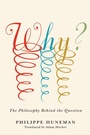
Why?
The Philosophy Behind the Question
Published on 25. July 2023
320 pages
978-1-5036-3571-5 (ISBN)
Available for download
Description

A philosopher explores the many dimensions of a beguilingly simple question.
Why did triceratops have horns? Why did World War I occur? Why does Romeo love Juliet? And, most importantly, why ask why? Through an analysis of these questions and others, philosopher Philippe Huneman describes the different meanings of "why," and how those meanings can, and should (or should not), be conflated.
As Huneman outlines, there are three basic meanings of why: the cause of an event, the reason of a belief, and the reason why I do what I do (the purpose). Each of these meanings, in turn, impacts how we approach knowledge in a wide array of disciplines: science, history, psychology, and metaphysics. Exhibiting a rare combination of conversational ease and intellectual rigor, Huneman teases out the hidden dimensions of questions as seemingly simple as "Why did Mickey Mouse open the refrigerator?" or as seemingly unanswerable as "Why am I me?" In doing so, he provides an extraordinary tour of canonical and contemporary philosophical thought, from Plato and Aristotle, through Descartes and Spinoza, to Elizabeth Anscombe and Ruth Millikan, and beyond.
Of course, no proper reckoning with the question "why?" can afford not to acknowledge its limits, which are the limits, and the ends, of reason itself. Huneman thus concludes with a provocative elaboration of what Kant called the "natural need for metaphysics," the unallayed instinct we have to ask the question even when we know there can be no unequivocal answer.
Why did triceratops have horns? Why did World War I occur? Why does Romeo love Juliet? And, most importantly, why ask why? Through an analysis of these questions and others, philosopher Philippe Huneman describes the different meanings of "why," and how those meanings can, and should (or should not), be conflated.
As Huneman outlines, there are three basic meanings of why: the cause of an event, the reason of a belief, and the reason why I do what I do (the purpose). Each of these meanings, in turn, impacts how we approach knowledge in a wide array of disciplines: science, history, psychology, and metaphysics. Exhibiting a rare combination of conversational ease and intellectual rigor, Huneman teases out the hidden dimensions of questions as seemingly simple as "Why did Mickey Mouse open the refrigerator?" or as seemingly unanswerable as "Why am I me?" In doing so, he provides an extraordinary tour of canonical and contemporary philosophical thought, from Plato and Aristotle, through Descartes and Spinoza, to Elizabeth Anscombe and Ruth Millikan, and beyond.
Of course, no proper reckoning with the question "why?" can afford not to acknowledge its limits, which are the limits, and the ends, of reason itself. Huneman thus concludes with a provocative elaboration of what Kant called the "natural need for metaphysics," the unallayed instinct we have to ask the question even when we know there can be no unequivocal answer.
Reviews / Votes
"This is an engaging, creative, and masterful exploration of human experience, stemming from the seemingly innocent question 'why?' Huneman expertly draws upon an exceptionally rich array of sources-from the philosophical to the everyday-brought to life through illuminating examples. Even if we never reach an ultimate answer to life's most pressing query, this lucidly written book not only evokes its necessity, but transforms the way we will forever approach the question."-Anthony J. Steinbock, author of Knowing by Heart "Ranging with ease and erudition across both contemporary Anglo-American analytic and so-called Continental philosophies of science and the history of Western philosophy, Huneman argues that the plurality of questions expressed by 'why?' nevertheless share an underlying unity. A stimulating text addressed to professional philosophers as well as readers seeking to deepen their understanding of philosophy's relevance to common concerns."-Helen Longino, author of Studying Human Behavior "With wry humor, engaging examples, and indefatigable curiosity, Huneman takes the primeval question 'why?' as a launchpad to explore topics throughout the philosophy of science and beyond-evidence, cause, chance, natural selection, contingency and necessity, and in the end, love and the self."-Michael Strevens, author of The Knowledge Machine "This work offers a vast panorama that is both deeply researched and pleasant to read."-Sylvain Guilbaud, La Recherche "This is a particularly well-crafted introduction to the philosophy of science, one that combines sharpness and quiet erudition."-Pascal Engel, En attendant NadeauMore details
Series
Edition
New edition
Language
English
Place of publication
Palo Alto
United States
Target group
Professional and scholarly
Edition type
New edition
Illustrations
4 halftones
ISBN-13
978-1-5036-3571-5 (9781503635715)
Copyright in bibliographic data and cover images is held by Nielsen Book Services Limited or by the publishers or by their respective licensors: all rights reserved.
Schweitzer Classification
Other editions
Additional editions
Book
07/2023
Stanford University Press
€28.50
Shipment within 15-20 days
Persons
Philippe Huneman is Research Director at the Institut d'Histoire et de Philosophie des Sciences et des Techniques, CNRS/ Universite Paris I Pantheon Sorbonne and the author of several books in French and English, including Philosophical Sketches of Death in Biology: An Historical and Analytic Investigation (2022).
Content
Introduction: Introduction
1. Why Is Oscar Pistorius Guilty of Murder?
2. Why Do Things Fall When We Let Them Go?
3. Why Did Mickey Mouse Open the Fridge?
4. Why Do Triceratops Have Horns?
5. Why Did World War I Happen?
6. Why Did Napoleon Lose at Waterloo?
7. Why Were There American Soldiers on the 15:17 Train from Amsterdam to Paris on August 21, 2015?
8. Why Does Romeo Love Juliet?
9. Why Am I Me?
Conclusion: Why "Why?"
1. Why Is Oscar Pistorius Guilty of Murder?
2. Why Do Things Fall When We Let Them Go?
3. Why Did Mickey Mouse Open the Fridge?
4. Why Do Triceratops Have Horns?
5. Why Did World War I Happen?
6. Why Did Napoleon Lose at Waterloo?
7. Why Were There American Soldiers on the 15:17 Train from Amsterdam to Paris on August 21, 2015?
8. Why Does Romeo Love Juliet?
9. Why Am I Me?
Conclusion: Why "Why?"

