

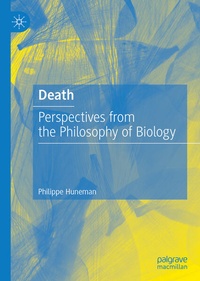
Death
Description

This book addresses several key issues in the biological study of death with the intent of capturing their genealogy, the assumptions and presuppositions they make, and the way that they open specific new research avenues. The book is divided into two sections: the first considers physiology and the second evolutionary biology. In the first part, Huneman reconstructs a conceptual genealogy of experimental physiology based on an in-depth analysis of Bichat's investigations of death processes. In the second part he explains that biologists in the late 1950s put forth a research framework that evolutionarily accounts for death in terms of either an effect of the weakness of natural selection or a by-product of natural selection for early reproduction. He illustrates how the biology of death is a central field and that studying it provides insight into the way that the epistemic structure of this knowledge has been constituted, persists until now, and may conflict with some traditional philosophical ideas.
Reviews / Votes
"Philippe Huneman's Death: Perspectives from the Philosophy of Biology presents itself as a major volume situated at the intersection of three main fields: philosophy, philosophy of biology . and biology itself ... . The volume is organized into two main parts, comprising respectively six and eight chapters, in addition to an introduction and a conclusion. . the volume constitutes an important milestone for interdisciplinary research, whose clarity of exposition and accessibility in English also deserve to be emphasized." (Jessica Lombard, The Quarterly Review of Biology, Vol. 101 (2), June, 2026)
"Death: Perspectives from the Philosophy of Biology is enormous in its scope and will stand as a major contribution to this exciting new field." (Pierre M. Durand, Journal for General Philosophy of Science, Vol. 56 (4), 2025)
"Those interested in the what, why, and the how of death will want to read Huneman's excellent book. The critical discussions of the development of key historical theories, and the overviews of current work, make it especially valuable." (Steven Luper, Metascience, Vol. 32 (3), 2023)
More details
Other editions
Additional editions
Person
Philippe Huneman is Research Director at the Institut d'Histoire et de Philosophie des Sciences et des Techniques at the Université Paris, France. He is also an affiliated professor at the University of Toronto, Canada, and he has published extensively on the philosophy of evolutionary biology and ecology.
Content
Chapter 1. Introduction . Why a book about biological death in philosophy? What to find in it?.- Chapter 2. How Late 18 th -Century Physiologists Understood the Living World and their task.- Chapter 3. Bichat's theories and their genealogy.- Chapter 4. Physiology in Bichat's Physiological Researches on Life and Death.- Chapter 5. Bichat's experimental physiology in the Recherches (part 2): death as an epistemic facilitator.- Chapter 6. Life and Death in Experimental Physiology after Bichat.- Chapter 7. A providentialist metaphysics and the traditional economics of death : mortality and individuality.- Chapter 8. The evolutionary synthesis' view of death: Peter Medawar, George C. Williams and the riddles of senescence.- Chapter 9 - Epistemology of death (1) : goals and evidences.- Chapter 10. Epistemology of death (2): experiments, tests and mechanisms.- Chapter 11. Ontology. The economics of death. and its trade-offs.- Chapter 12. Ontology (2). Death programs and their discontents.- Chapter 13. Ontology (3). The case(s) for programs: Altruistic suicide, quasi-programs and smurfs.- Chapter 14. Death is a social issue.- Chapter 15. Conclusion.
