

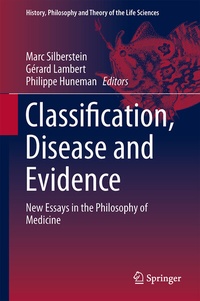
Classification, Disease and Evidence
Description

This anthology of essays presents a sample of studies from recent philosophy of medicine addressing issues which attempt to answer very general (interdependent) questions: (a) what is a disease and what is health? (b) How do we (causally) explain diseases? (c) And how do we distinguish diseases, i.e. define classes of diseases and recognize that an instance X of disease belongs to a given class B? (d) How do we assess and choose cure/ therapy?
The book is divided into three sections: classification, disease and evidence. In general, attention is focused on statistics in medicine and epidemiology, issues in psychiatry and connecting medicine with evolutionary biology and genetics. Many authors position the theories that they address within their historical contexts.
The nature of health and disease will be addressed in several essays that also touch upon very general questions about the definition of medicine and its status. Several chapters scrutinize classification because of its centrality within philosophical problems raised by medicine and its core position in the philosophical questioning of psychiatry. Specificities of medical explanation have recently come under a new light, particularly because of the rise of statistical methods and several chapters investigate these methods in specific contexts such as epidemiology or meta-analysis of random testing. Taken together this collection addresses the question of how we gather, use and assess evidence for various medical theories.
The rich assortment of disciplines featured also includes epidemiology, parasitology and public health, while technical aspects such as the application of game theory to medical research and the misuse of the DSM in forensic psychiatry are also given an airing. The book addresses more than the construction of medical knowledge, however, adding cogent appraisal of the processes of decision making in medicine and the protocols used to justify therapeutic choices.
Reviews / Votes
"This volume is a collection of philosophy of medicine chapters that deal, in one way or another, with the three linked themes of the title. . The chapters are well-researched and well-written and provide the reader with a useful snapshot of contemporary philosophy of medicine. . this book is a valuable addition to the research literature. " (Brendan Clarke, Metascience, Vol. 25, 2016)
More details
Other editions
Additional editions
Content
Introduction.- Evolutionary Models of Virulence: Concepts, History and Current Applications; Alizon, Sam and Méthot, Pierre Olivier.-Objectivity, Scientificity and the Dualist Epistemology of Medicine; Cunningham; Thomas.- The Function Debate and the Concept of Mental Disorder; Steeves, Demazeux.- Defining genetic disease; Dekeuwer; Catherine.- Causal and probabilistic inferences in diagnostic reasoning: casting a historical light onto the current debates; Coste, Joël.- Risk factor and causality in epidemiology; Giroux, Elodie.- The naturalization of the concept of disease; Lemoine, Mael.- The Epistemology of Mental Illness; Dominic Murphy.- Power, Knowledge and Laughter: Forensic Psychiatry and the misuse of the DSM; Singy, Patrick.- Quality Assessment Tools for Evidence in Medicine; Stegenga, Jacob.
