

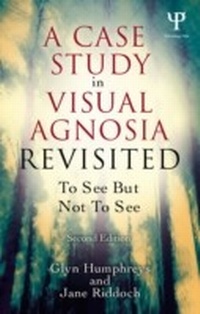
A Case Study in Visual Agnosia Revisited
To see but not to see
2nd Edition
Published on 15. October 2013
182 pages
978-1-136-76703-6 (ISBN)
Description

Visual agnosia is a rare but fascinating disorder of visual object recognition that can occur after a brain lesion. This book documents the case of John, who worked intensively with the authors for 26 years after acquiring visual agnosia following a stroke. It revisits John's case over twenty years after it was originally described in the book To See But Not To See, in 1987. As in the previous book, the condition is illuminated by John and his wife, Iris, in their own words.
A Case Study in Visual Agnosia Revisited discusses John's case in the context of research into the cognitive neuroscience of vision over the past twenty years. It shows how John's problems in recognition can provide important insights into the way that object recognition happens in the brain, with the results obtained in studies of John's perception being compared to emerging work from brain imaging in normal observers. The book presents a much fuller analysis of the variety of perceptual problems that John experienced, detailing not only his impaired object recognition but also his face processing, his processing of different visual features (colour, motion, depth), his ability to act on and negotiate his environment, and his reading and writing.
A Case Study in Visual Agnosia Revisited will be a key reference for those concerned with understanding how vision is implemented in the brain. It will be suitable for both undergraduate students taking courses in cognitive psychology and neuropsychology, and also researchers in the cognitive neuroscience of vision. The presentation of John's case, and the human aspects of the disorder, will also be of great interest to a general audience of lay people interested in perception.
A Case Study in Visual Agnosia Revisited discusses John's case in the context of research into the cognitive neuroscience of vision over the past twenty years. It shows how John's problems in recognition can provide important insights into the way that object recognition happens in the brain, with the results obtained in studies of John's perception being compared to emerging work from brain imaging in normal observers. The book presents a much fuller analysis of the variety of perceptual problems that John experienced, detailing not only his impaired object recognition but also his face processing, his processing of different visual features (colour, motion, depth), his ability to act on and negotiate his environment, and his reading and writing.
A Case Study in Visual Agnosia Revisited will be a key reference for those concerned with understanding how vision is implemented in the brain. It will be suitable for both undergraduate students taking courses in cognitive psychology and neuropsychology, and also researchers in the cognitive neuroscience of vision. The presentation of John's case, and the human aspects of the disorder, will also be of great interest to a general audience of lay people interested in perception.
Reviews / Votes
'This book represents the very best of scientific sleuthing and captures the ingenuity of researchers delving into the mechanisms underlying visual agnosia. This scientific account is coupled with the personal and poignant story of a man, his life and two dedicated researchers. It is both intellectually compelling and heartwarming.This book is a wonderful illustration of the evolution of scientific knowledge, as Riddoch and Humphreys revisit their studies of John, and show how our understanding of visual agnosia and its underlying mechanisms has grown since 1987. The book is scientifically grounded and, at the same time, offers a charming account of a patient and his ups and downs.
The approach adopted by Humphreys and Riddoch reflects the best of cognitive neuropsychology using detailed single-case study methodology. The experiments are ingenious and creative and the results elucidate the mechanisms underlying visual agnosia. A brilliant and compelling read for anyone interested in how the brain works.' - Marlene Behrmann, Department of Psychology, Carnegie Mellon University, USA
'Through the fascinating first-hand descriptions of the patient, HJA, we learn what it is like to lose many of the essential features of vision (such as the ability to recognise colours and objects) but yet still have the experience of seeing; and through the ingenious research of Humphreys and Riddoch we learn what this tells us about how the brain creates our vision of the world. This classic book is a great read and very accessible.' - Jamie Ward, Department of Psychology, University of Sussex, UK
More details
Edition
2nd edition
Language
English
Place of publication
London
United Kingdom
Publishing group
Taylor & Francis Ltd
Target group
College/higher education
Edition type
Revised edition
Product notice
Reflowable
Illustrations
55 s/w Abbildungen, 11 farbige Abbildungen, 33 s/w Photographien bzw. Rasterbilder, 11 Farbfotos bzw. farbige Rasterbilder, 22 s/w Zeichnungen
22 Line drawings, black and white; 11 Halftones, color; 33 Halftones, black and white; 11 Illustrations, color; 55 Illustrations, black and white
File size
17,85 MB
ISBN-13
978-1-136-76703-6 (9781136767036)
Copyright in bibliographic data and cover images is held by Nielsen Book Services Limited or by the publishers or by their respective licensors: all rights reserved.
Schweitzer Classification
Other editions
Additional editions
Book
10/2013
2nd Edition
Psychology Press Ltd
€205.60
Shipment within 3-4 weeks
Book
10/2013
2nd Edition
Psychology Press Ltd
€70.90
Shipment within 3-4 weeks
Persons
Glyn Humphreys is Watts Professor of Experimental Psychology at the University of Oxford, UK. His research covers the diagnosis and management of cognitive problems after brain injury, visual attention, perception, language and the control of action, and social cognition. He has published over 500 papers in international journals and 16 books.
Jane Riddoch is Professorial Research Fellow at the University of Oxford, UK. Her research covers visual disorders (agnosia, optic aphasia), disorders of attention (neglect, extinction), and action (apraxia, action disorganisation syndrome) and neuropsychological rehabilitation. She has published 150 papers in leading international journals and authored/editedfive books.
Jane Riddoch is Professorial Research Fellow at the University of Oxford, UK. Her research covers visual disorders (agnosia, optic aphasia), disorders of attention (neglect, extinction), and action (apraxia, action disorganisation syndrome) and neuropsychological rehabilitation. She has published 150 papers in leading international journals and authored/editedfive books.
Content
1. Serendipity 2. Meeting in a dressing gown 3. On becoming agnostic 4. The visual brain 5. A short history of agnosia 6. Integrative agnosia 7. Seeing the whole 8, What's in a face? 9. Colour, movement, action! 10. The written word 11. Living with agnosia
