

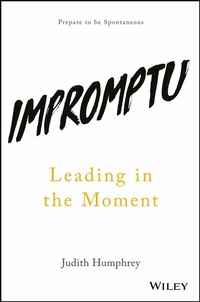
Impromptu
Description

Impromptu shows leaders how to think on their feet and respond eloquently in every situation. Never have there been so many opportunities to inspire and influence in everyday situations -- elevator chats, corridor conversations, networking gatherings, meetings, and ceremonial events. Indeed, today the most iconic leadership moments are spontaneous, spur-of-the-moment events that reveal the inner workings of the leader's mind. When these impromptu opportunities arise, leaders must be able to listen, think, and respond within seconds. They don't read a script from a page, they convey the narrative that is already in their mind. They can tailor a message--in a meeting, in the corridor, or in a tweet--to influence and inspire any audience. Those who shine in that moment are remembered for their leadership. Those who stumble are remembered for their gaffes, mixed messages, or insensitivity. Nobody remembers the leaders who retreat to their office, formulate a strategic plan, and distribute a memo the following week.
Guided by her entrepreneurial success as founder of The Humphrey Group and her firm's work with tens of thousands of leaders over the past 30 years, Judith Humphrey makes clear the importance of preparing to be spontaneous -- as counterintuitive as that may sound! Drawing upon the best impromptu moments from the Greeks to the present, the book looks at every aspect of impromptu speaking. You will learn how to:
* Think like an impromptu leader
* Quickly read an audience of one or a thousand
* Collect your thoughts and craft a persuasive message
* 'Script' yourself within seconds for any occasion
* Avoid 'um's' and 'ah's' and use the right words at the right time
* Discover improv techniques that will enable you to shine
* Deliver your message with clarity, confidence, and conviction.
The ability to speak on the spot is often seen as an innate gift, a talent of 'natural-born' leaders. The truth is, it's a skill that can be learned--a skill that is quickly becoming a must-have for anyone in a leadership position. Impromptu provides clear, actionable guidance to help you reach your full leadership potential. It will enable you to influence and inspire followers on the many 'small stages' that define our daily lives.
More details
Other editions
Additional editions
Content
Introduction 1
Part I The New World of Impromptu 9
1 The Rise of Impromptu Speaking 11
2 Power of Spontaneity 23
Part II The Impromptu Mind-Set 33
3 Be Intent on Leading 35
4 Be a Listener 45
5 Be Authentic 55
6 Be Focused 65
7 Be Respectful 71
Part III The Leader's Script 79
8 Lay the Groundwork 81
9 Read Your Audience 89
10 The Scripting Template 97
11 Commit to a Message 103
12 Make a Compelling Case 111
13 Beginnings and Endings 119
Part IV Impromptu Scripts For Every Occasion 125
14 Meetings 127
15 Job Interviews, Networking, and Elevator Conversations 135
16 "Just the Big Picture" 145
17 Toasts and Tributes 151
18 The Impromptu Speech 159
19 Q & a 165
Part V The Impromptu Stage 175
20 Rehearse Your Remarks 177
21 Choose Your Words 187
22 Use Improv Techniques 195
23 Find Your Voice 203
24 Master Body Language 211
Conclusion: Don't Be Scared, Be Prepared 219
Endnotes 225
Acknowledgments 239
Index 243
INTRODUCTION
At the 2017 Oscars®, movie producer Jordan Horowitz provided viewers with a remarkable impromptu moment. He had just accepted the Best Picture award for La La Land. Suddenly there was commotion on stage, and the PricewaterhouseCoopers folks informed him that Moonlight had actually won. Others might have been speechless-or angry. But instead, Horowitz boldly announced: "There's a mistake. 'Moonlight,' you guys won Best Picture. This is not a joke." Then, holding up his Oscar statuette, he said: "I'm going to be really proud to hand this to my friends from 'Moonlight.'"1
These brief remarks were brilliant, and were justly praised by the media. Horowitz showed grace in announcing the real winner and offering up the prize so generously. Later he explained, "It was not about me. It was about making sure that 'Moonlight' got the recognition it really deserves."2
I'd like to think that everyone who reads this book will respond to off-the-cuff situations as eloquently as Jordan Horowitz did.
"But," you may ask, "isn't impromptu speaking something people do without thinking much about it?" The word "impromptu" conjures up the instantaneous remark, the wedding toast done in a flash of friendship, the job interview where you decided to "wing it," the insightful comment that just came into your head at a meeting. Yes, these are all acts of spontaneity. But as we know, they don't always go well. Who could be more aware of this than Tony Hayward, the BP executive who told a reporter after the explosion on the Deepwater Horizon oil rig that "I'd like my life back." The world knew, as he did, that eleven individuals had lost their lives in the fire. His words left a bad taste-so bad that he was vilified in the media and removed from his high-profile role.3
And it's not just high-profile leaders who wing it and regret it. How many managers become tongue-tied when they speak up at a meeting, or go on too long, losing the thread of what they had wanted to say? How many leaders, when asked a question, ramble and conclude with a desperate, "What I'm really saying is . . .?" How many of us on conference calls wish we had been more astute and wonder if the others on the call tuned out? Who has not passed a colleague in the corridor and only afterward thought of something more meaningful to say than "How's it going?" What manager has not been stuck in the elevator with a senior executive and looked down at the floor, afraid to speak, not knowing what to say, regretting afterward the missed opportunity? And who has not spoken up at a meeting only to feel that she "lost it" in the middle of her thought?
Here's the rub: so many of us think of impromptu speaking as "winging it." That's why our corridor and watercooler conversations can sound so banal, our comments in meetings can be poorly thought out, and we can be awkward in our attempt to distill a thirty-minute PowerPoint deck into a few pithy messages when our boss says, "Just give me the big picture." It's not surprising that we have phone conversations that don't seem to go anywhere. It is not surprising that when we answer a question, we can flounder. It is, in short, not surprising that our daily conversations are often not geared to leadership and our encounters can be less than inspiring.
Impromptu speaking is an art that few have mastered. Yet it's a critical skill for leaders-not just those with fancy titles-but those at all levels who wish to come across as polished and persuasive. Impromptu speaking enables us to influence and inspire in day-to-day situations that are becoming more and more common.
What You Will Learn from This Book
The purpose of this book is to enable every reader to become much better at extemporaneous speaking. The secret is preparation! As paradoxical as it may sound, you must prepare to be spontaneous. The two statements on the cover of this book are key. "Leading in the moment" is the goal for anyone who wishes to have day-to-day impact on others. And "prepare to be spontaneous" is the means to achieving that goal.
We all have so much to say-all of us are experts in one or more fields, and we can talk endlessly if we are excited about our topic. But to say something meaningful, something motivational, something that conveys leadership on the spot, takes discipline. In some cases, you'll have only moments to collect your thoughts. In other cases, your preparation can begin well in advance of the event.
Here's a range of impromptu situations that demand some degree of preparation and forethought.
- Deciding you want to contribute to a meeting and collecting your thoughts in a few seconds.
- Sitting at a dinner event and suddenly hearing you are receiving an award (which you knew), but also hearing that you will be giving an acceptance speech (which you didn't know). You jot down a few notes on the back of a napkin.
- Attending a networking event, where you know you'll see prospective employers. You wisely polish your "elevator pitch" in advance.
- Being told you have only five minutes to give what you had thought was a thirty-minute presentation. You quickly redraft the talk to give only "the big picture."
- Seizing a moment to coach an employee and collecting your thoughts so you can leave her with a few key messages.
- Preparing for a Q&A by thinking of possible questions and developing answers.
- Finding yourself in the elevator with your boss's boss. Knowing exactly what to say because you've been thinking about how much you liked his last speech.
- Paying tribute to a departing employee with a few notes you've created.
- Being interviewed for a job and making a strong case for yourself because you've prepared notes that sell you into the role.
You won't read a script in any of these situations. You'll invent the words on the spot. But you must prepare. In fact, there needs to be just as much discipline in creating your impromptu remarks as there is in preparing for more formal speaking situations.
To lead in impromptu situations requires the right mind-set, knowledge of your material, key messages, a sound structure, clear language, and an engaging presence. All this takes preparation. In fact the word, "impromptu" derives from the Latin in promptu meaning "in readiness."4 This book will show you how to be ready for all the extemporaneous situations you face every day.
Mastering the art of impromptu speaking is more important than ever in today's fast-paced, time-challenged world. Whereas decades ago you might have had weeks or months to prepare your remarks for an off-site strategy session, today such planned events are often replaced by conference calls, sometimes scheduled in a matter of minutes. And while in the past scripted speaking was the order of the day for executives and political leaders, today these staged communications are often replaced by Q&A sessions or press conferences. With the advent of social media, impromptu remarks are instantly broadcast to far-flung audiences.
Times have dramatically changed, and the stakes for these off-the-cuff comments have become very high. Those spontaneous remarks can inspire and unite audiences, or they can wreak havoc. They can upset employees or anger voters. More than ever, there is a need to bring leadership to the impromptu stage.
This book will equip you to speak "in the moment" in ways that will convey leadership. And it will enable you to speak off the cuff in ways that will look and sound spontaneous-but will be thoughtful, well-argued, and deeply motivational.
History's Great Impromptu Speakers Were Made, Not Born
History provides many examples of individuals who faced the challenge of impromptu speaking-and discovered how to measure up to that challenge.
The first story recorded in Old English, back in the seventh century, told of a humble cowherd named Caedmon who was called upon to speak spontaneously at a mead hall feast. It was customary to pass around a harp and ask each guest to tell a story. The cowherd saw the harp coming toward him and panicked. He fled the hall in embarrassment. But he had a mystical dream that night, and when he returned to the hall he was able to miraculously compose a song of creation. All agreed it was divinely inspired.5
Abraham Lincoln knew the importance of spur-of-the-moment comments. He told young lawyers that: "Extemporaneous speaking should be practiced and cultivated. It is the lawyer's avenue to the public."6 Lincoln practiced what he preached, and as a result became an extraordinary impromptu speaker as was evident in the Lincoln-Douglas debates.7
Winston Churchill, who would become one of the greatest orators of all time, honed his impromptu speaking skills. Early in his career he stood up to speak before the British Parliament and his mind went blank. According to a contemporary, Churchill stood there in silence "until at last he could bear it no longer; back in his seat, he could only bury his head in his hands....
