

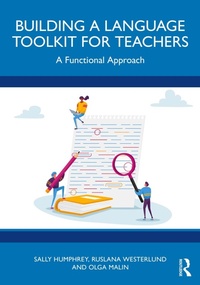
Building a Language Toolkit for Teachers
A Functional Approach
1st Edition
Published on 23. March 2026
210 pages
978-1-040-63016-7 (ISBN)
Description

This book is designed for pre-service teachers and K-8 educators seeking to develop their knowledge of how language works. Grounded in Systemic Functional Linguistics, it serves as a practical language toolkit, offering supportive task cycles with exercises that help teachers identify, analyze, and apply language features to support student learning.
This book is essential for those looking to develop their pedagogical language knowledge (PLK) to support multilingual students. Through accessible, targeted, task-based resources for pre-service teachers, this guide supports teachers to apply a functional approach for disciplinary purposes of narrating, informing, explaining and arguing in elementary and middle grade level instruction.
This book is essential for those looking to develop their pedagogical language knowledge (PLK) to support multilingual students. Through accessible, targeted, task-based resources for pre-service teachers, this guide supports teachers to apply a functional approach for disciplinary purposes of narrating, informing, explaining and arguing in elementary and middle grade level instruction.
Reviews / Votes
"The recent and growing body of work on a functional approach to language development, especially for teaching multilingual learners, is an area of research that has expanded a focus on the practice of teachers in classrooms in the context of the WIDA 2020 English Language Development Standards Framework. This book addresses specific ways of developing teachers' knowledge about language and using a functional metalanguage, providing a comprehensive overview of issues and a toolkit for implementation. This book should be a resource in every TESOL practitioner and teacher educator's library!"- Luciana C. de Oliveira, Ph.D., Professor, Department of Teaching and Learning, School of Education, Virginia Commonwealth University
"Empowering teachers to understand and teach language in functional ways through accessible explanations, examples, and activities makes this book a valuable source for teacher preparation. The distinction among everyday, cross-disciplinary, and technical subject-specific language, illustrated with examples, is valuable because multilingual learners need to learn all those aspects of language. Often books addressing the language of schooling tend to focus just on disciplinary language. In addition, the book embraces students' everyday language as important in the acquisition of disciplinary language."
- Maria Estela Brisk, Boston College
"This book is a vital resource for teachers seeking to develop a strong, shared functional metalanguage for explicitly teaching academic patterns. The functional perspective presented in the WIDA Standards is demonstrated through authentic language resources and task cycles in a clear, logical, and contextually relevant manner. Both experienced and novice teachers are guided to view aspects of language, such as sentence structure and word or phrase usage, in a new way, fostering a gradual understanding of the connection between these elements within larger language units necessary for academic success."
- Dr. Andres Ramirez, Associate Professor, Florida Atlantic University
More details
Edition
1. Auflage
Language
English
Place of publication
London
United Kingdom
Publishing group
Taylor & Francis Ltd
Target group
College/higher education
Professional and scholarly
Product notice
Reflowable
Illustrations
78 Tables, black and white; 39 Line drawings, black and white; 39 Illustrations, black and white
File size
4,36 MB
ISBN-13
978-1-040-63016-7 (9781040630167)
Copyright in bibliographic data and cover images is held by Nielsen Book Services Limited or by the publishers or by their respective licensors: all rights reserved.
Schweitzer Classification
Other editions
Additional editions
Sally Humphrey | Ruslana Westerlund | Olga Malin
Building a Language Toolkit for Teachers
A Functional Approach
Book
approx. 03/2026
1st Edition
Routledge
€211.20
Not yet published
Sally Humphrey | Ruslana Westerlund | Olga Malin
Building a Language Toolkit for Teachers
A Functional Approach
Book
approx. 03/2026
1st Edition
Routledge
€67.10
Not yet published
Persons
Dr. Sally Humphrey, a teacher educator and literacy researcher, has long collaborated with international scholars to research and apply knowledge of grammar and discourse in K-12 schools, pre-service, and professional learning contexts. Many of these studies have informed teaching resources, including reference and workbooks used in international professional learning contexts. Research-based publications that are most relevant to the content of this book are:
Humphrey, S. (2017). Academic literacies in the middle years: A framework for enhancing teacher knowledge and student achievement. Routledge.
Ruslana Westerlund is an educational consultant, teacher educator and researcher of disciplinary literacy through Systemic Functional Linguistics with 30 years of experience in the field of Multilingual learner education. Her recent Routledge publications are:
Besser, S. & Westerlund, R. (2024). Making Language Visible in Social Studies: A Guide to Disciplinary Literacy in the Social Studies Classroom. Routledge.
de Oliveira, L. C., & Westerlund, R. (Eds.). (2022). Scaffolding for multilingual learners in elementary and secondary schools (1st ed.). Routledge.
Olga Malin is an English Speakers of Other Languages (ESOL) Teacher in grades K-5 and an ESOL Endorsement Instructor in Columbia County, Georgia. She earned a master's degree in Foreign Languages and Linguistics at Chernivtsi National University in Ukraine, where she taught English and translation. Olga completed her Education Specialist Degree in Advanced Educational Studies with a Concentration in ESOL at Augusta University with the Dyslexia Endorsement.
Humphrey, S. (2017). Academic literacies in the middle years: A framework for enhancing teacher knowledge and student achievement. Routledge.
Ruslana Westerlund is an educational consultant, teacher educator and researcher of disciplinary literacy through Systemic Functional Linguistics with 30 years of experience in the field of Multilingual learner education. Her recent Routledge publications are:
Besser, S. & Westerlund, R. (2024). Making Language Visible in Social Studies: A Guide to Disciplinary Literacy in the Social Studies Classroom. Routledge.
de Oliveira, L. C., & Westerlund, R. (Eds.). (2022). Scaffolding for multilingual learners in elementary and secondary schools (1st ed.). Routledge.
Olga Malin is an English Speakers of Other Languages (ESOL) Teacher in grades K-5 and an ESOL Endorsement Instructor in Columbia County, Georgia. She earned a master's degree in Foreign Languages and Linguistics at Chernivtsi National University in Ukraine, where she taught English and translation. Olga completed her Education Specialist Degree in Advanced Educational Studies with a Concentration in ESOL at Augusta University with the Dyslexia Endorsement.
Content
Introduction, 1. The Functional Language Toolkit, 2. Language for Disciplinary Learning, 3. School genres and their structures, 4. Cohesion of language, 5. Density of language, 6. Grammatical complexity7. Precision of language
,
,
