

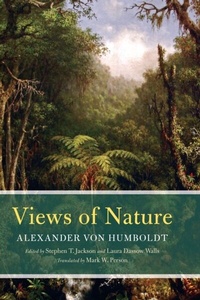
Views of Nature
1st Edition
Published on 22. December 2022
485 pages
978-0-226-92319-2 (ISBN)
Description

The German naturalist and explorer chronicles his 1799 expedition to Central and South America in this classic work of natural history.
While the influence of Alexander von Humboldt (1769-1859) looms large over the natural sciences, his legacy reaches far beyond the field notebooks of naturalists. Humboldt's 1799-1804 research expedition to Central and South America with botanist Aimé Bonpland not only set the course for the great scientific surveys of the nineteenth century, but also served as the raw material for his many volumes-works of both scientific rigor and aesthetic beauty that inspired such essayists and artists as Emerson, Goethe, Thoreau, Poe, and Frederic Edwin Church.
Views of Nature, or Ansichten der Natur, was Humboldt's best-known and most influential work-and his personal favorite. While the essays that comprise it are themselves remarkable as innovative, early pieces of nature writing-they were cited by Thoreau as a model for his own work-the book's extensive endnotes incorporate some of Humboldt's most beautiful prose and mature thinking on vegetation structure, its origins in climate patterns, and its implications for the arts. Written for both a literary and a scientific audience, Views of Nature was translated into English (twice), Spanish, and French in the nineteenth century, and it was read widely in Europe and the Americas. But in contrast to many of Humboldt's more technical works, Views of Nature has been unavailable in English for more than one hundred years. Largely neglected in the United States during the twentieth century, Humboldt's contributions to the humanities and the sciences are now undergoing a revival to which this new translation will be a critical contribution.
Praise for Views of Nature
"Alexander von Humboldt's wide-ranging Views of Nature is a masterpiece of nineteenth-century natural history, at once science and art. Mark W. Person's stunning new translation makes the wonders of this classic accessible to the English-language world of the present." -Daniel Walker Howe, author of the Pulitzer Prize-winning What Hath God Wrought
"From the plains of Venezuela to volcanoes and waterfalls, von Humboldt combines observations with travel narratives and philosophical musings. Annotations really help provide a context to the essays; this work also includes an index, conversions for von Humboldt's various measurement units, an introduction, and preface. This excellent translation of one of von Humboldt's most important works should introduce this great naturalist to an entirely new audience." -Edward J. Valauskas, curator of Rare Books, Library, Chicago Botanic Garden, Current Books on Gardening and Botany
While the influence of Alexander von Humboldt (1769-1859) looms large over the natural sciences, his legacy reaches far beyond the field notebooks of naturalists. Humboldt's 1799-1804 research expedition to Central and South America with botanist Aimé Bonpland not only set the course for the great scientific surveys of the nineteenth century, but also served as the raw material for his many volumes-works of both scientific rigor and aesthetic beauty that inspired such essayists and artists as Emerson, Goethe, Thoreau, Poe, and Frederic Edwin Church.
Views of Nature, or Ansichten der Natur, was Humboldt's best-known and most influential work-and his personal favorite. While the essays that comprise it are themselves remarkable as innovative, early pieces of nature writing-they were cited by Thoreau as a model for his own work-the book's extensive endnotes incorporate some of Humboldt's most beautiful prose and mature thinking on vegetation structure, its origins in climate patterns, and its implications for the arts. Written for both a literary and a scientific audience, Views of Nature was translated into English (twice), Spanish, and French in the nineteenth century, and it was read widely in Europe and the Americas. But in contrast to many of Humboldt's more technical works, Views of Nature has been unavailable in English for more than one hundred years. Largely neglected in the United States during the twentieth century, Humboldt's contributions to the humanities and the sciences are now undergoing a revival to which this new translation will be a critical contribution.
Praise for Views of Nature
"Alexander von Humboldt's wide-ranging Views of Nature is a masterpiece of nineteenth-century natural history, at once science and art. Mark W. Person's stunning new translation makes the wonders of this classic accessible to the English-language world of the present." -Daniel Walker Howe, author of the Pulitzer Prize-winning What Hath God Wrought
"From the plains of Venezuela to volcanoes and waterfalls, von Humboldt combines observations with travel narratives and philosophical musings. Annotations really help provide a context to the essays; this work also includes an index, conversions for von Humboldt's various measurement units, an introduction, and preface. This excellent translation of one of von Humboldt's most important works should introduce this great naturalist to an entirely new audience." -Edward J. Valauskas, curator of Rare Books, Library, Chicago Botanic Garden, Current Books on Gardening and Botany
All prices
More details
Other editions
Additional editions
Alexander von Humboldt | Stephen T. Jackson | Laura Dassow Walls
Views of Nature
Book
07/2014
University of Chicago Press
€99.20
Shipment within 10-20 days
Persons
Stephen T. Jackson is professor emeritus of botany and ecology at the University of Wyoming and the editor of von Humboldt's
Essay on the Geography of Plants. He lives in Tucson, AZ.
Laura Dassow Walls is the William P. and Hazel B. White Professor of English at the University of Notre Dame and the author of several books, including
The Passage to Cosmos: Alexander von Humboldt and the Shaping of America. She lives in Granger, IN.
Mark W. Person is associate academic professional lecturer in German in the Department of Modern and Classical Languages and director of the language lab at the University of Wyoming. He lives in Laramie, WY.
Content
- Intro
- Contents
- Editors' Preface
- Introduction: Reclaiming Consilience
- Translator's Note
- Humboldt's Ansichten der Natur Measurement Units
- Views of Nature
- Preface to the First Edition
- Preface to the Second and Third Editions
- 1. Concerning the Steppes and Deserts
- Annotations and Additions
- 2. Concerning the Waterfalls of the Orinoco near Atures and Maypures
- Annotations and Additions
- 3. The Nocturnal Wildlife of the Primeval Forest
- Annotations and Additions
- 4. Hypsometric Addenda
- 5. Ideas for a Physiognomy of Plants
- Annotations and Additions
- 6. Concerning the Structure and Action of Volcanoes in Various Regions of the Earth
- Annotations and Additions
- 7. The Life Force, or The Rhodian Genius
- Commentary and Addendum
- 8. The Plateau of Cajamarca, the Old Residential City of the Inca Atahualpa
- First Sight of the Pacific from the Ridge of the Andes Chain
- Annotations and Additions
- Index

