

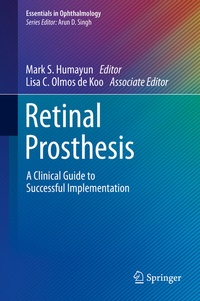
Retinal Prosthesis
Description

Intended as a useful and practical guide primarily oriented toward ophthalmic practitioners involved in retinal prosthesis implantation and post-operative visual rehabilitation, this book focuses on the Argus II Retinal Prosthesis and its revolutionary incorporation into the practice. The reader will get an update on patient selection, expected visual outcomes, surgical implantation techniques, and post-operative visual rehabilitation. Retinal Prosthesis - A Clinical Guide to Successful Implementation is written in a clear and concise manner and includes diagrams and high quality photographs to demonstrate best practices in surgical techniques and desired outcomes. Covering topics such as history of retinal prostheses, bioengineering considerations, clinical therapies, and other therapies and future directions, this book is written for practicing ophthalmologists, residents, and medical students interested in retinal implants.
More details
Other editions
Additional editions
Persons
Mark S. Humayun, M.D., Ph.D. is a professor of ophthalmology at the University of Southern California. His research projects focus on the treatment of the most debilitating and challenging eye diseases through advanced engineering. Leading a team of more than 30 faculty and 200 students from 15 different institutes, Dr. Humayun is focused on developing therapies for 1) retinal degenerations such as retinitis pigmentosa, 2) macular degenerations such as age-related macular degeneration, 3) retinovascular diseases such as vein occlusions, 4) diabetic retinopathy, as well as 5) glaucoma. He has been voted as one of the Best Doctors in America and has received numerous research awards. He is the director of the National Science Foundation BioMimetic MicroElectronic Systems Engineering Research Center, as well as the director of the Department of Energy Artificial Retina Project.
Lisa C. Olmos de Koo, MD, MBA, is an assistant professor of ophthalmology at the University ofSouthern California and is the associate director of the Vitreoretinal Fellowship Program at the USC Eye Institute. She is the primary investigator on the clinical trials for the Argus retinal prosthetic devices, and she is currently leading the commercial launch of the Argus II at USC. As former director of Ocular Trauma at the Bascom Palmer Eye Institute, she has experience in the management of the most complex surgical and medical retinal disorders.
Content
1. Retinal Prostheses: A Brief History.- 2. Retinal Prostheses: Bioengineering Considerations.- 3. Retinal Prostheses: Patient Selection and Screening.- 4. Retinal Prostheses: Surgical Techniques & Post-Operative Management.- 5. Retinal Prostheses: Clinical Outcomes and Potential Complications.- 6. Retinal Prostheses: Functional Outcomes and Visual Rehabilitation.- 7. Retinal Prostheses: Other Therapies and Future Directions.
