

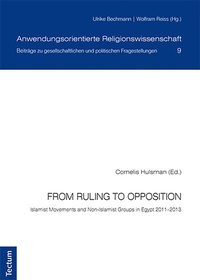
From Ruling to Opposition
Islamist Movements and Non-Islamist Groups in Egypt 2011-2013
1st Edition
Published on 13. March 2017
262 pages
978-3-8288-6739-0 (ISBN)
Description

In 2013, a group of researchers had the unique chance to interview 65 Egyptian Islamists and their opponents both prior to and after Egypt's military ousted President Mursi on July 3. Up to that time, Islamists with very different political perspectives were hopeful that they would be able to implement their interpretation of the shari?a and to create a utopian Islamic state. After their failure to achieve political dominance many of them refused to acknowledge the massive resistance to their rule and rejected the subsequent changes in government. A number became involved in militant attacks on police, military and the judiciary. This resulted in harsh government responses. Their criticism has been muted, but they still exist. These interviews document their authentic voices during this period of major political transformation. A must read for anyone who wants to understand contemporary Egypt.
More details
Other editions
Additional editions
Cornelis Hulsman
From Ruling to Opposition
Islamist Movements and Non-Islamist Groups in Egypt 2011-2013
Book
03/2017
1st Edition
Tectum Wissenschaftsverlag
€29.95
Shipment within 7-9 days
Persons
Cornelis Hulsman obtained a M.A. in Development Sociology from Leiden University in 1984 and held leading functions in the Dutch emigration service. Hulsman has been living in Egypt since 1994 where, together with his wife, he founded Arab-West Report and the Center for Intercultural Dialogue and Translation in Cairo.
Content
- Intro
- Contents
- Abbreviations
- Notes on Transliteration
- Glossary (Cornelis Hulsman)
- Foreword (Ambassador Mona Omar)
- Comments of Scholars on the Book
- 1 Introduction (Cornelis Hulsman)
- 2 The Political Participation of the Muslim Brotherhood (Eline Kasanwidjojo)
- 2.1 Introduction
- 2.2 Brief Historical Overview of the Muslim Brotherhood
- 2.3 Structure and Organization of the Brotherhood
- 2.4 Recruitment Process
- 2.5 The Idea of Political Participation
- 2.6 Leadership
- 2.7 Brotherhood Political Participation After 2011
- 2.7.1 The Freedom and Justice Party
- 2.7.2 The Political Project of the Brotherhood
- 2.7.3 Muslim Brotherhood Political Presence and the Ballot Box After January 25, 2011
- 2.7.4 Divisions Following the Revolution
- 2.7.4.1 Strong Egypt P
- 2.7.4.2 Egyptian Current Party
- 2.8 The Brotherhood in Power and Their Fall from Power
- 2.8.1 Public Support for the Brotherhood
- 2.8.2 Challenges During Mursi's Presidency
- 2.8.3 Political Decisions and Mistakes
- 2.8.3.1 Pluralism and Inclusivity
- 2.8.3.2 Presidential Decree
- 2.8.3.3 Christian Support
- 2.8.3.4 Economy
- 2.8.3.5 Security
- 2.8.3.6 Ethiopian Dam
- 2.8.3.7 'Brotherhoodization'
- 2.8.4 After June 30, 2013
- 2.9 Conclusion
- 3 Salafi Political Participation and the "Islamic Project" (Quinta Smit)
- 3.1 Introduction
- 3.2 Defining Concepts
- 3.2.1 Salafism
- 3.2.2 Islamism
- 3.3 History and the January 25 Revolution: Becoming Politically Active
- 3.3.1 Before the January 25 Revolution
- 3.3.2 The Salafi Shaykhs and the January 25 Revolution
- 3.3.3 The Ideological Agenda of Salafi Parties
- 3.4 Tension Between Political and Religious Salafism
- 3.4.1 No United Salafi Movement
- 3.4.2 Dilemma with the Shaykhs
- 3.4.3 Mobilizing Support
- 3.4.4 Shaykhs' Limited Knowledge of Economics and Politics
- 3.4.5 June 30 and the Struggle Between Political Pragmatism and Religious Purity
- 3.4.5.1 Al-Nür Party and Political Pragmatism
- 3.4.5.2 Preservation of a Religiously Conservative Identity
- 3.4.6 The "Islamic Project
- 3.4.6.1 The Constitutional Debate
- 3.4.6.2 2012 Presidential Elections
- 3.4.6.3 The Making and Breaking of Alliances
- 3.5 Product of the Revolution
- 3.5.1 A Revolutionary Environment and Support Base
- 3.5.2 The Revolutionary Character of Salafi Political Parties
- 3.5.3 Implications of Being a Product of the Revolution
- 3.6 Conclusion
- 4 Al-Jamaa al-Islamiyya: The Burden of History on Internal Transition (Jayson Casper)
- 4.1 Introduction
- 4.2 History
- 4.2.1 Hisba
- 4.2.2 State Response
- 4.2.3 Adoption of Violence
- 4.2.4 'The Revisions'
- 4.3 Reconstitution
- 4.4 Politicization
- 4.4.1 Internal Democracy
- 4.4.2 Financing
- 4.4.3 Political Influence
- 4.5 Mobilization
- 4.5.1 Revolutionary Fervor
- 4.5.2 Nonviolent Advocacy
- 4.5.3 Joining a Social Islamism
- 4.5.4 Controversies in Mobilizing Practice
- 4.5.4.1 Militias
- 4.5.4.2 Rhetoric for the People
- 4.6 Philosophy
- 4.6.1 The Conception of Violence
- 4.6.2 The Conception of Democracy and Shürä
- 4.7 Conclusion
- 5 Non-Political Islamists: The Jihadi Salafis and the Situation in Sinai (Jayson Casper)
- 5.1 Introduction
- 5.2 Jihädi Salafis and Ideological Non-Participation
- 5.2.1 Restoring Jihäd and Shari'a
- 5.2.2 How to Restore Jihäd and Shari'a
- 5.3 Bedouins, Jihadis, and Geographical Non-Participation
- 5.3.1 The Security Sector and Bedouin Tribes
- 5.3.2 Militancy in the Sinai
- 5.3.3 Local Political Islamism
- 5.4 Conclusion
- 6 Non-Islamist Political Actors in Egypt (Nicholas Gjorvad)
- 6.1 Introduction
- 6.2 Defining non-Islamist Groups in Egypt
- 6.3 Non-Islamists Before the Egyptian Revolution: Cooperation with Islamist Groups
- 6.4 Non-Islamists after the Egyptian Revolution
- 6.5 The NDP and the Fulül
- 6.6 The Meaning of F
- 6.6.1 Political Involvement After 2011
- 6.7 Non-Islamist Parties
- 6.8 Non-Islamist Movements
- 6.9 Non-Islamists in Politics
- 6.9.1 Religion and Personal Freedoms
- 6.9.2 The Issue of Shari'a in the Constitution
- 6.9.3 Egypt or an Organization?
- 6.9.4 Religious Diversity in Egypt
- 6.9.5 Religion in Electoral Politics
- 6.10 Countering the Islamist Rule: Reflections of Non-Islamists
- 6.10.1 Uniting Non-Islamists
- 6.10.1.1 The National Salvation Front
- 6.10.1.2 Tamarrud
- 6.10.2 "Principles" Versus "Politics
- 6.10.3 Reaching a Broader Audience
- 6.10.4 The Political Issue of Social Services
- 6.10.5 Mobilizing the Street
- 6.10.6 Time as an Ally?
- 6.11 Conclusion
- 7 Conclusion (Cornelis Hulsman)
- Appendix 1: Organizations and Interviewees Mentioned in This Book (Cornelis Hulsman)
- 1 Muslim Brotherhood & Freedom and Justice Party (FJP)
- 1.1 Dr. 'Issäm al-Haddäd (Essam el-Haddad)
- 1.2 Dr. 'Amr Darräj (Amr Darrag)
- 1.3 Dr. Walid al-Haddäd (Walid el-Haddad)
- 1.4 Dinä Zakariyya Husayn
- 1.5 Ishtishhäd al-Bannä, Sanä' al-Bannä
- 1.6 Dr.Wafä Hafni
- 1.7 'Ali Khafäji (Aly Khafagy)
- 1.8 Muhammad Abd Allah
- 1.9 Ahmad Kamäl
- 1.10 Anonymous
- 1.11 Usama Farid
- 1.12 W a il Hadara (Wael Haddara)
- 2 Former Members of the Muslim Brotherhood
- 2.1 Dr. 'Abd al-Mun'im Abu al-Futuh
- 2.2 Dr. Kamäl al-Hilbäwi
- 2.3 Dr. Ibrähim al-Hudaybi
- 3 Council of Trustees of the Revolution
- 3.1 Ahmad Najib
- 3.2 Dr. Safwät Hijäzi (Safwat Hegazy)
- 6 Hizb al-Nür (al-Nür/Light Party)
- 6.1 Bassäm al-Zarqä
- 6.2 Nädir Bakkär
- 4 Salafi Associations and Political Parties
- 5 al-Da W a a l-S a la fiy y a
- 5.1 Muhammad Ism ä il al-Muqaddim
- 7 Hizb al-Watan (the Homeland Party)
- 7.1 Dr. Imad 'Abd al-Ghafur
- 7.2 Dr. Ahmad al-Qadri 'Abd al-Salam (Ahmed Kadry Abdelsalam)
- 7.3 Anonymous Former Member of al-NUr and al-Watan Parties
- 8 Hizb al-Asäla (The Authenticity Party)
- 8.1 Ihäb Shiha
- 8.2 'Issäm al-Sharif
- 8.3 Häni Fawzi
- 9 Hizb al-Fadtla (Virtue Party)
- 9.1 Mahmüd Fathi
- 10 Hizb al-Isläh (Egyptian R eform Party)
- 10.1 Khälid Mansür
- 11 Al-Jama a al-Islam iy y a (Islamic Group)and Hizb al-bina ' wa l-tanmiyya(Building and D evelopment Party)
- 11.1 Muhammad Ahmad
- 11.2 Sharaf al-Din al-Jibali
- 11.3 Izzat al- Salamüni (Ezzat al-Salamony)
- 11.4 AlaAbu al-Nasr
- 11.5 Muhammad 'Umar 'Abd al-Rahmän
- 12 Jihädi Salafis
- 12.1 °Ahmad AshUsh
- 12.2 'Abd al-Bäsit al-Fashni
- 12.3 Ashraf
- 13 Islamist scholars
- 13.1 Dr. Muhammad Saläh
- 13.2 Dr. Nädiya Mustafä (Nadia Mustafa)
- 14 Non-Islamist Organizations, Researchers, Authors and Journalists
- 14.1 Jamal al-Banna (Gamal el-Banna, 1920-2013)
- 14.2 Dr. 'Abd al-Mun'im al-Mashshat (Abdul-Monem al-Mashat)
- 14.3 Abd al-Rahim 'Ali
- 14.4 'Imäd Shähin
- 14.5 Jerome Drevon
- 14. 6 Mamdüh Sarür
- 14. 7 Ismä il Alexanderni
- 14.8 Professor Abdallah Schleifer
- 15 Non-religious political parties and coalitions
- 16 New al-Wafd Party
- 16.1 Dr. George Naji Masiha Ibrähim (George Messiha)
- 16.2 'Abd Allah al-Mughäzi
- 17 Hizb Misr al-Hurriyya (Freedom Egypt Party)
- 17.1 Dr. 'Amr Hamzäwi (Amr Hamzawy)
- 18 Hizb al-Misriyym a l - 'Ahrnr (Free Egyptians Party)
- 18.1 'Äsim Mimün (Assem Memon)
- 19 Hizb al-Dustür (Constitution Party)
- 19.1 Khalid Dawüd (Khaled Daoud)
- 20 Hizb al-Mu tam ar (Congress Party)
- 20.1 Muhammad 'Abd al-Latif
- 21 Al-Hizb al-Misrt al-Dimüqrätl a l-Ijtim ä 'l (Egyptian SocialDemocratic Party)
- 21.1 Mahä 'Abd al-Näsir
- 22 Hizb al-Karäma (Dignity Party)
- 22.1 Sayyid al-Tükhi
- 23 Hizb a l- Ahrar (Liberal Party)
- 23.1 Ahmad Talat (Ahmed Talaat)
- 24 Other Parties Mentioned in the Book but No Members Interviewed
- 25 April 6 Youth Moveme
- 25.1 Ahmad 'Abd Allah
- 25.2 Rami al-Suwisi
- 25.3 'Amal Sharaf
- 26 Tamarrud (Rebellion)
- 26.1 Walid al- Masri
- 26.2 MahmUd Badr
- 26.3 Muhammad 'Aziz
- 26.4 Shimä' al-Tüni
- 27 Military/Security
- 27.1 Anonymous Former Security Advisor for the Government inNorth Sinai
- 27.2 Sämih Sayf al-Yazal
- 27.3 Other Opposition to Islamists
- Appendix 2: Index of Names of People(Cornelis Hulsman)
- Appendix 3: Chronology of Events (Cornelis Hulsman)
- Bibliography
- Institutional Authors
- About the Authors
- About the Center for Arab-West Understanding
