

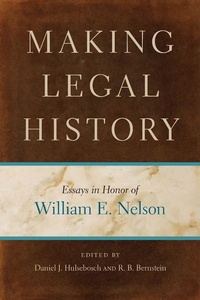
Making Legal History
Essays in Honor of William E. Nelson
Published on 20. September 2013
277 pages
978-0-8147-0844-6 (ISBN)
Description

One of the academy's leading legal historians, William E. Nelson is the Edward Weinfeld Professor of Law at New York University School of Law. For more than four decades, Nelson has produced some of the most original and creative work on American constitutional and legal history. His prize-winning books have blazed new trails for historians with their substantive arguments and the scope and depth of Nelson's exploration of primary sources. Nelson was the first legal scholar to use early American county court records as sources of legal and social history, and his work (on legal history in England, colonial America, and New York) has been a model for generations of legal historians.
This book collects ten essays exemplifying and explaining the process of identifying and interpreting archival sources-the foundation of an array of methods of writing American legal history. The essays presented here span the full range of American history from the colonial era to the 1980s.Each historian has either identified a body of sources not previously explored or devised a new method of interrogating sources already known.The result is a kaleidoscopic examination of the historian's task and of the research methods and interpretative strategies that characterize the rich, complex field of American constitutional and legal history.
This book collects ten essays exemplifying and explaining the process of identifying and interpreting archival sources-the foundation of an array of methods of writing American legal history. The essays presented here span the full range of American history from the colonial era to the 1980s.Each historian has either identified a body of sources not previously explored or devised a new method of interrogating sources already known.The result is a kaleidoscopic examination of the historian's task and of the research methods and interpretative strategies that characterize the rich, complex field of American constitutional and legal history.
Reviews / Votes
Making Legal History is not just a tribute to one of the most productive and creative legal historians in the United States, but a fundamental contribution to our understanding of this countrys legal history. These fine essays cover a wide chronological and topic range, and provide the reader with an understanding of just how far we have come in understanding the role of law in American society under Bill Nelsons intellectual influence. The book is a fitting tribute to a great scholar, and a boon to students of our legal past. - Stanley N. Katz,Princeton University These essays epitomize the deep and broad impact that William Nelson has had on the writing of American legal history. In them we see his passion for archival research and his creative application of new sources and new ideas. Nelson has not so much transformed a field as shaped an entirely new one and inspired one of the most vibrant intellectual communities in academia today. - David Thomas Konig,Washington University in St. Louis It is, literally, impossible to overstate Bill Nelsons importance to the field of legal history, whether as a result of his prodigious scholarly output, his generous mentorship of young scholars, or his creative institution building. But his influence in all these roles is displayed in this wonderful collection of essays by many of Americas leading legal historians (all former Goliebs who cut their teeth under Bills incomparable tutelage). - Larry Kramer,President, William & Flora Hewlett Foundation Over the past forty years, William Nelson has played a crucial role in the amazing growth of the field of legal history. His significance comes in the first place from his prodigious scholarship. But as important have been the institutions he has founded and the young scholars he has nurtured. He has been and continues to be a model of the generous and creative senior scholar. The Golieb Fellowship at NYU School of Law, an institution he has long led, has offered a home to two generations of the best young legal historians, as they made transitions into distinguished careers. In the pages of Making Legal History, one finds a wonderful offering of some of their best work. - Hendrik Hartog,Princeton University The collection is determinedly eclectic. This is especially evident in the temporal range covered by the essays, from the colonial era through the Civil War up to the Reagan era. [] The eclecticism may also reflect an intellectual generosity: Whatever the sources a scholar uses, follow them where they lead. As the editors put it, & the essays exemplify less a & school of legal or constitutional history than a shared sense of scholarly purpose. (The Journal of American History)More details
Language
English
Place of publication
New York
United States
Target group
Professional and scholarly
ISBN-13
978-0-8147-0844-6 (9780814708446)
Copyright in bibliographic data and cover images is held by Nielsen Book Services Limited or by the publishers or by their respective licensors: all rights reserved.
Schweitzer Classification
Other editions
Additional editions
Book
09/2013
New York University Press
€61.00
Shipment within 15-20 days
Persons
Daniel J. Hulsebosch is Charles Seligson Professor of Law and Professor of History at New York University. He is the author of Constituting Empire: New York and the Transformation of Constitutionalism in the Atlantic World, 1664-1830.
R. B. Bernstein is Distinguished Adjunct Professor of Law at New York Law School and Adjunct Professor of Political Science in the Skadden, Arps Honors Program in Legal Studies at the City College of New York. He has written, edited, or co-edited over 20 books in the fields of American constitutional and legal history, including the prize-winning The Founding Fathers Reconsidered and Thomas Jefferson.
R. B. Bernstein is Distinguished Adjunct Professor of Law at New York Law School and Adjunct Professor of Political Science in the Skadden, Arps Honors Program in Legal Studies at the City College of New York. He has written, edited, or co-edited over 20 books in the fields of American constitutional and legal history, including the prize-winning The Founding Fathers Reconsidered and Thomas Jefferson.
Content
Foreword: Making Legal History Morton J. Horwitz IntroductionI. Civil Wars and Legal Rights 1. The Landscape of FaithSarah Barringer Gordon 2. "It cant be cald stealin' ”Thomas C. Mackey 3. Debating the Fourteenth AmendmentDaniel W. HamiltonII. Law and Social Regulation 4. Was the Warning of Strangers Unique to Colonial New England?Cornelia H. Dayton and Sharon V. Salinger 5. Ambiguities of Free Labor RevisitedBarry Cushman 6. The Long, Broad, and Deep Civil Rights MovementTomiko Brown-Nagin 7. Counting as a Tool of Legal History John WertheimerIII. Courts, Judges, and Litigators 8. A Mania for AccumulationSusanna L. Blumenthal 9. The Political Economy of Pain John Fabian Witt 10. An Unexpected AntagonistReuel SchillerBibliography of the Scholarship of William E. Nelson, 1963-2012Acknowledgments About the Contributors Index
