

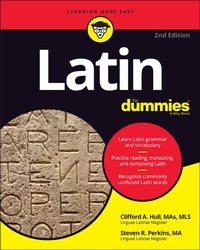
Latin For Dummies
Description

Even though most people don't use Latin anymore, it used to be spoken by millions of people from across the ancient world. It later morphed into new languages we still use today!
In Latin For Dummies, you'll take a tour through the language of ancient Rome. Beginning with Latin you may already know, like "carpe diem" and "quid pro quo," the book walks you through essential Latin grammar and everyday Latin phrases. It also explores how Latin shaped and molded modern languages, including English.
In this book, you'll find:
* Lessons to learn Latin grammar and vocabulary
* Practices for reading, translating, and composing Latin
* Tips to recognize commonly confused Latin words
Latin For Dummies proves that learning Latin, while challenging, can be fun and exciting too! It's perfect for first timers interested in the ancient language and anyone who wants to learn more about ancient Roman history and culture.
More details
Other editions
Additional editions
Persons
Steven R. Perkins MA in Classics, is an award-winning teacher who has taught Latin and Classics for more than 30 years at secondary and undergraduate levels.
Content
Part 1: Getting Started with Latin 7
Chapter 1: You Already Know a Little Latin 9
Chapter 2: The Nitty Gritty: Basic Latin Grammar 23
Chapter 3: Salve! (Hello!): Greetings and Introductions 47
Part 2: Latin in Action 67
Chapter 4: The Roman Family and Social Structure 69
Chapter 5: Food and Housing in Roman Life 87
Chapter 6: The Roman Calendar 105
Chapter 7: The Roman Army 129
Chapter 8: Roman Entertainment and Sports 145
Chapter 9: Roman Government 161
Chapter 10: More Lasting Than Bronze: Latin Literature 185
Part 3: Latin in the Modern World 201
Chapter 11: Keeping It Simple, Silly 203
Chapter 12: The Decline and Fall of Roman Declensions 223
Chapter 13: We All Live In a Yellow Subordinate Clause 243
Chapter 14: Latin in Zoology and Botany 265
Chapter 15: Translating and Reading Latin 275
Chapter 16: Mottoes, Sayings, and Quotes: Cocktail Party Latin 299
Part 4: The Part of Tens 313
Chapter 17: More than Ten Loanwords from Latin 315
Chapter 18: Ten (or So) False Friends: Common Mistakes in Latin 321
Part 5: Appendices 327
Appendix A: Noun, Adjective, and Verb Tables 329
Appendix B: Latin-English Mini-Dictionary 353
Appendix C: Answer Key 381
Index 395
Introduction
Julius Caesar once wrote that all of Gaul was divided into three parts, but when it comes to Latin, you can really find only two groups: those who have some knowledge of the language and those who don't. Whichever group you fall into, this is the book for you. You might want to get a better handle on this language for so many reasons. Perhaps you remember a few Latin words from when you were in school and want to dust off the cobwebs and refresh the knowledge you once had. Then again, you may just want to find out what all the fuss is about and discover for yourself why so many people still read, write, and even speak a language that has been popular for more than 2,000 years.
Sure, you have to know a few rules and master a few tricks, but after you do, Latin is actually pretty easy to figure out, and you're going to have fun doing it! Latin was the language of the Romans, the movers and shakers of the ancient world. These are the folks who built a republic and then an empire that stood for hundreds of years, created (and destroyed) Caesars, and produced the Colosseum, the Pantheon, and Hadrian's Wall. They can also take credit for one of the most lasting man-made concoctions of all time: concrete.
As if that wasn't enough, Latin continues to influence the world through the many languages, such as French, Italian, and Spanish, that come from it. And Latin has had much influence on English, too, given that more than half of all English words are derived from Latin words. (In fact, you use Latin words without even knowing it.) One of the best-kept secrets about Latin is that not only does figuring out Latin help you understand Latin, but it also helps you understand English, too.
Not too shabby for what some people call a dead language!
About This Book
What's great about this book is that it leads you step by step to understand how Latin works. With more than a century of combined teaching experience, we (the authors) give you the information that you need without distracting you with things that you don't. Oh, we offer up plenty of fun facts along the way, but we also give you a lot of practice exercises to help you become comfortable with your new favorite language.
Each chapter is divided into sections, and each section contains information about some part of understanding Latin, such as
- How to decline Latin nouns and adjectives and how to conjugate Latin verbs
- How to translate a sentence so that it makes sense in English
- How Latin continues to influence English
- All sorts of interesting tidbits about Roman culture
Conventions Used in This Book
To make this book easy for you to navigate, we set up a few conventions:
- Latin terms are set in boldface to make them stand out, and their English translations are in italics.
- Verb conjugations (lists that show you the forms of a verb) appear in two-column tables. The first column contains the singular forms in this order: the I form, the you (singular) form, and the he/she/it form. The second column lists the plural forms: the we form, the you (plural) form, and the they form. Here's an example, using the verb amo, amare, amavi, amatus (to love):
Singular
Plural
amo
amamus
amas
amatis
amat
amant
Language learning is a peculiar beast, so this book includes a few elements that other For Dummies books don't include:
- Talkin' the Talk dialogues: One of the best (and most fun) ways to really understand a language is to see it in action. The dialogues under the heading "Talkin' the Talk" show you a conversation in Latin, as well as the English translation.
- Words to Know lists: You do have to memorize key words and phrases when you get familiar with a language, so we collect important words within the chapters (or sections) and place them in these lists. Some things to keep in mind about these lists are
-
The function of Latin nouns depends on their declension (the term for the grammatical groupings into which Latin nouns are divided and their gender). The nouns in these lists include the first two dictionary forms (which tell you the noun's declension) and the gender. Here's an example: coquus, coqui, m: cook.
For more on gender, see Chapter 2.
- Because Latin adjectives have to match the nouns that they modify in case, number, and gender, adjective entries show the masculine, feminine, and neuter forms: frigidus, frigida, frigidum: cold.
- The translation of a verb depends on its conjugation, so the Words to Know lists include the four dictionary forms of the verb. For example: paro, parare, paravi, paratus: to prepare.
-
- Fun & Games activities: On top of all these other language-specific sections, we provide fun activities to reinforce what each chapter shows you about Latin. These word games give you a fun way to gauge your progress.
Foolish Assumptions
In writing this book, we made a few assumptions about you:
- You know no Latin - or if you took Latin a long time ago, you may not remember much of it.
- You don't want to be intimidated or made to feel foolish while you try something new.
- You want to have fun and learn Latin (or refresh your knowledge of it) at the same time.
How This Book Is Organized
To help you find the information that you want more easily, this book is organized into five parts, each covering a particular topic. Each part contains several chapters relating to that part.
Part 1: Getting Started with Latin
This part gives you the basics that you need to know if you want to understand Latin - how to deal with an inflected language (which Latin is), handling verb conjugations, and figuring out the basic rules of Latin grammar. To boost your confidence, we also introduce you to some Latin that you probably already know.
Part 2: Latin in Action
The Roman world was a fascinating one. In this part, we give you all sorts of info about Roman life and the language that the Romans used relating to those areas. In Part 2, you can find information on the Roman family, the mighty Roman army, Roman entertainment, and more.
Part 3: Latin in the Modern World
Many professions still use Latin today. Obviously, the legal and medical professions use Latin heavily, but many Christian churches also use Latin, as well as sciences such as botany and zoology. Because you run into Latin in so many places, this part gives you the terms that you're most likely to hear. With all these words at your disposal, you can actually translate Latin, so this part also gives you the lowdown on how to make sense of what you read or hear.
Part 4: The Part of Tens
Perfect for the person who wants useful info in digestible chunks, the Part of Tens gives you lists that you might find helpful. In this part, you can find lists of ten (or so) Latin words that give people the most trouble as well as ten "false friends" that could potentially steer you wrong.
Part 5: Appendices
This part of the book includes important information that you can use for reference. We include noun tables, verb tables, and a mini-dictionary so that you can easily look up words that you just can't seem to remember. If you want to grade yourself on the Fun & Games activities, we give you the answer keys, too.
Icons Used in This Book
To help you find information you're interested in or to highlight information that's particularly helpful, we use the following icons:
This icon points out advice, suggestions, and pointers that you can find helpful in your Latin adventure.
This icon appears next to important information that will help you understand key aspects of grammar and Roman culture.
This icon appears beside information that you may find interesting but that you can skip without impairing your understanding of the topic.
Latin, like any language, is full of quirks and exceptions that you need to know to translate the language accurately. This icon draws your attention to fuller discussions about grammar rules that can help you understand why Latin is the way that it is.
This icon highlights cultural tidbits and information relating to Latin and the ancient Romans. Search for this icon if you want to know more about the culture from which the Latin language came.
Beyond the Book
In addition to what you're reading right now, this book comes with a free, access-anywhere Cheat Sheet containing helpful tips and techniques (as well as some handy tables) for understanding Latin. To get this Cheat Sheet, simply go to www.dummies.com, type Latin For Dummies Cheat Sheet in the search box, and click the Search button. Then select the Cheat Sheet from the drop-down list of results that appears to open the Cheat Sheet in all its...
