

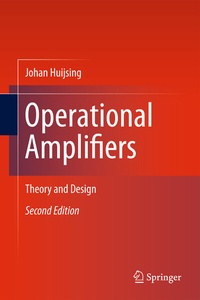
Operational Amplifiers
Description

Operational Amplifiers - Theory and Design, Second Edition presents a systematic circuit design of operational amplifiers. Containing state-of-the-art material as well as the essentials, the book is written to appeal to both the circuit designer and the system designer. It is shown that the topology of all operational amplifiers can be divided into nine main overall configurations. These configurations range from one gain stage up to four or more stages. Many famous designs are evaluated in depth.
Additional chapters included are on systematic design of µV-offset operational amplifiers and precision instrumentation amplifiers by applying chopping, auto-zeroing, and dynamic element-matching techniques. Also, techniques for frequency compensation of amplifiers with high capacitive loads have been added.
Operational Amplifiers - Theory and Design, Second Edition presents high-frequency compensation techniques to HF-stabilize all nine configurations. Special emphasis is placed on low-power low-voltage architectures with rail-to-rail input and output ranges.
In addition to presenting characterization of operational amplifiers by macro models and error matrices, together with measurement techniques for their parameters it also develops the design of fully differential operational amplifiers and operational floating amplifiers.
Operational Amplifiers - Theory and Design, Second Edition is carefully structured and enriched by numerous figures, problems and simulation exercises and is ideal for the purpose of self-study and self-evaluation.
More details
Other editions
Additional editions
Person
Johan H. Huijsing received his M.Sc. in Electrical Engineering from Delft University of Technology, Delft, The Netherlands, in 1969, and his Ph.D. from the same University in 1981 for work on operational amplifiers. Since 1969 he has been a member of the Research and Teaching Staff of the Electronic Instrumentation Laboratory, Department of Electrical Engineering, Delft University of Technology, where he became a full Professor of Electronic Instrumentation since 1990, and professor-emeritus since 2003. He teaches courses on Electrical Measurement Techniques, Electronic Instrumentation, Operational Amplifiers and Analog-to-digital Converters. His field of research is Analog Circuit Design (operational amplifiers, analog multipliers, etc.) and Integrated Smart Sensors. He is author or co-author of some 250 scientific papers, 40 patents and 13 books, and co-editor of 13 books. He is fellow of IEEE. He received the title award of "Simon Stevin Meester" from the Dutch Technology Foundation.
Content
Summary.- Introduction. Notation. 1. Definition of Operational Amplifiers.- 2. Macromodels.- 3. Applications.- 4. Input Stages.- 5. Output Stages.- 6. Overall Design.- 7. Design Examples.- 8. Fully Differential Operational Amplifiers.- 9. Operational Floating Amplifiers (Ofa).- 10. Low Noise and Low Offset Amplifiers.- Biography.- Index.
