

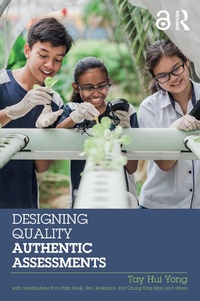
Designing Quality Authentic Assessments
1st Edition
Published on 19. April 2018
240 pages
978-1-351-71543-0 (ISBN)
Description

This book examines the principles and practice of authentic assessment. It seeks to answer the following questions. What is authentic assessment? How is authentic assessment different from 'performance assessment' or 'alternative assessment'? How can authentic assessment support learner-centred education, especially when a performance-oriented culture favours pen-and-paper examinations?
The book is structured into two major parts. The first, 'Principles of authentic assessment design', provides readers with a conceptual explanation of authenticity; the principles for designing quality authentic assessments for valid evidence of student learning; and guidance about how to develop quality rubrics to structure assessment tasks.
The second part of the book, 'Theory into practice' provides examples developed by teachers to demonstrate an understanding of authentic assessment. The subject areas covered include humanities, languages, mathematics, sciences, character and citizenship. Two case studies are discussed to demonstrate how authentic assessment can be used to comprehensively address key learning objectives in a variety of curriculum contexts.
This book provides practitioners with concrete examples on how to develop authentic assessment to suit their context and also enhance their students' learning. The book will also enable teachers to face assessment challenges present in our changing world.
Chapter 1 of this book is freely available as a downloadable Open Access PDF under a Creative Commons Attribution-Non Commercial-No Derivatives 4.0 license available at http://www.taylorfrancis.com
The book is structured into two major parts. The first, 'Principles of authentic assessment design', provides readers with a conceptual explanation of authenticity; the principles for designing quality authentic assessments for valid evidence of student learning; and guidance about how to develop quality rubrics to structure assessment tasks.
The second part of the book, 'Theory into practice' provides examples developed by teachers to demonstrate an understanding of authentic assessment. The subject areas covered include humanities, languages, mathematics, sciences, character and citizenship. Two case studies are discussed to demonstrate how authentic assessment can be used to comprehensively address key learning objectives in a variety of curriculum contexts.
This book provides practitioners with concrete examples on how to develop authentic assessment to suit their context and also enhance their students' learning. The book will also enable teachers to face assessment challenges present in our changing world.
Chapter 1 of this book is freely available as a downloadable Open Access PDF under a Creative Commons Attribution-Non Commercial-No Derivatives 4.0 license available at http://www.taylorfrancis.com
Reviews / Votes
'Authentic assessment is assessment that mirrors what it is in the real world we want students to learn. We want students to enact performances that show they have understood and can use what we have taught them at an acceptable level. Just telling us back what we have taught them - typical assessment practice fr a long time - just doesn't cut it. The practical issues are: to make clear what outcomes we want students to achieve, to design tasks that mirror those outcomes, and to be able to judge what an acceptable level of performance or of understanding is. Thus book is in two parts: the principles of authentic assessment design and their application to a wide range of school subjects.This is an important work for without properly designed authentic assessment we cannot be really sure if we have successfully taught what we wanted students to learn. And what could be more important than that to a teacher? One of the critical aspects of this form of assessment is designing rubrics or criteria for judging quality of performance: this is handled by Pam Hook using her well known work on the SOLO Taxonomy. Tay Hui Yong and her team are to be congratulated in making the principles so clear and the applications to so many subjects so available to teachers.' - John Biggs, Honorary Professor of Psychology, University of Hong Kong, Hong Kong
More details
Series
Edition
1. Auflage
Language
English
Place of publication
London
United Kingdom
Publishing group
Taylor & Francis Ltd
Target group
College/higher education
Professional and scholarly
Product notice
Reflowable
Illustrations
13 s/w Zeichnungen, 65 s/w Tabellen
65 Tables, black and white; 13 Line drawings, black and white
File size
12,96 MB
ISBN-13
978-1-351-71543-0 (9781351715430)
Copyright in bibliographic data and cover images is held by Nielsen Book Services Limited or by the publishers or by their respective licensors: all rights reserved.
Schweitzer Classification
Other editions
Additional editions
Tay Hui Yong
Designing Quality Authentic Assessments
Book
04/2018
1st Edition
Routledge
€206.40
Shipment within 10-20 days
Tay Hui Yong
Designing Quality Authentic Assessments
Book
04/2018
1st Edition
Routledge
€60.20
Shipment within 10-20 days
Person
Tay Hui Yong is Senior Lecturer with the Curriculum, Teaching and Learning Academic Group at the National Institute of Education, Nanyang Technological University, Singapore. She has previously served in secondary schools as a teacher, a head of department, the dean of curriculum and as vice principal. Currently, she teaches courses to a wide range of learners in her areas of expertise, particularly authentic assessment and self-regulated learning. She has published on other areas of assessments e.g., use of technology. Above all, she is interested in all things that will enhance a student's learning experience in school.
Content
Acknowledgement, Introduction, Part 1: Principles of Authentic Assessment (AA) Design, 1. What is "authenticity" in AA?, 2. Why bother with "authenticity" in assessments?, 3. How do you design quality AA?, 4. How do you design quality rubrics to accompany the AA? (Pam Hook), 5. What is the place of AA in 21st Century Competencies?, Part 2: Theory into Practice, 6. AA in Humanities, 7. AA in Languages, 8. AA in Mathematics, 9. AA in Sciences, 10. AA in Character and Citizenship, 11. Personalising Assessment in Sport Science (Ben Jenkinson), 12. Developing Empathy through AA (Eric Chong King Man), 13. Conclusion, Index
